This is a special post for quick takes by jacquesthibs. Only they can create top-level comments. Comments here also appear on the Quick Takes page and All Posts page.
Comment Permalink
News on the next OAI GPT release:
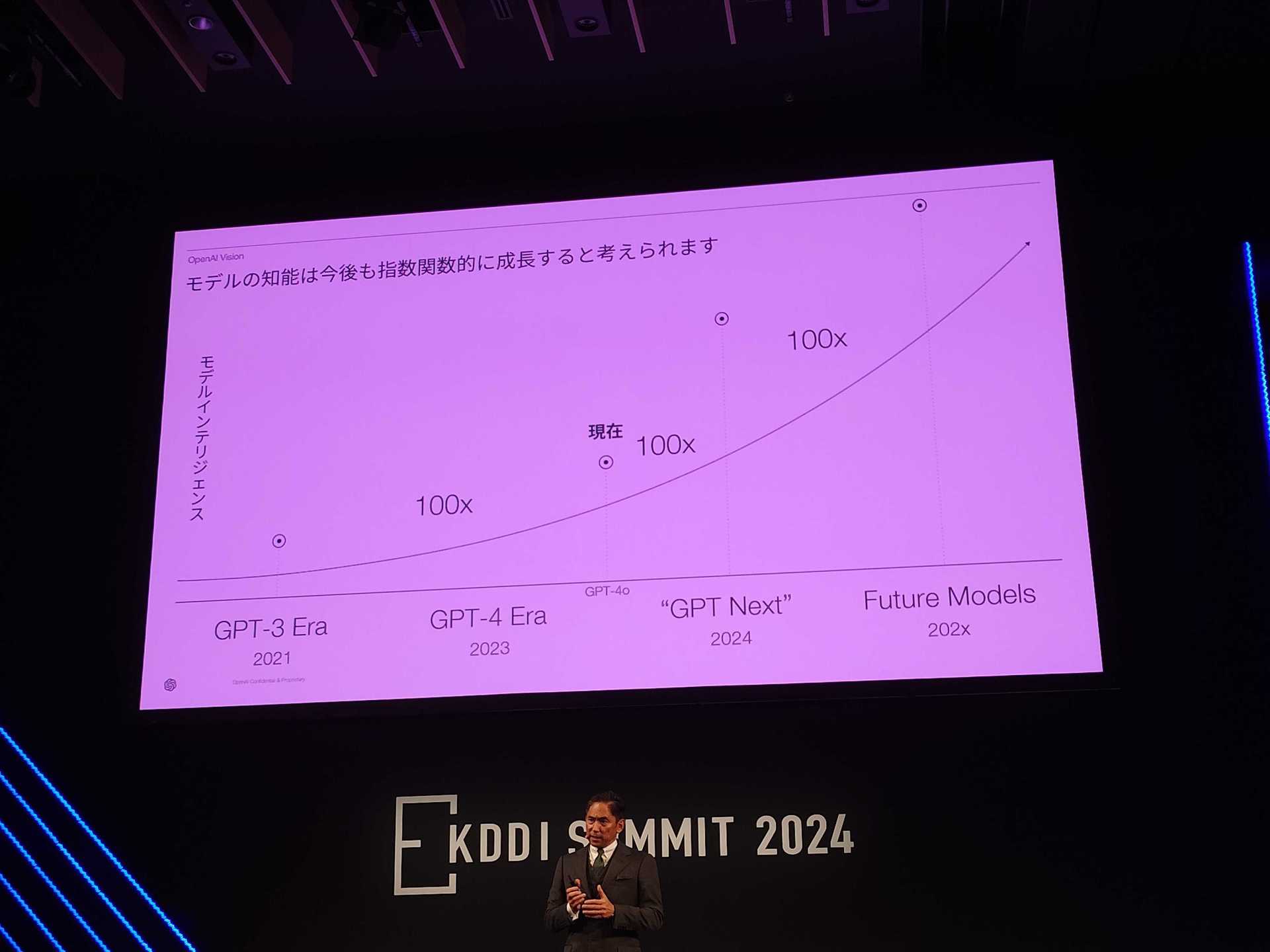
Nagasaki, CEO of OpenAI Japan, said, "The AI model called 'GPT Next' that will be released in the future will evolve nearly 100 times based on past performance. Unlike traditional software, AI technology grows exponentially."
https://www.itmedia.co.jp/aiplus/articles/2409/03/news165.html
The slide clearly states 2024 "GPT Next". This 100 times increase probably does not refer to the scaling of computing resources, but rather to the effective computational volume + 2 OOMs, including improvements to the architecture and learning efficiency. GPT-4 NEXT, which will be released this year, is expected to be trained using a miniature version of Strawberry with roughly the same computational resources as GPT-4, with an effective computational load 100 times greater. Orion, which has been in the spotlight recently, was trained for several months on the equivalent of 100k H100 compared to GPT-4 (EDIT: original tweet said 10k H100s, but that was a mistake), adding 10 times the computational resource scale, making it +3 OOMs, and is expected to be released sometime next year.
Note: Another OAI employee seemingly confirms this (I've followed them for a while, and they are working on inference).
 3
 2
 1