This is a special post for quick takes by LouisMegatron. Only they can create top-level comments. Comments here also appear on the Quick Takes page and All Posts page.
Comment Permalink
Some (over) simplified explanation to the METR anthropic article
first I suspect ECI progress rate is constant against compute. i.e. k = FLOP/eci.
supporting evidence: Mimo's live RL run demonstrates that benchmarks points went up as RL steps went up. this is a clean RL run, no idea change, no model arch change, only compute input.

mimo RL run
then what is needed to let the GPUs run? there are 1) ideas 2) code. 3) let them run on GPU. they are serialised.
for code there are two types of code: a researcher would write codes to test their ideas, and adopt/discard it. (exp-code), and the training-related infrastructure code (infra-code) , like the distributed training framework, GPU kernels, etc.
Exp-codes and infra-codes are different. in exp-code, it needs to be written-from-scratch most of the time, since ideas are new. and for infra-code, it needs to be built, then to be maintained. companies rarely write infra from scratch every few months.

I now suspect three things changed after the release of Opus 4.5, i.e. the slope change in METR post.
1. FLOPs went up. Most post-oct-2025 models are trained on Blackwell GPUs, and the massive deployment of Vera Rubins may change that number. since the FLOPs for VR GPUs are higher than Blackwells. (it needs fewer seconds to achieve the FLOP needed for raising one ECI point). So GPU Flops could be the dominent reason.
2. Opus 4.5 is capable of boosting exp-code writing 10-100x, which eliminates the coding bottleneck completely. from metr's interview, and as a software engineer myself, I assign high confidence to this argument.
3. the infra code is built. and only needs to be maintained. I am not that confident, though, as I am not an insider. If most infra bugs are eliminated, running large pretraining runs would be easier, even without superhuman ai coders.
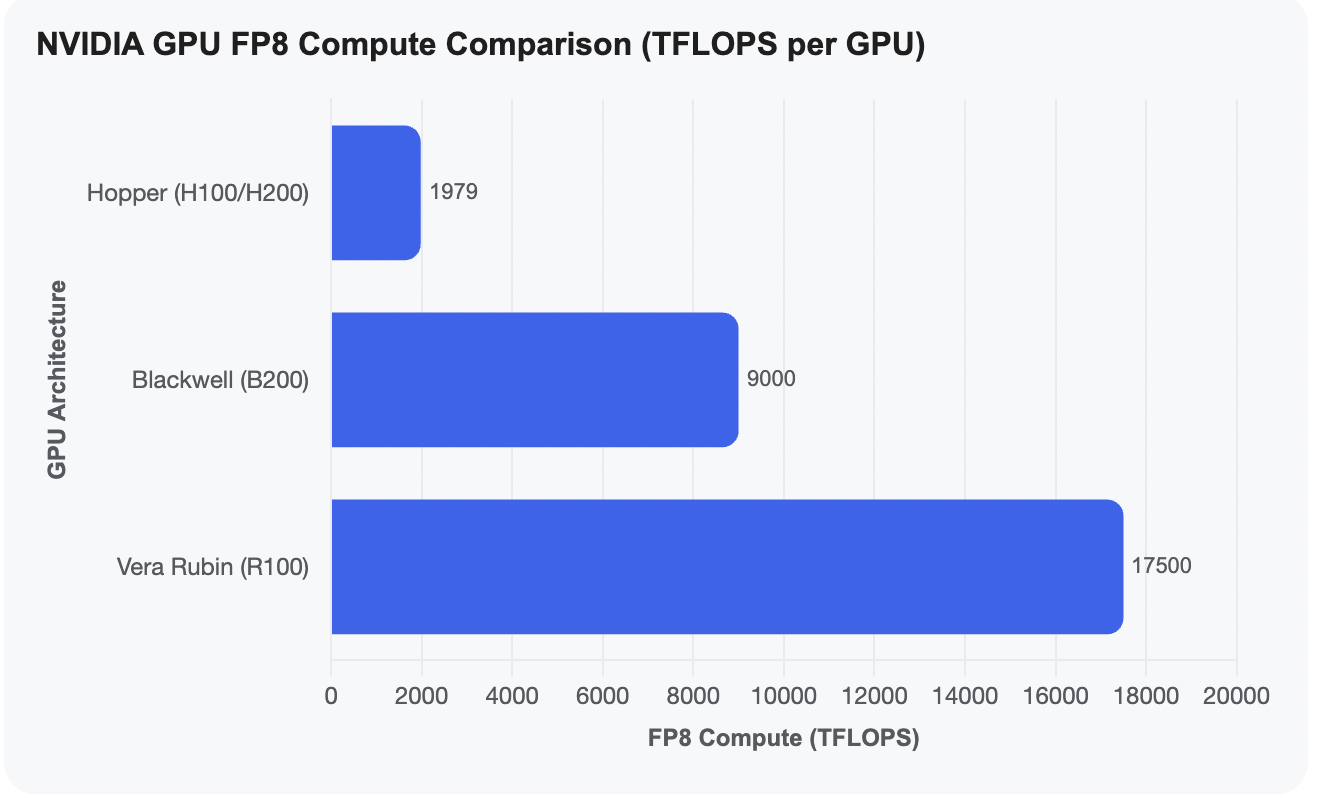
FP8 flops for Hopper, Blackwell and Rubin
by combining 1) 2) and 3), it is possible that a ECI step change is explainable, by completely removing the coding part. This does not necessary means that anthropic's internal model can write the infra codes from scratch, as maintaining codes are easier than building a new one, also they are still hiring.
Next question is, could it accelerate more? I am not sure, but I have some thoughts here:
1. Rubins are coming. if FLOPs is the dominant factor, more speedups incoming.
2. how fast u could propose idea is also a crux. This openai infra engineer's podcast suggested that idea may not be that important. but I am not sure.