This is a special post for quick takes by Caleb Biddulph. Only they can create top-level comments. Comments here also appear on the Quick Takes page and All Posts page.
Comment Permalink
I recently learned about Differentiable Logic Gate Networks, which are trained like neural networks but learn to represent a function entirely as a network of binary logic gates. See the original paper about DLGNs, and the "Recap - Differentiable Logic Gate Networks" section of this blog post from Google, which does an especially good job of explaining it.
It looks like DLGNs could be much more interpretable than standard neural networks, since they learn a very sparse representation of the target function. Like, just look at this DLGN that learned to control a cellular automaton to create a checkerboard, using just 6 gates (really 5, since the AND gate is redundant):
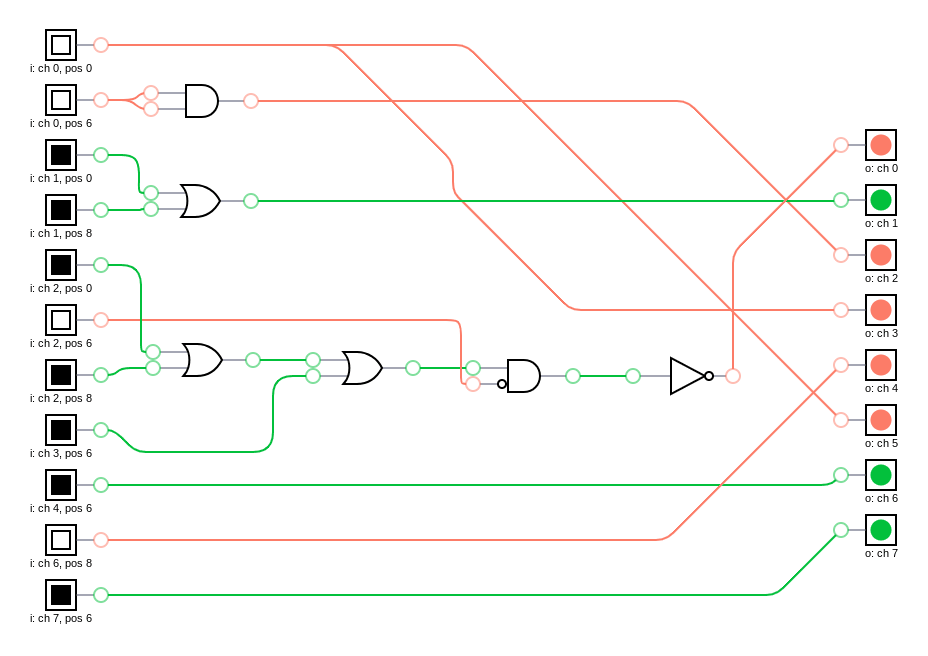
So simple and clean! Of course, this is a very simple problem. But what's exciting to me is that in principle, it's possible for a human to understand literally everything about how the network works, given some time to study it.
What would happen if you trained a neural network on this problem and did mech interp on it? My guess is you could eventually figure out an outline of the network's functionality, but it would take a lot longer, and there would always be some ambiguity as to whether there's any additional cognition happening in the "error terms" of your explanation.
It appears that DLGNs aren't yet well-studied, and it might be intractable to use them to train an LLM end-to-end anytime soon. But there are a number of small research projects you could try, for example:
- Can you distill small neural networks into a DLGN? Does this let you interpret them more easily?
- What kinds of functions can DLGNs learn? Is it possible to learn decent DLGNs in settings as noisy and ambiguous as e.g. simple language modeling?
- Can you identify circuits in a larger neural network that would be amenable to DLGN distillation and distill those parts automatically?
- Are there other techniques that don't rely on binary gates but still add more structure to the network, similar to a DLGN but different?
- Can you train a DLGN to encourage extra interpretability, like by disentangling different parts of the network to be independent of one another, or making groups of gates form abstractions that get reused in different parts of the network (like how an 8-bit adder is composed of many 1-bit adders)?
- Can you have a mixed approach, where some aspects of the network use a more "structured" format and others are more reliant on the fuzzy heuristics of traditional NNs? (E.g. the "high-level" is structured and the "low-level" is fuzzy.)
I'm unlikely to do this myself, since I don't consider myself much of a mechanistic interpreter, but would be pretty excited to see others do experiments like this!