I didn't want to include this in the main post, because I wanted to keep it concise and on-topic, but I don't think determinism is relevant. If you were given the options of receiving a million dollars or of receiving death, you would try damn well to make your choice as deterministic as possible. That doesn't stop it from being a choice you make. Likewise, a computer can be given a source of entropy and run a random algorithm; computers need not be deterministic. Stochasticity doesn't magically give you any more "real" choices than you had before.
I think people get the idea into their head about stochasticity being necessary for choosing because they consider a real choice to require the possibility to choose otherwise. So, they imagine a choice function like a brain split in two, sometimes choosing one way and sometimes choosing another:
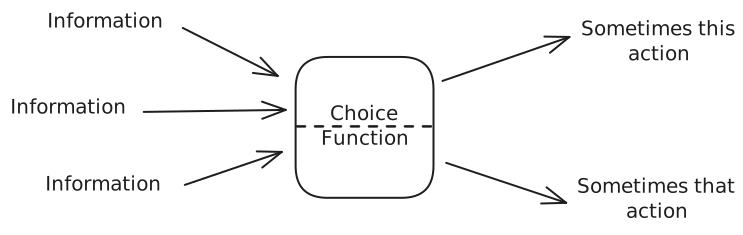
However, I think this is the wrong model to have for the possibility of choosing otherwise. Instead, you should imagine that a different choice function in your place might choose a different action:

This solves the problem of capacity to choose otherwise without requiring stochasticity. That a choice is made is just a way of pointing out there is some choice function, a chooser, and that there exists a different chooser that would result in a different action. That it is one chooser and not another determining the action is the whole point of saying that that chooser, and not the other made the choice. In how I view choosing, choices are still made even if the universe is deterministic, it's just that the choosers are determined beforehand in what places they will be. But that doesn't make the concept of a chooser or a choice useless, no less than abstracting away a clump of particles as a rock is useless. We abstract clumps of particles as rocks because we can model rocks more simply than modelling all the particles one by one. We abstract away choosers because there are choosers, entities such as humans that take actions based on information they gather.
On the other hand, the question of whether someone is to be held responsible for their choices is a social problem.
People often use free will to explain how we make choices, but have great difficulty explaining how free will itself works. Philosophers gesture towards ideas like "the capacity to choose" or "the freedom to do otherwise", but these concepts just raise the same question to me: What are "capacity" and "freedom"? I suspect that the reason free will is so hard to explain is because it is not actually clarifying anything. It's a fake explanation, like the physics textbook that says everything runs on energy.[1] "What makes the bicycle move?" Energy! "How do we make choices?" Free will! It doesn't really answer anything.
However, most people do feel like they make choices. I think making choices is a real phenomenon, just that the answer isn't "free will". When I want to answer the question of how we make choices, I look at the process by which it occurs. For me, that consists of gathering information to determine the best action, and then performing that action. If you look at it from a purely mechanistic lens, choice-making is simply following some function from information to actions:
From this perspective, many things make choices that we might not traditionally consider to have free will. For example, my computer chooses which threads to schedule on which processors.
Nevertheless, there is definitely a difference between a computer and myself. Someone programmed the computer to make its choices, but I make my own choices. What explains the difference between us?
I think it's simply a matter of self-reference and bootstrapping. The computer doesn't write its own code (at least, not yet), but we modify our own choice functions. Namely, given certain kinds of information—such as that an action led to a suboptimal outcome—our choice functions output actions to modify themselves. When the choice function is sufficiently clever, it can even realize that these updates may be suboptimal, and bootstrap itself to an even cleverer choice function.
Eventually, the choice function is determined mostly by the modifications it has done to itself, and it starts to make sense to say the choice function is responsible for its own choices. I think this is the answer to the mystery behind the sense of ownership we have of our actions.
Volition doesn't have to be mysterious.
"Judging Books by Their Covers," Surely You're Joking, Mr. Feynman!