This is a special post for quick takes by dprkay. Only they can create top-level comments. Comments here also appear on the Quick Takes page and All Posts page.
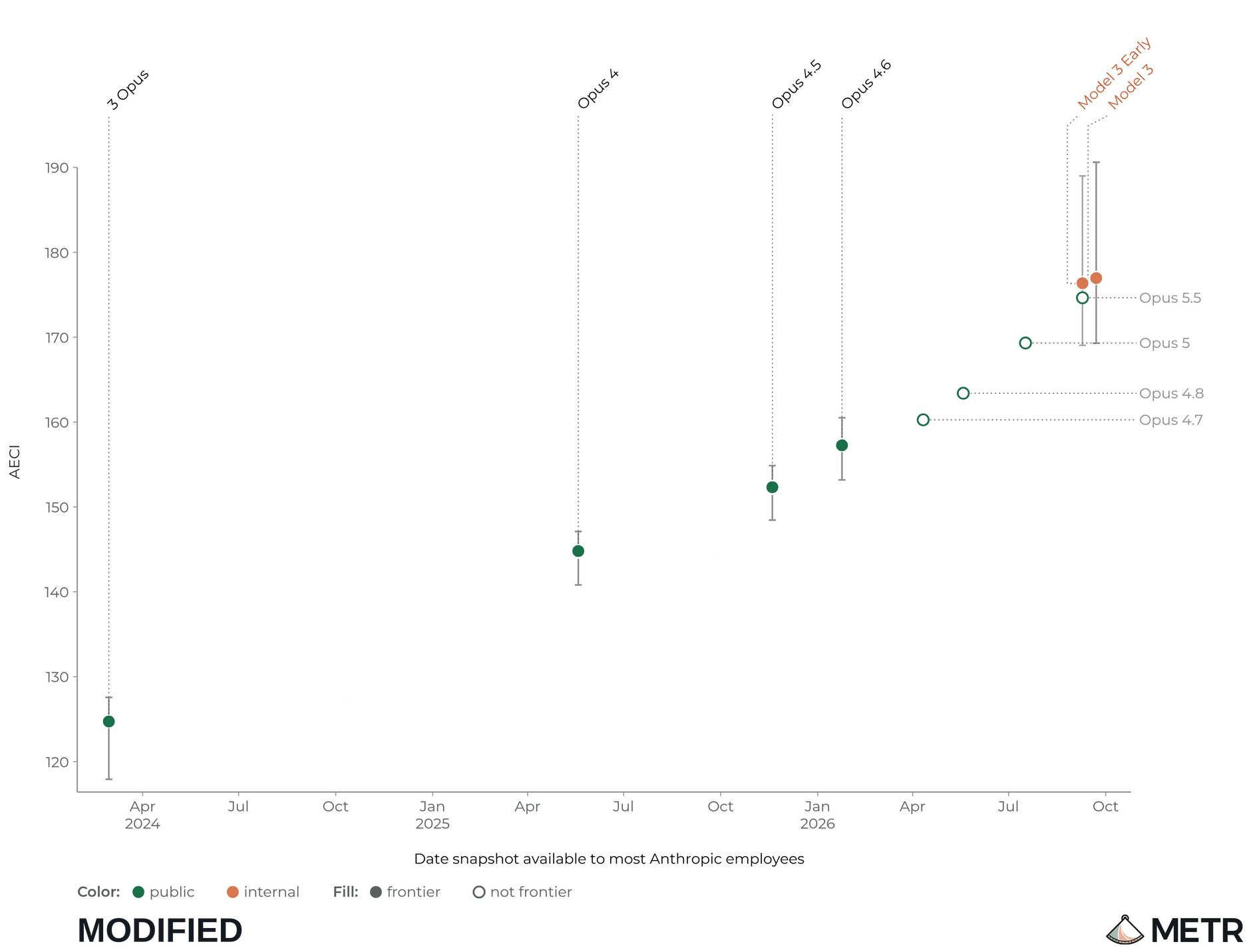
I had Opus 5.5 (via Claude Code) make a few modified versions of METR's AECI graph. It seems useful to view the data from multiple angles and notice how well they track certain hypotheses.
Here's the original, for reference:
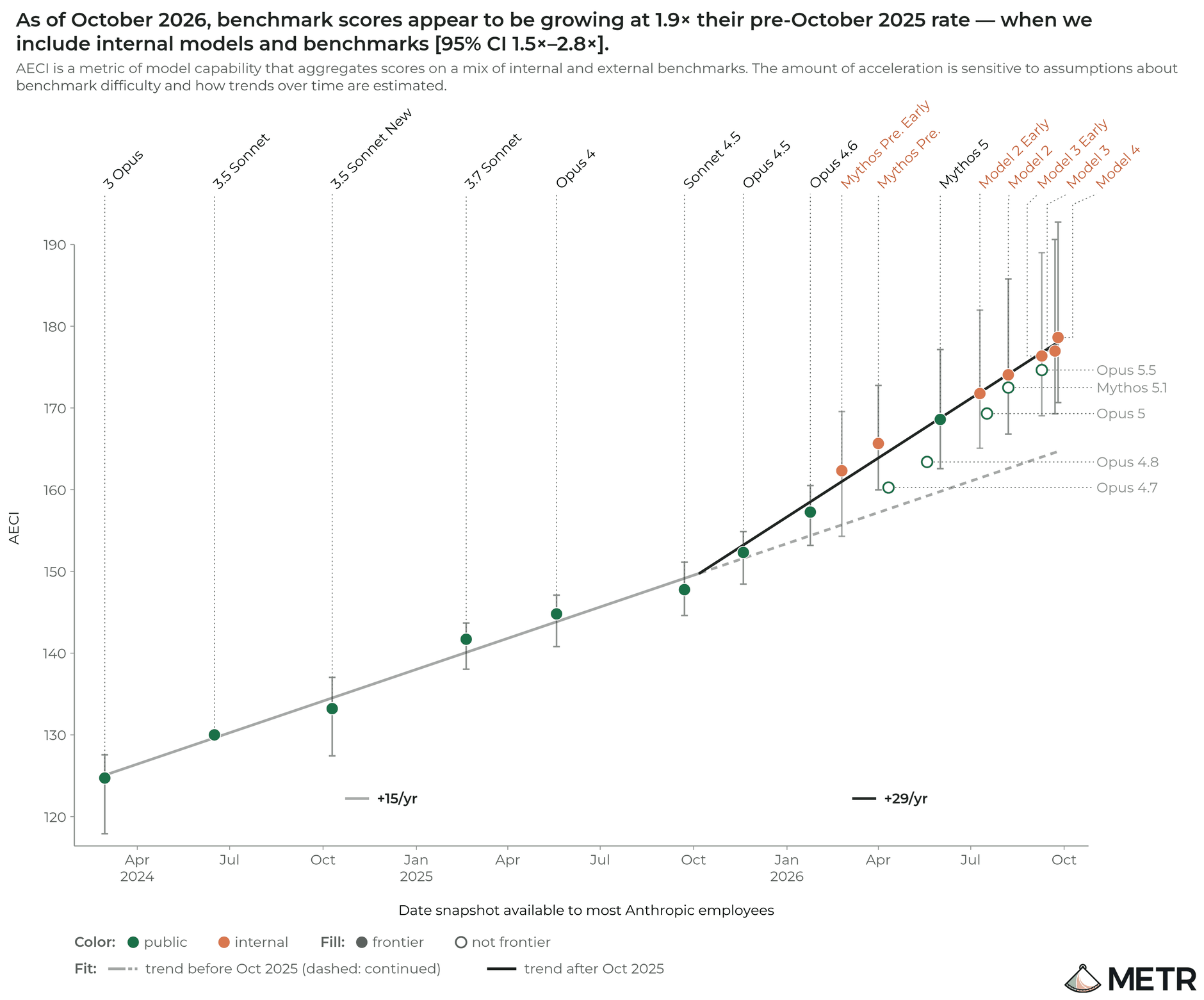
I got a slight sense that "lies, damned lies, and statistics" could be about. Not to imply anything bad on METR's part—I'm just concerned it frames things strongly when the data could speak for itself. Of course, they weren't allowed to share almost any of the relevant data.
No trend lines
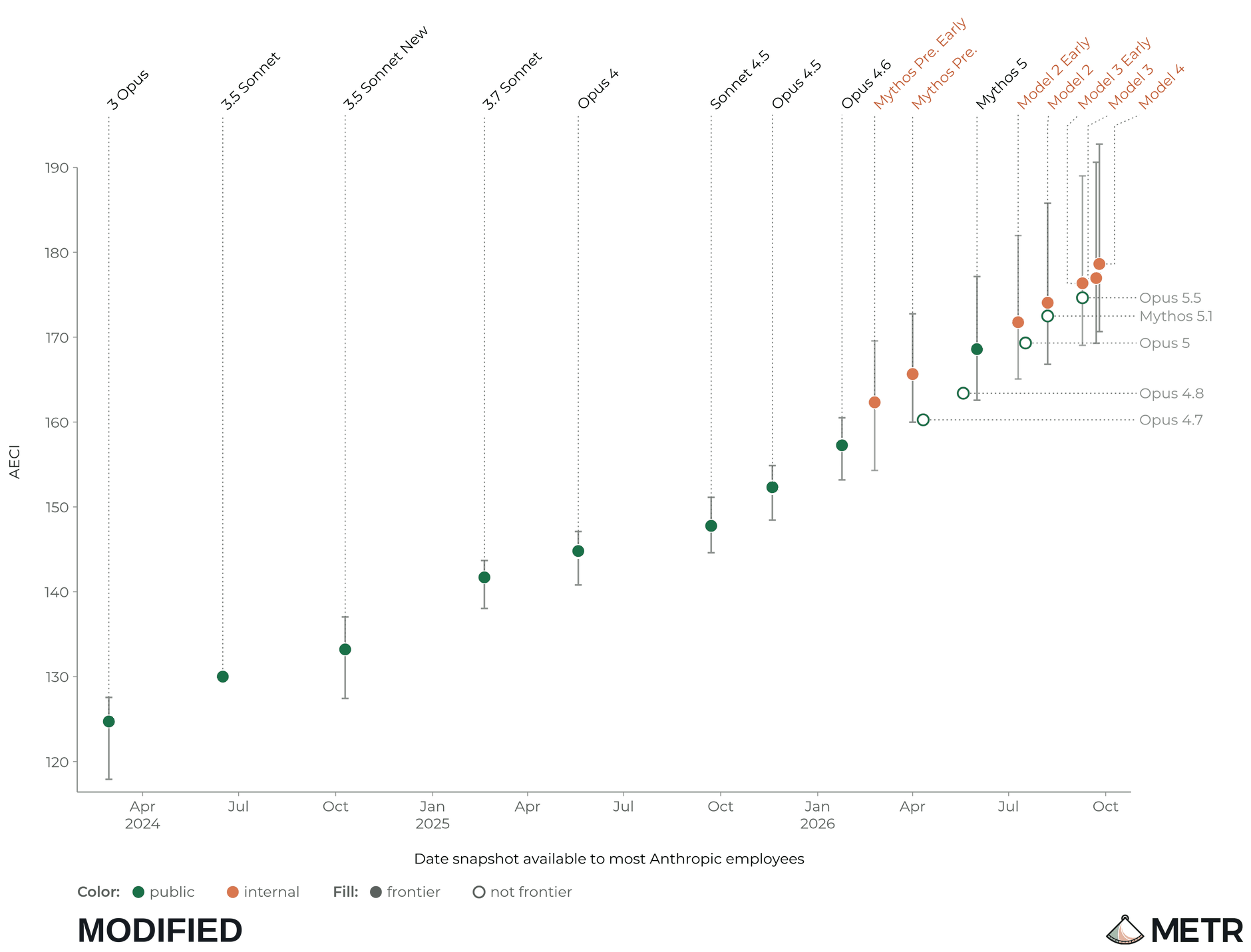
Notice that Model 2 and Model 3 Early share dates with public models, which I take to mean that they're different checkpoints of the same pre-trained model. The gaps are 1.6-1.7 points, which at the +29/yr trend corresponds to 3 weeks of AI progress. I assume Model 4 is a Mythos model mostly because of the cadence and it scoring so well.
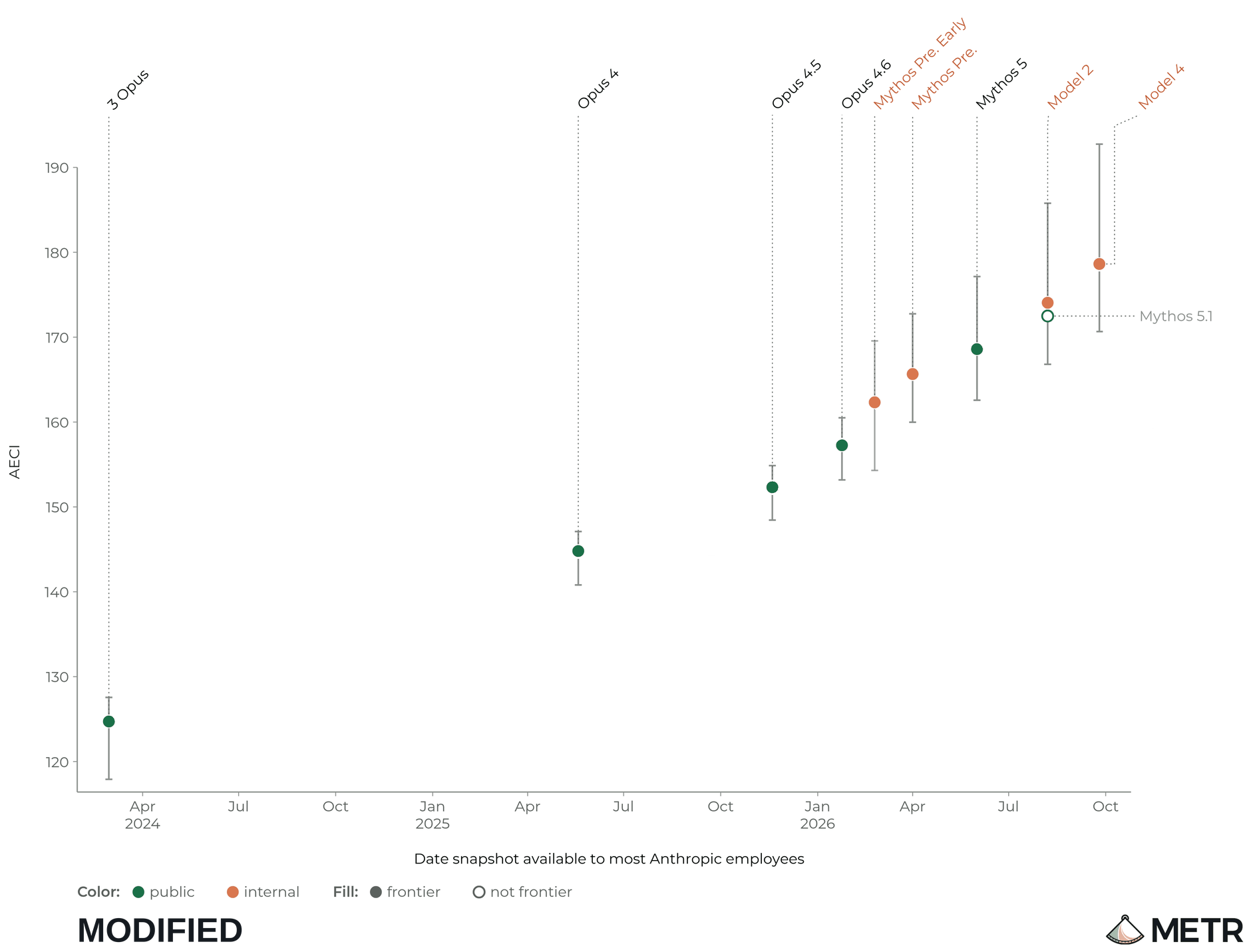
Largest model family at the time (Opus, then Mythos)
Public models only
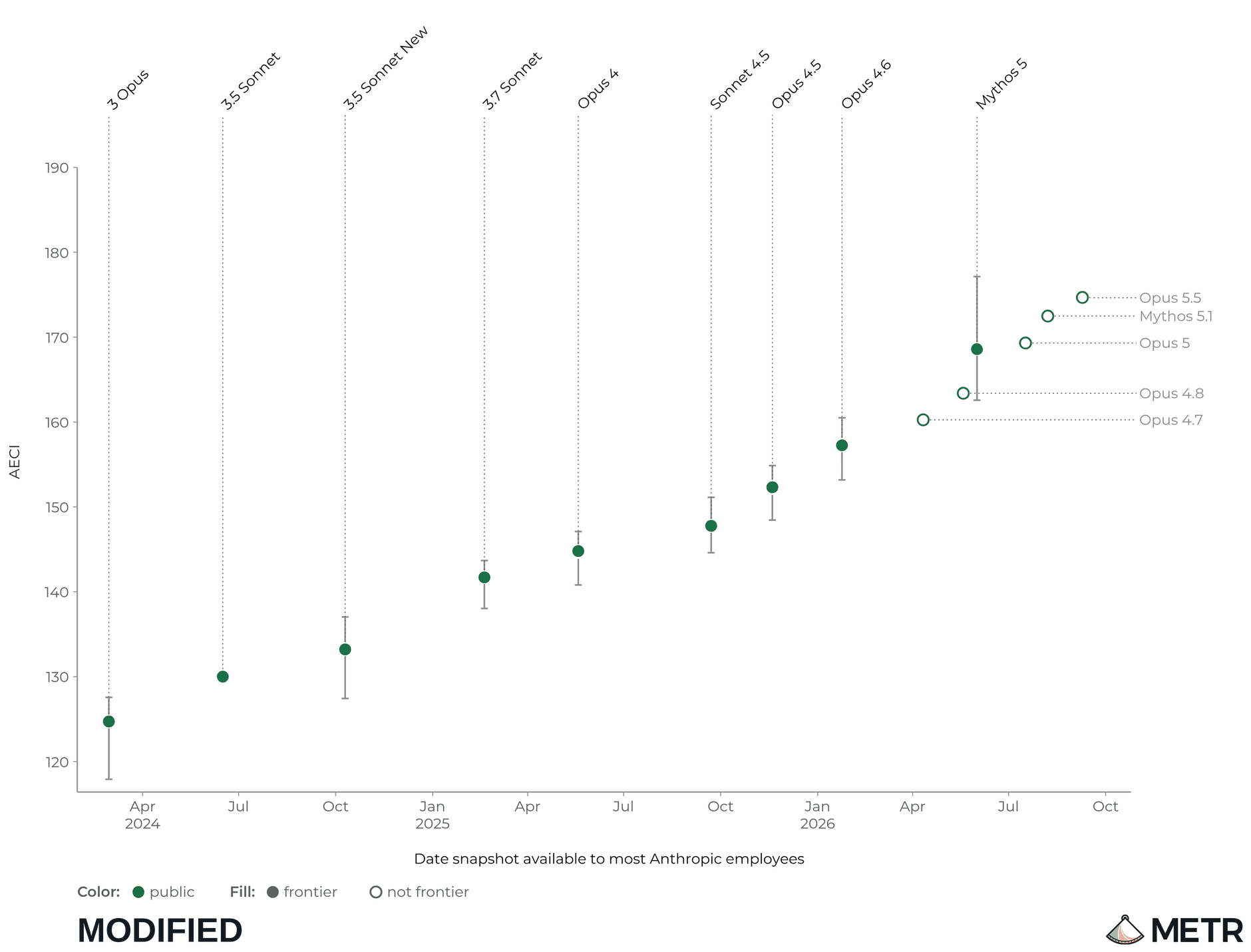
Opus models only
My prior is that there's a substantial jump with Mythos, plus a moderate acceleration afterwards (beyond what they already had) from using it internally. METR's assessment rebuts there being only a jump, but it matches the data quite well if you also change the slope (to 1.63x the pre-Mythos slope)
My own trendlines, excluding Sonnet models
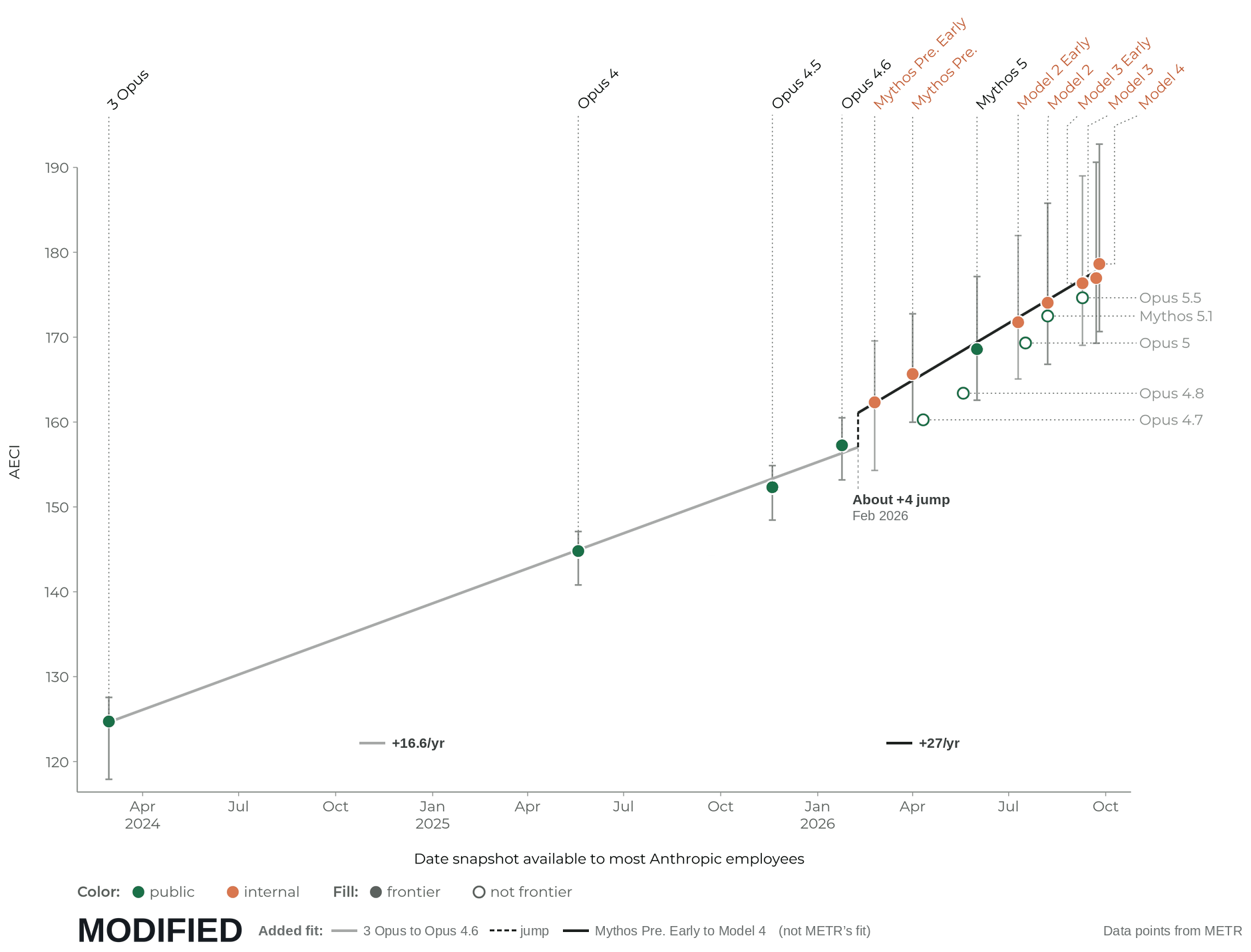
But I'd expect a reasonably long delay between when a model is available and when its impact is noticeable in AI progress. Partly because training takes a while, but also if it's a true paradigm shift then it takes a while for researchers to utilize it well (diffusion, basically). So the above graph works conditional on Opus 4.5 being the start of acceleration, not Mythos.
It's further complicated because for pretraining, algorithmic progress should take longer to show up than for post-training (I'd guess 3-6 months) but I don't know what the relative importance is there. And it would also matter when data companies (like whoever makes RL environments) gain access to the better models.
Waiting 10 weeks after Mythos Preview Early (slope goes to 1.69x)
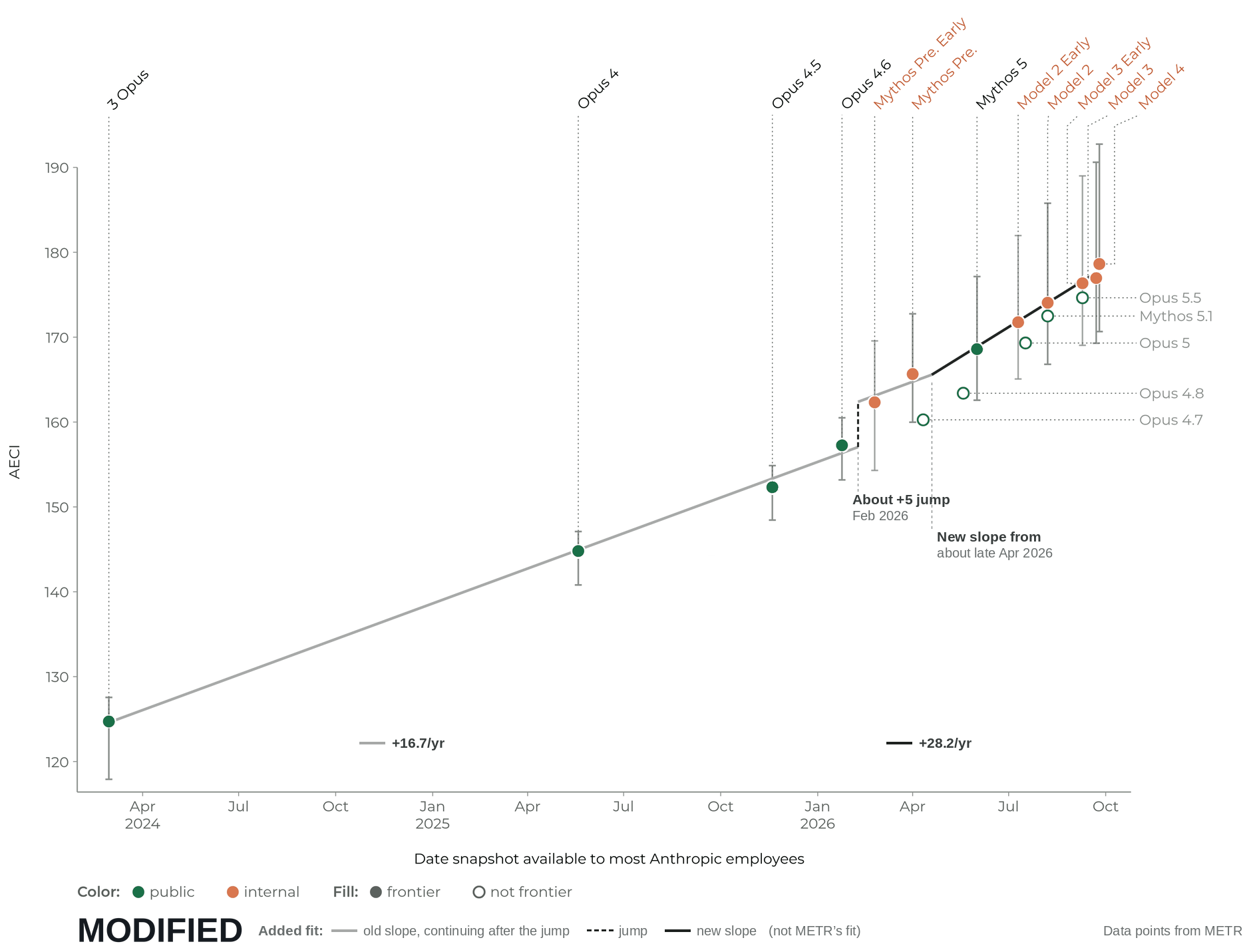
METR says "we are confident that the acceleration was not due to an acceleration in the scaling of training compute" which I initially interpreted as explaining why they didn't use a jump, but I think it could mean that the slope change isn't due to training compute doubling faster than before?
I still find it hard to not assume a jump, because Mythos Preview is so much better than Opus 4.7. An explanation would be that the training compute graph shows Mythos Preview as on trend compared to Opus 4.5/4.6, and that Opus 4.7/4.8 were substantially below trend? To put it another way, if faster algorithmic progress was the driver behind Mythos Preview being so good, then Anthropic must've skimped on the other input (training compute) to counteract that with Opus 4.7.
My own trendlines, excluding Mythos as well. I included 3.5 Sonnet and 3.7 Sonnet since they don't have a corresponding Opus version, though this basically doesn't change the trend at all.
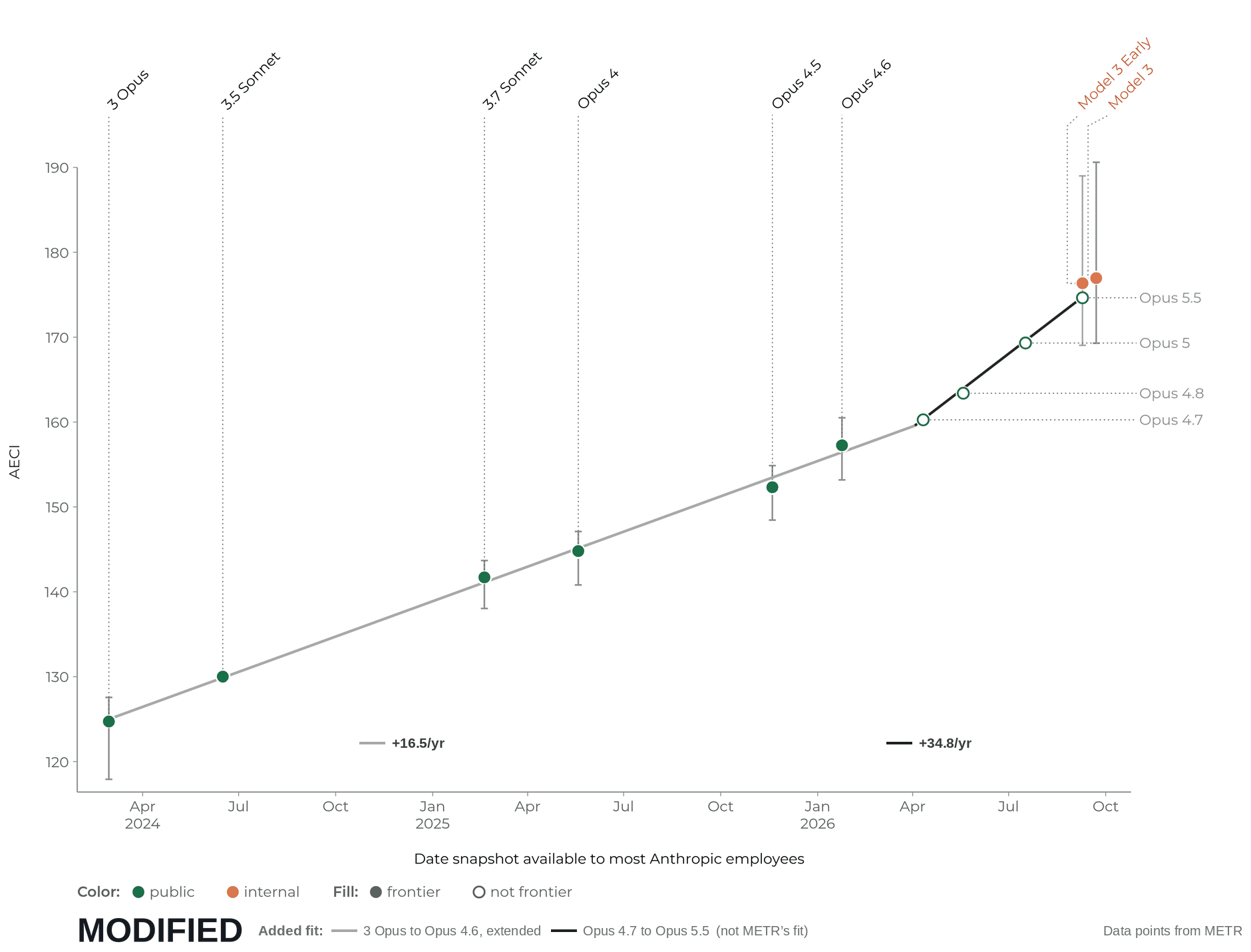
Note that the +34.8/yr slope can't hold along with the 27-29/yr Mythos slope without intersecting soon, so either the Opus trend will flatten or the Mythos trend will steepen. It seems intuitive to view this as a catchup effect from now being able to distill from Mythos. This seems like only a partial explanation, since Opus 5.5 and Model 3 are close to the Mythos trendline.
My current hypothesis is that METR is correct that the rate of acceleration is now ~2x, but that this is a more recent development and the acceleration for much of 2026 was more like 1.5x. A linear increase in (A)ECI corresponds to an exponential increase in time horizon, so if there are multiple straight lines—each getting steeper—then that's basically a superexponential.
There's of course a lot of uncertainty, here's some other variables that seem relevant for either interpreting the past or forecasting future progress:
- Number of capability researchers (I'd guess growing 1.5-2x/yr). 2 of the 11 researchers quoted in METR's report mentioned hiring, one as the biggest factor and the other as one of the two biggest factors. Quality of course matters a ton, and you can't mint new experts quickly.
- Token spend per researcher. Based on the graph here https://openai.com/index/research-acceleration-view-inside-openai/ it seems to have doubled for OpenAI from Jul 10 to Aug 15 reaching $7500/day for the 90th percentile researcher. Assuming that's API pricing and it's really 10x cheaper, it still only leaves a few more doublings before it becomes untenable. There's a lot of low-hanging fruit in reducing token usage, but that still might only buy a few months.
- Fiscal health and strategy of the labs. Maybe they go bankrupt or become much more like normal product-y tech companies.
- Share of training compute spent on RL. It seems like this is very high now and maybe impossible to double again.
- Maybe (A)ECI scores have a bias of forming straight lines. ECI is based on benchmarks, and benchmark development is very reactive to model progress. Or model training is very reactive to benchmarks.
- Maybe this is just noise (the error bars are very big) that happens to line up with our pre-existing expectations, and if we had the true AECI scores we'd see the exponential or single straight line. Also see how some of the previous AA Index versions gave clearly silly scores for new releases like GPT-6 Astra.
- From Anthropic researcher L “My favored interpretation: [redacted non-AI factor]”