This is a special post for quick takes by Francisco Ferreira da Silva. Only they can create top-level comments. Comments here also appear on the Quick Takes page and All Posts page.
Stefan Heimersheim and I recently introduced a measurement method that appears to distinguish feature directions from non-feature directions in LLMs, see here for details. tl;dr, We perturb activations into candidate feature directions and fit an
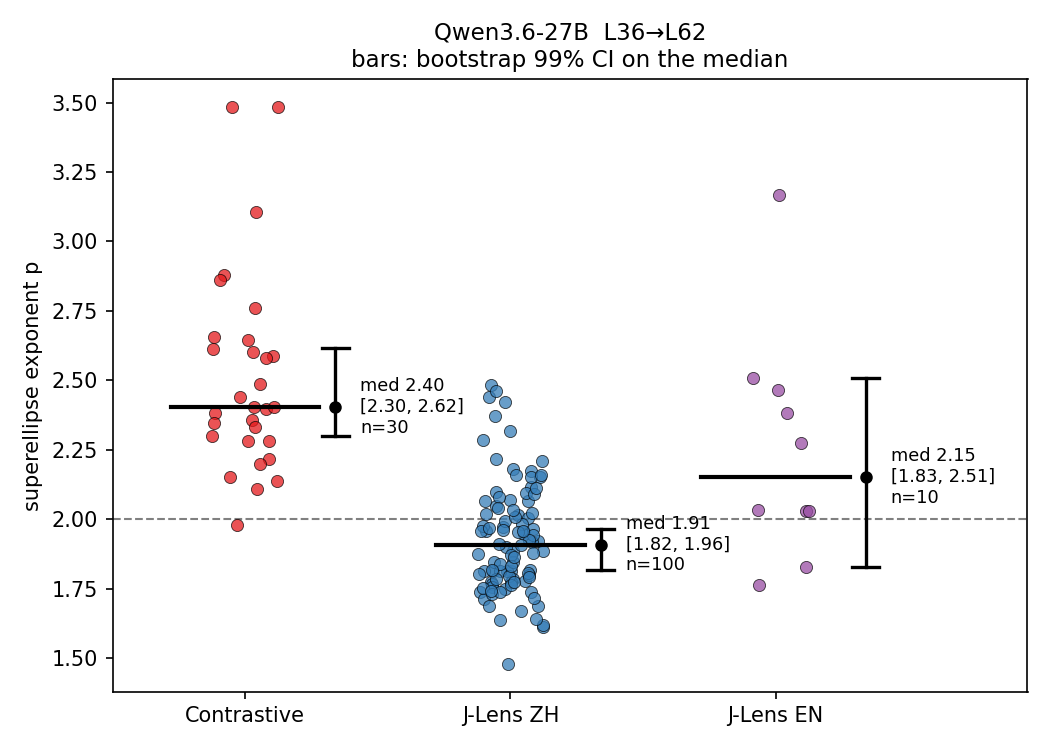
We applied our method to J-lens directions from Anthropic's recent workspace paper in Qwen3.6-27B (for which many of the key results have been replicated, see here for details) and found
Thanks to Neel Nanda for suggesting this experiment.
Experimental details:
- We perturb at layer 36. Qwen3.6-27B has 64 layers, workspace layers are a band ~30–90% through the model, and our method works best on directions far from the model's output.
- Our analysis runs on pairs of directions, with each token corresponds to a direction as per J-lens. We need low cosine similarity within a pair, because we make them orthogonal for our analysis. If they're not already close to orthogonal we distort them significantly, which changes results in unpredictable ways. We employ a threshold of
- We run our analysis for 100 Chinese pairs of directions corresponding to 200n distinct tokens, drawn from a pool of 1200 single-token Chinese words selecting for lower cosine similarity. All pairs come out at
- We tried doing the same for English, but it was a struggle to find J-lens directions with low cosine similarity for English tokens. We relaxed the threshold to 0.25 to reach
- We compute the median
Code for reproduction: https://github.com/FranciscoHS/fsec-paper/tree/main/jlens