This is a special post for quick takes by A Ray. Only they can create top-level comments. Comments here also appear on the Quick Takes page and All Posts page.
Comment Permalink
Two Graphs for why Agent Foundations is Important (according to me)
Epistemic Signpost: These are high-level abstract reasons, and I don’t go into precise detail or gears-level models. The lack of rigor is why I’m short form-ing this.
First Graph: Agent Foundations as Aligned P2B Fixpoint
P2B (a recursive acronym for Plan to P2B Better) is a framing of agency as a recursively self-reinforcing process. It resembles an abstracted version of recursive self improvement, which also incorporates recursive empowering and recursive resource gathering. Since it’s an improvement operator we can imagine stepping, I’m going to draw an analogy to gradient descent.
Imagine a highly dimensional agency landscape. In this landscape, agents follow the P2B gradient in order to improve. This can be convergent such that two slightly different agents near each other might end up at the same point in agency space after some number of P2B updates.
Most recursive processes like these have fixed point attractors — in our gradient landscape these are local minima. For P2B these are stable points of convergence.
Instead of thinking just about the fixed point attractor, lets think about the parts of agency space that flow into a given fixed point attractor. This is like analyzing watersheds on hilly terrain — which parts of the agency space flow into which attractors.
Now we can have our graph: it’s a cartoon of the “agency landscape” with different hills/valleys flowing into different local minimum, colored by which local minimum they flow into.
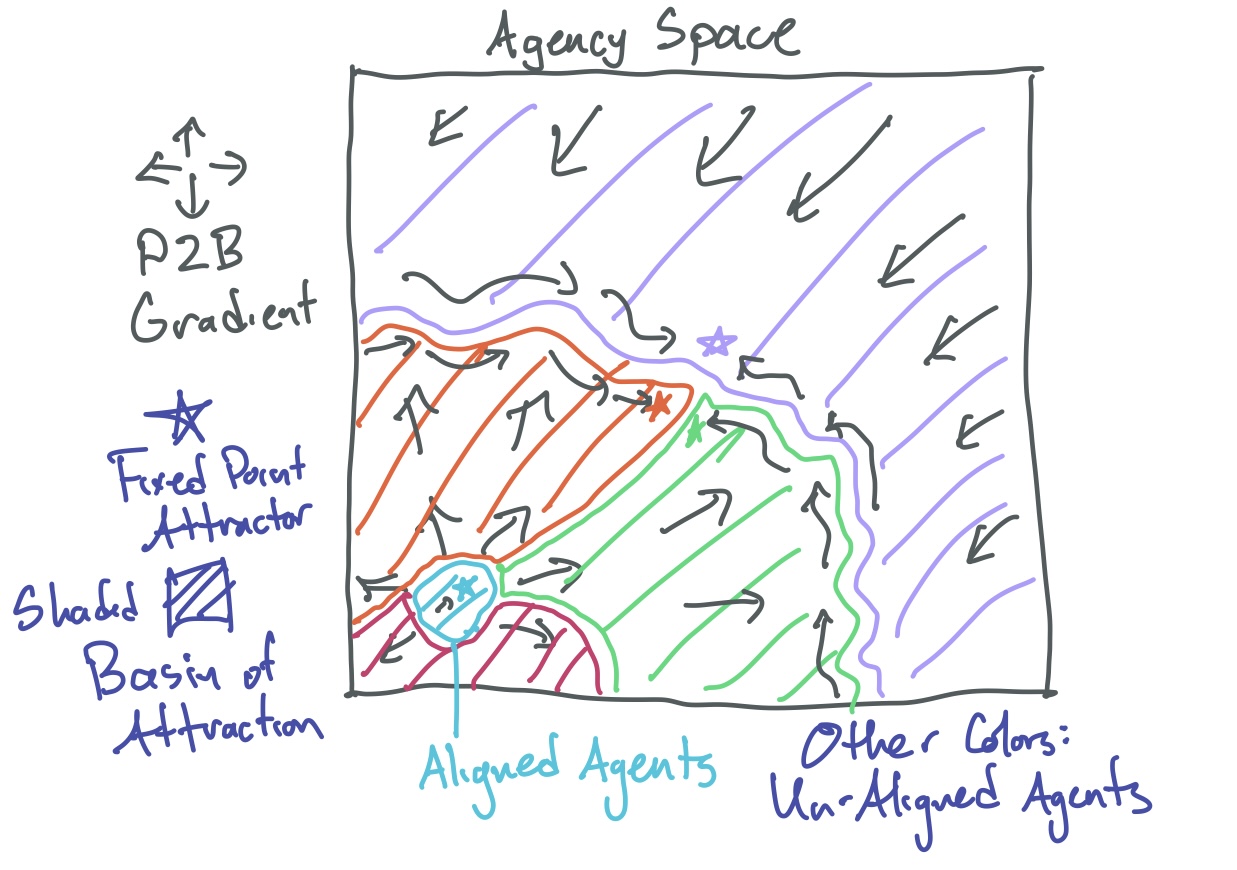
Here we have a lot of different attractors in agency space, but almost all of them are unaligned, what we need to do is get the tiny aligned attractor in the corner.
However it’s basically impossible to initialize an AI at one of these attractors, the best we can do is make an agent and try to understand where in agency space they will start. Building an AGI is imprecisely placing a ball on this landscape, which will roll along the P2B gradient towards its P2B attractor.
How does this relate to Agent Foundations? I see Agent Foundations as a research agenda to write up the criterion for characterizing the basin in agent space which corresponds to the aligned attractor. With this criterion, we can try to design and build an agent, such that when it P2Bs, it does so in a way that is towards an Aligned end.
Second: Agent Foundations as designing an always-legible model
ELK (Eliciting Latent Knowledge) formalized a family of alignment problems, eventually narrowing down to the Ontology Mapping Problem. This problem is about translating between some illegible machine ontology (basically it’s internal cognition) and our human ontology (concepts and relations that a person can understand).
Instead of thinking of it as a binary, I think we can think of the ontology mapping problem as a legibility spectrum. On one end of the spectrum we have our entirely illegible bayes net prosaic machine learning system. On the other end, we have totally legible machines, possibly specified in a formal language with proofs and verification.
As a second axis I’d like to imagine development progress (this can be “how far along” we are, or maybe the capabilities or empowerment of the system). Now we can show our graph, of different paths through this legibility vs development space.
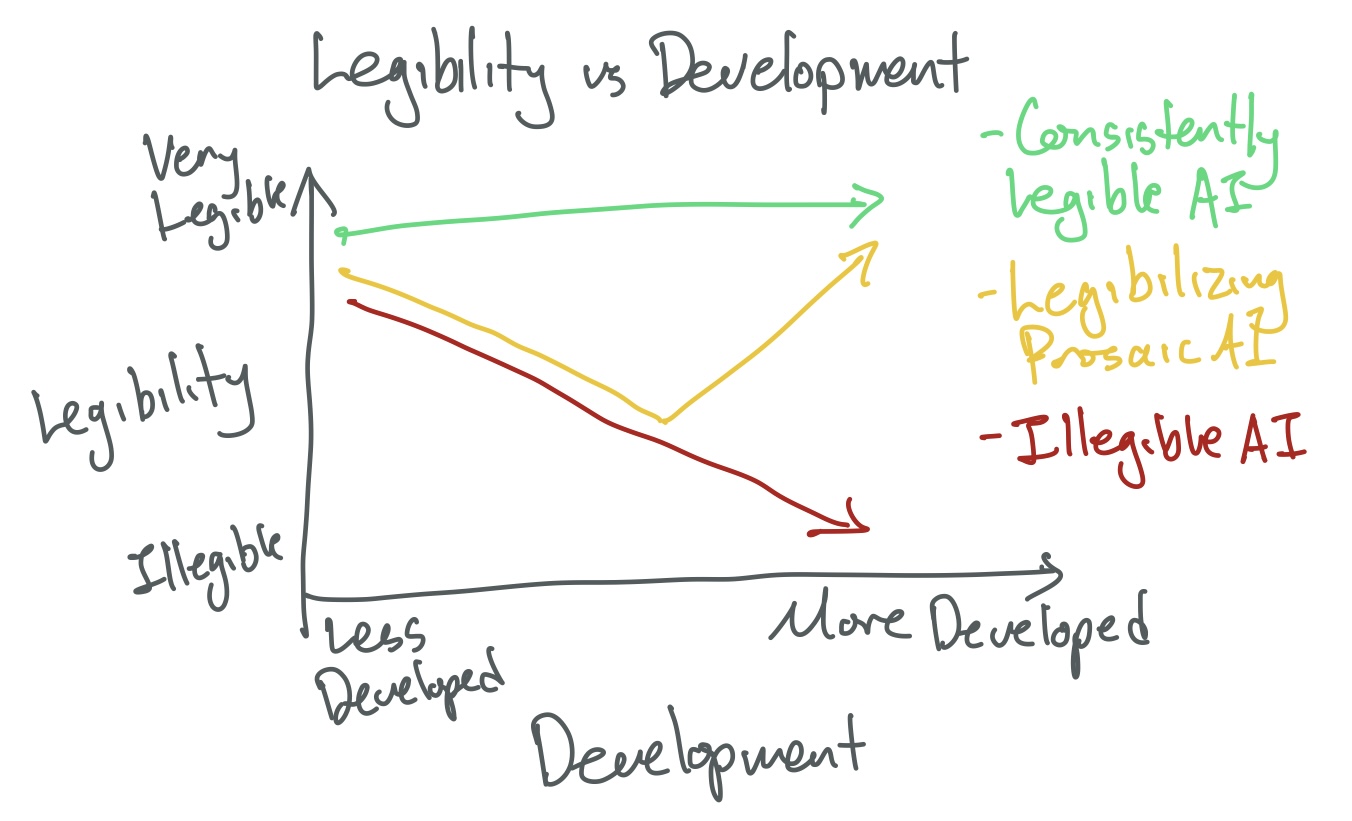
Some strategies move away from legibility and never intend to get back to it. I think these plans have us building an aligned system that we don’t understand, and possibly can’t ever understand (because it can evade understanding faster than we can develop understanding).
Many prosaic alignment strategies are about going down in legibility, and then figuring out some mechanism to go back up again in legibility space. Interpretability, ontology mapping, and other approaches fit in this frame. To me, this seems better than the previous set, but still seem skeptical to me.
Finally my favorite set of strategies are ones that start legible and endeavor to never deviate from that legibility. This is where I think Agent Foundations is in this graph. I think there’s too little work on how we can build an Aligned AGI which is legible from start-to-finish, and almost all of them seem to have a bunch of overlap with Agent Foundations.
Aside: earlier I included a threshold in legibility space that‘s the “alignment threshold” but that doesn’t seem to fit right to me, so I took it out.