This is a special post for quick takes by Alexander Gietelink Oldenziel. Only they can create top-level comments. Comments here also appear on the Quick Takes page and All Posts page.
Comment Permalink
The Ammann Hypothesis: Free Will as a Failure of Self-Prediction
A fox chases a hare. The hare evades the fox. The fox tries to predict where the hare is going - the hare tries to make it as hard to predict as possible.
Q: Who needs the larger brain?
A: The fox.
This is a little animal tale meant to illustrate the following phenomenon:
Generative complexity can be much smaller than predictive complexity under partial observability. In other words, when partially observing a blackbox there are simple internal mechanism that create complex patterns that require very large predictors to predict well.
Consider the following simple 2-state HMM
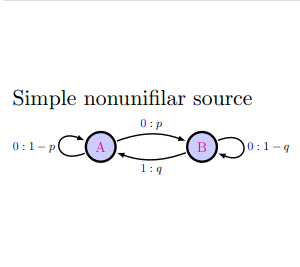
Note that the symbol 0 is output in three different ways: A -> A, A-> B, and B -> B. This means that if we see the symbol 0 we don't know where we are. We can use Bayesian updating to guess where we are but starting from a stationary distribution our belief states can become extremely complicated - in fact, the data sequence generated by the simple nonunifalar source has an optimal predictor HMM that requires infinitely many states :
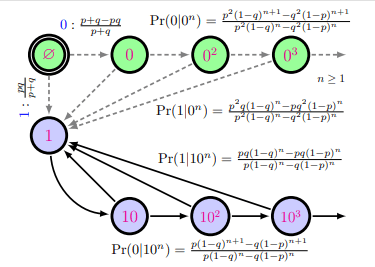
This simple example illustrates the gap between generative complexity and predictive complexity, a generative-predictive gap.
I note that in this case the generative-predictive is intrinsic. The gap happens even (especially!) in the ideal limit of perfect prediction!
Free Will as generative-predictive gap
The brain is a predictive engine. So much is accepted. Now imagine an organism/agent endowed with a brain predicting the external world. To do well, it may be helpful to predict its own actions. What if this process has a predictive-generative gap?The brain will ascribe an inherent uncertainty ['entropy'] to its own actions!
An agent having a generative-predictive gap for predicting its own action would experience a mysterious force ' choosing' its actions. It may even decide to call this irreducible uncertainty of self-prediction "Free Will" .
************************************************************
[Nora Ammann initially suggested this idea to me. Similar ideas have been expressed by Steven Byrnes]
 5
 1
 1