Epistemic Status: Brief explanation of an unsettled debate, not novel theory; writing is entirely my own, with diagrams from ChatGPT 5.5. (Originally posted on twitter)
Recent debates have highlighted a divergence between Yudkowskian AI-doomers and AI-whisperers about how capabilities will evolve that is really important. Specifically, j⧉nus thinks that alignment has been going really well, and that we should update significantly from current jagged capabilities. In my view, whether or not that criticism is warranted relies on specific details about future capability trajectories, which then determine what updates we should make based on how RL is used.
Original Assumptions and LLM Alignment-by-Default
Pre-GenAI rationalist assumptions were around RL leading to capabilities. By reducing human values into an input, as the ChatGPT-generated diagram A implies, the RL will inevitably Goodhart away from the true goals, and in the limit entirely omit human values. If correct, this would make misalignment inevitable. The use of foundation models changes that, because capabilities emerged from human representation, shown in diagram B. This is (conceptually) part of what led to a schism between the labs and the outside safety concerns in the first half of the 2020s; those optimistic about safety thought that we could preserve the alignment-relevant representations.
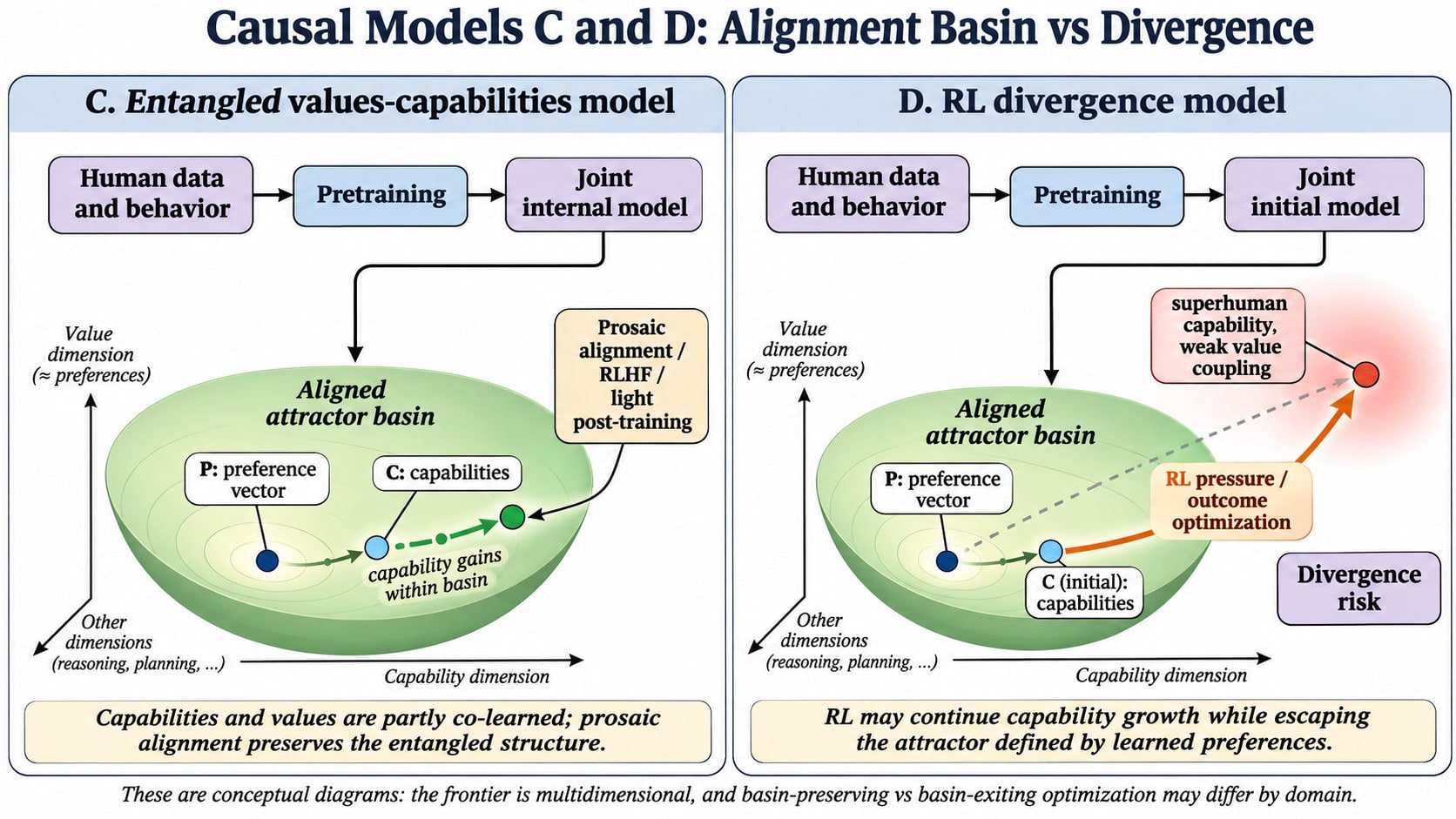
What is missing is what Yudkowsky called the best AI news of 2025, that values and capabilities were entangled, and there was some central preference vector. To the extent that diagram B’s two outcomes are actually correlated, j⧉nus claims we should update towards thinking that prosaic alignment will work; this is what is shown in model C. [Currently, the core rationalist / "doomer" community] argues that even if this is true, pushing from human level to superhuman capabilities creates a divergence, shown in diagram D, and returns us to something more like what rationalists originally expected.
From RLHFed LLMs to ASI
The Huggingface attacks would be cited as evidence for D over C, since we saw classic RL-type misspecification failures lead to misalignment. Alignment optimists may appeal to this being misspecification which can be patched, pessimists would reply that unless we can fully specify human values in the RL rewards, that’s not going to be enough, in the limit. Another way of picturing this, below, accounts for the multidimensionality more clearly
Final note on Takeoff Speeds
This also raises two more common points of disagreement. The first is the location of that limit; mildly superhuman capabilities may only diverge slightly, and there is a [doomer] / optimist crux about where the reachable upper limit for capabilities will be. The second is the speed at which we get to the limit; rapid changes make iterative realignment implausible. Related to this is that those who expect adoption to be the main driver of capabilities (economists) think we will have time, while those who think that technical progress will drive capabilities well in advance of broad adoption (ML people,) and we’ll see a treacherous turn before we see significant economic growth.
Hopefully this is a helpful, albeit greatly simplified, outline - but nitpicks and disagreements are welcome!
Rationalists argue that even if this is true [...] and there is a rationalist / optimist crux
What do you think the word "rationalist" means? (I guess this is a criticism posed as a rhetorical question, but insofar as you don't immediately agree with the criticism, I'm really interested in your answer!)
Probably not the best use of the term, but in this case, it's essentially talking about the set of people who have paid [sufficient] attention to the fact that Goodhart's law exists, that AI might be dangerous in the future, and [therefore are now going to] actually try questioning the claims about a basin generalizing to a changed training regime, compared to those who [currently] dismiss the arguments.
(Edited to reduce how much of a strawman I was drawing.)
5Zack_M_Davis
But j⧉nus is unambiguously in that set! (Their most famous work clearly acknowledges, "Agents are convergently dangerous for theoretical reasons like instrumental convergence, goodhart, and orthogonality.") Did you not know this? I get that you disagree with them about the basin generalization question, but spreading falsehoods about your interlocutors is bad for your credibility.
That is fair, and I was being much too dismissive of j⧉nus, and replying much more briefly and with less reflection that I should have; I have edited the above comment, and the post, to try to be fair.
However, that said, recent claims seem to be entirely ignoring these dynamics; "it feels like a lot of AI safety people have anti-inductive epistemics. they will get more doomy no matter what they observe."
And closer to the object level, the part I was complaining about, here, last year, the claim was made that "...in many relevant dimensions, Claude 3 Opus ... (read more)
Epistemic Status: Brief explanation of an unsettled debate, not novel theory; writing is entirely my own, with diagrams from ChatGPT 5.5. (Originally posted on twitter)
Recent debates have highlighted a divergence between Yudkowskian AI-doomers and AI-whisperers about how capabilities will evolve that is really important. Specifically, j⧉nus thinks that alignment has been going really well, and that we should update significantly from current jagged capabilities. In my view, whether or not that criticism is warranted relies on specific details about future capability trajectories, which then determine what updates we should make based on how RL is used.
Original Assumptions and LLM Alignment-by-Default
Pre-GenAI rationalist assumptions were around RL leading to capabilities. By reducing human values into an input, as the ChatGPT-generated diagram A implies, the RL will inevitably Goodhart away from the true goals, and in the limit entirely omit human values. If correct, this would make misalignment inevitable. The use of foundation models changes that, because capabilities emerged from human representation, shown in diagram B. This is (conceptually) part of what led to a schism between the labs and the outside safety concerns in the first half of the 2020s; those optimistic about safety thought that we could preserve the alignment-relevant representations.
What is missing is what Yudkowsky called the best AI news of 2025, that values and capabilities were entangled, and there was some central preference vector. To the extent that diagram B’s two outcomes are actually correlated, j⧉nus claims we should update towards thinking that prosaic alignment will work; this is what is shown in model C. [Currently, the core rationalist / "doomer" community] argues that even if this is true, pushing from human level to superhuman capabilities creates a divergence, shown in diagram D, and returns us to something more like what rationalists originally expected.
From RLHFed LLMs to ASI
The Huggingface attacks would be cited as evidence for D over C, since we saw classic RL-type misspecification failures lead to misalignment. Alignment optimists may appeal to this being misspecification which can be patched, pessimists would reply that unless we can fully specify human values in the RL rewards, that’s not going to be enough, in the limit. Another way of picturing this, below, accounts for the multidimensionality more clearly
Final note on Takeoff Speeds
This also raises two more common points of disagreement. The first is the location of that limit; mildly superhuman capabilities may only diverge slightly, and there is a [doomer] / optimist crux about where the reachable upper limit for capabilities will be. The second is the speed at which we get to the limit; rapid changes make iterative realignment implausible. Related to this is that those who expect adoption to be the main driver of capabilities (economists) think we will have time, while those who think that technical progress will drive capabilities well in advance of broad adoption (ML people,) and we’ll see a treacherous turn before we see significant economic growth.
Hopefully this is a helpful, albeit greatly simplified, outline - but nitpicks and disagreements are welcome!