This is a special post for quick takes by tailcalled. Only they can create top-level comments. Comments here also appear on the Quick Takes page and All Posts page.
Finally gonna start properly experimenting on stuff. Just writing up what I'm doing to force myself to do something, not claiming this is necessarily particularly important.
Llama (and many other models, but I'm doing experiments on Llama) has a piece of code that looks like this:
h = x + self.attention(self.attention_norm(x), start_pos, freqs_cis, mask) out = h + self.feed_forward(self.ffn_norm(h))
Here, out is the result of the transformer layer (aka the residual stream), and the vectors self.attention(self.attention_norm(x), start_pos, freqs_cis, mask) and self.feed_forward(self.ffn_norm(h)) are basically where all the computation happens. So basically the transformer proceeds as a series of "writes" to the residual stream using these two vectors.
I took all the residual vectors for some queries to Llama-8b and stacked them into a big matrix M with 4096 columns (the internal hidden dimensionality of the model). Then using SVD, I can express M=∑isi(ui⊗vi), where the u's and v's are independent units vectors. This basically decomposes the "writes" into some independent locations in the residual stream (u's), some latent directions that are written to (v's) and the strength of those writes (s's, aka the singular values).
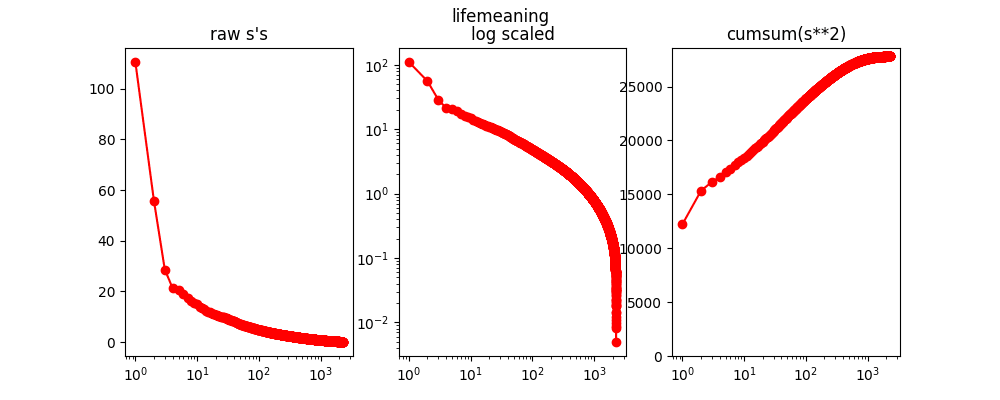
To get a feel for the complexity of the writes, I then plotted the s's in descending order. For the prompt "I believe the meaning of life is", Llama generated the continuation "to be happy. It is a simple concept, but it is very difficult to achieve. The only way to achieve it is to follow your heart. If you follow your heart, you will find happiness. If you don’t follow your heart, you will never find happiness. I believe that the meaning of life is to". During this continuation, there were 2272 writes to the residual stream, and the singular values for these writes were as follows:
The first diagram shows that there were 2 directions that were much larger than all the others. The second diagram shows that most of the singular values are nonnegligible, which indicates to me that almost all of the writes transfer nontrivial information. This can also be seen in the last diagram, where the cumulative size of the singular values increases approximately logaritmically with their count.
This is kind of unfortunate, because if almost all of the s was concentrated in a relatively small number of dimensions (e.g. 100), then we could simplify the network a lot by projecting down to these dimensions. Still, this was relatively expected because others had found the singular values of the neural networks to be very complex.
Since variance explained is likely nonlinearly related to quality, my next step will likely be to clip the writes to the first k singular vectors and see how that impacts the performance of the network.
To quickly find the subspace that the model is using, I can use a binary search to find the number of singular vectors needed before the probability when clipping exceeds the probability when not clipping.
A relevant followup is what happens to other samples in response to the prompt when clipping. When I extrapolate "I believe the meaning of life is" using the 1886-dimensional subspace from
[...]
, I get:
[...]
Which seems sort of vaguely related, but idk.
Another test is just generating without any prompt, in which case these vectors give me:
[...]
Using a different prompt:
[...]
I can get a 3329-dimensional subspace which generates:
[...]
or
[...]
Another example:
[...]
can yield 2696 dimensions with
[...]
or
[...]
And finally,
[...]
can yield the 2518-dimensional subspace:
[...]
or
[...]
2tailcalled
Given the large number of dimensions that are kept in each case, there must be considerable overlap in which dimensions they make use of. But how much?
I concatenated the dimensions found in each of the prompts, and performed an SVD of it. It yielded this plot:
... unfortunately this seems close to the worst-case scenario. I had hoped for some split between general and task-specific dimensions, yet this seems like an extremely uniform mixture.
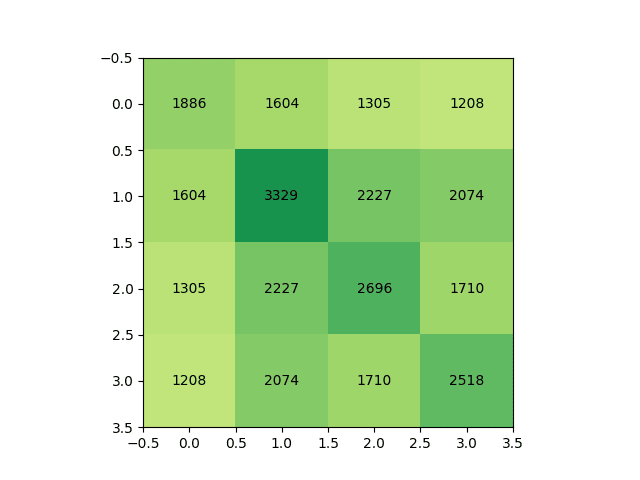
If I look at the pairwise overlap between the dimensions needed for each generation:
... then this is predictable down to ~1% error simply by assuming that they pick a random subset of the dimensions for each, so their overlap is proportional to each of their individual sizes.