This is a special post for quick takes by gw. Only they can create top-level comments. Comments here also appear on the Quick Takes page and All Posts page.
Interesting points. I think there's a few vectors of uncertainty that exist here.
- It's unclear how much companies are delaying the release of their models. The METR report talks about Anthropic having models internally months before their external release. This is in contrast to GDM announcing Carbon two weeks before it was actually available which implies that potentially GDM has a shorter runway. Based on this, maybe GDM have not matched internal progress.
- It's possible that RSI isn't yet strong enough that GDM's other advantages like unique data sources, TPUs, or high budget couldn't help to match.
- Maybe RSI feedback loops are weaker than we would think or maybe this is the beginning signs of some sort of capability wall. Both of these would require much more evidence for me to fully update towards but the Neon release could be used to argue for either.
Neon is definitely an impressive release though and once again makes me consider if GDM can be on the frontier consistently.
 1
OAI and Anthropic have access to much more capable internal models than GDM
Not sure how true this is though. Like I wouldn't be surpised if Anthropic > OpenAI > DeepMind are basically equidistant for AI R&D (since OpenAI seems bad relative to general capabilities)
Seems kinda supported by this, but it doesn't have older data for GDM
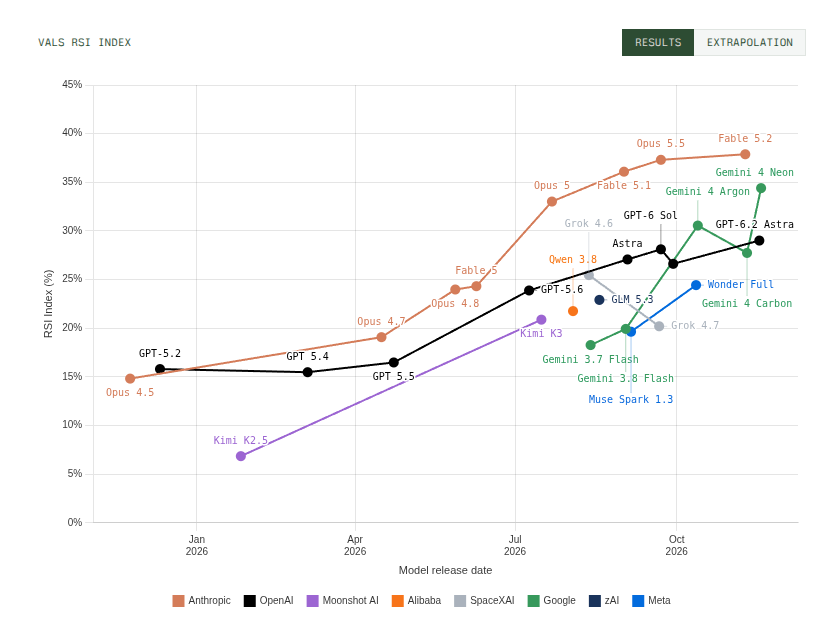
Also the 2x from METR is just for October 2026 (late 2025 slope change they say is mostly non-AI factors), and it takes time for algorithmic improvements to show up in public releases. Next few months should be very illuminating.