This is a special post for quick takes by yams. Only they can create top-level comments. Comments here also appear on the Quick Takes page and All Posts page.
Bernie Sanders has released a video on x-risk featuring a discussion with Eliezer, Nate, Daniel Kokotajlo, and Jeffrey Ladish. An excerpt from it appears to be blowing up on twitter.
EDIT: re 'blowing up': initial view velocity was really high (~200k/hour), but steeply dropped off and it doesn't seem to have really broken containment

5Kaarel
some additional recent AI x-risk things by Bernie Sanders:
* a presentation on AI on the Senate floor
* a press conference introducing the AI Data Center Moratorium Act (with Alexandria Ocasio-Cortez)
* the text of the act
1XelaP
...it has 1.2 M views. Surely it's "blown up" at this point.
9yams
Depends on the reference class. As of the past year or so, 1m eyes on a piece of AI safety content isn’t crazy, especially for a video on Twitter, where my impression is the criteria for what counts as a ‘view’ are pretty liberal. Like, plausibly the video has been viewed in full (much) less than half that many times.
Separately, videos posted by that account seem to routinely get ~1m views - not outperforming other content from an external collaborator is a little disappointing from a raw metrics perspective! Naively you’d hope to get the combined weight of your respective audiences, which seems to have only somewhat happened here.
When I posted this I think I expected we’d get to 2m views in the first couple days (weakly outperforming other Sanders Twitter content). I think with a different video, that could have happened.
Still an exciting crossover episode.
1XelaP
Huh? Eliezer's main account tens to get a few ten thousands of views. So under the combination of respective audiences theory, it's... mostly the audience of Bernie Sanders! Surely that breaks containment.
Also, looking at Bernie's account suggests that it's in the higher view count class of his posts - some get 2M but others get 100K and if you go by eyeballed average it seems to be 500k.
2yams
1. I was comparing to other video posts by Sanders.
2. I was comparing to a broader activation of Eliezer’s audience vs any given tweet.
3. Outperforming the ‘average’ is the wrong standard for ‘blowing up’. ‘Blowing up’ would be ‘outperforming all the recent similar artifacts’, at least as I intended it in my original post.
Meta: it feels pretty strange to have used an underspecified colloquial term, to have walked back the applicability of that term as I intended to use it, and then to be told I’m wrong for walking it back. The point I cared about capturing in that edit is ‘this tweet didn’t do as well as I expected when it first dropped.’ That’s a claim about my own expectations.
1XelaP
The point I care about is whether it's gotten to a substantial audience of 'normal' people. I had read you as making claims that that hadn't really happened; yet it looks to me that, to the extent that twitter's viewcount is reasonable (though I believe you that it probably isn't), a million people who are mostly Bernie Sanders fans got exposed to the video. If you only meant that this is less than what you expected, then that's my bad and we don't have any disagreement.
New reacts available only to paid users of LessWrong Premium (not you freeloaders) facilitate frictionless, borderline-telepathic communication.
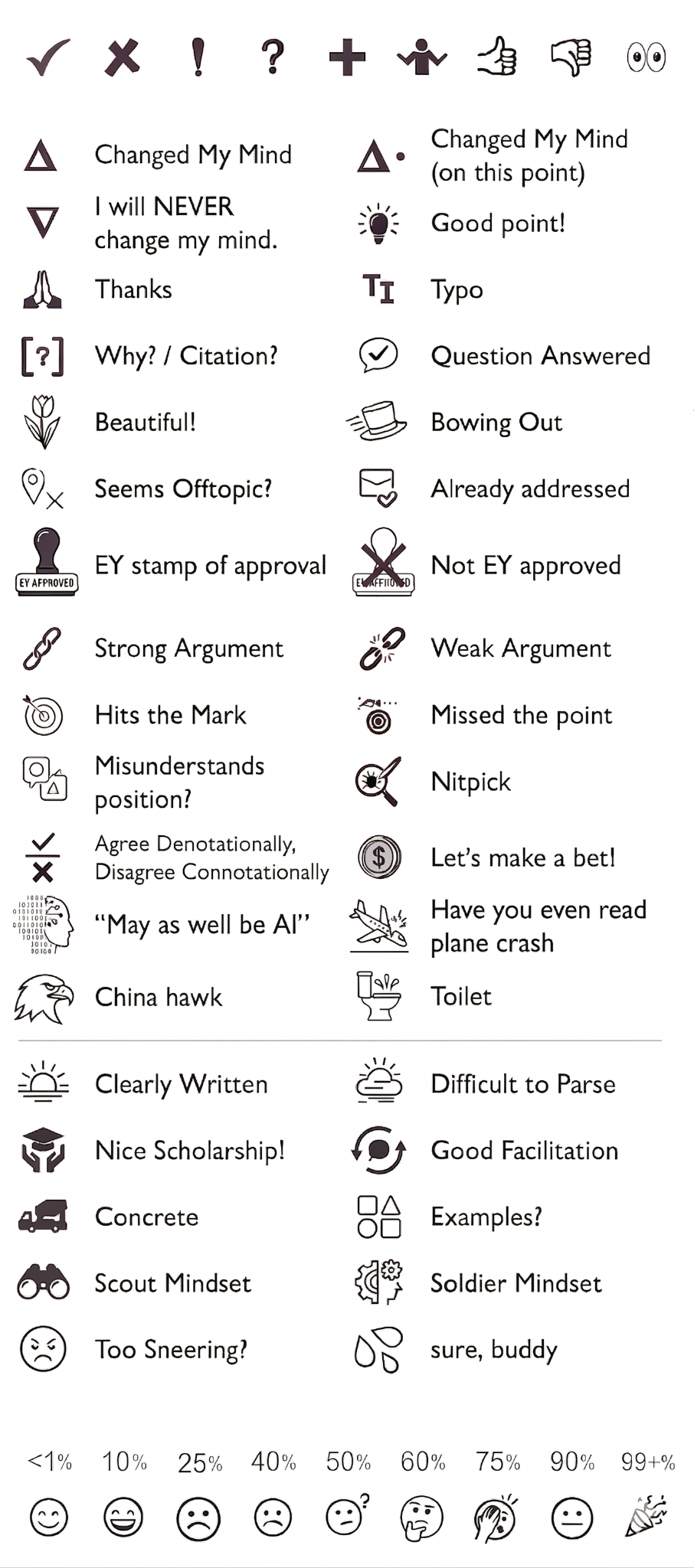
‘I will NEVER change my mind’: Use this react to assert that you’re content with exactly how wrong you are (which is not at all), and that the case is permanently closed on this matter, so far as you’re concerned.1
‘EY Stamp of Approval’: Use this react to assert that, on your personal authority, Eliezer Yudkowsky agrees with the contents of the comment, rendering it beyond reproach.
‘NOT EY Approved’: Use this react to assert that, on your personal authority, Eliezer Yudkowsky disagrees with the contents of the comment, rendering it immensely reproachful. Users who accrue too many ‘NOT EY Approved’ reacts will have their accounts suspended (although actual thresholds here have yet to be set).2
‘May as well be AI’: Use this react when you’re indifferent to whether or not a statement was generated by AI because shit, it may as well be. You’re ignoring it either way.
‘Have you even read plane crash?’: Use this react when your interlocutor’s unfamiliarity with prior literature is clearly on display.
‘China Hawk’: Use this react to assert American ... (read more)
 13
13Disappointed that they left out these—I really don't like choosing between being technically correct and politically correct. Maybe they can go in a LessWrong Max tier.
 143
1438the gears to ascension
I will not do this and nobody else should either, but I think in a world where the negative effects were magically not present, it would be quite funny to react to all EY comments with "not EY approved"
Edit: also no way to pay lw has been forthcoming, making the thing I'm replying to effectively only an April fools lie
3Richard_Kennaway
Perhaps both. The composer and musician Max Reger once responded to a disagreeable review thus:
Ich sitze im kleinsten Raum des Hauses. Ich habe Ihre Kritik vor mir. Bald werde ich sie hinter mir haben.
Pete Hegseth just declared Anthropic a supply chain risk.
Under the most expansive naive interpretation of what this might mean, it seems plausible that this bottlenecks their compute access (e.g., through Amazon, who has government contracts).
Does anyone know more here / has thought more about this? I'd be pretty surprised if the most expansive naive interpretation held, but it's also probably not the most narrow one (e.g., can't work with the defense industry, or on government-specific contracts in larger companies).
That so many companies (the majority of Fortune 500s, for instance) contract with the government seems to make this dramatically impactful (e.g. some-double-digit-percentage of B2B revenue; but is it 10 percent or 90? How much does it impact other aspects of their operation? I just don't know).
Edit: An important detail here, not obvious from the initial post, is that 'Hegseth makes a tweet' is kind of a 'step 0' to the actual process unfolding. We actually don't know if he's really placed the order, if the order will be followed through on, and with what level of diligence/brutality (it's this last question that my original post was asking, but in some importance sense 'we're just not there yet').
Not to be overly political (although how do you avoid it with a topic like this?) but I think it's just another part of "MAGA maoism" as it's been called. The idea of the Republican party as a small government free market pro liberty group died with Trump, who painted over that whole philosophy with his focus on culture war grievances, state control, and "owning the libs".
Matt Yglesias had a good piece two years ago about how the tariff regime essentially makes a mini central planning department and we've seen Trump expressly use it as such, trying to bend the economy to attack companies and nations over personal grievances.
And Scott Lincicome of the CATO institute has covered this new brand of "state corporatism" as he calls it quite well IMO, about the nationalization of various companies and the various market distortions it creates.
"First they came" is a famous poem about the oppression of people, but it's also a good general warning for all sorts of behavior. What someone will happily do to another is what they can happily do to you if you ever cross them. Whether that be the chick who cheated on her husband for you cheating on your new relationship, stuffing people into camp... (read more)
-42Shankar Sivarajan
0Shankar Sivarajan
As I understand it, the "supply chain risk" only restricts the target in one direction. Amazon can still sell to Anthropic and keep its government contracts.
9yams
I expect this is true in the simple case of 'you can sell a service to them'; the reason I used the Amazon example, is that Amazon owns shares in Anthropic ($60B worth according to quick Claude check), which it purchased (at least in part) with compute credits; this is a much more intimate entanglement then Anthropic being yet-another-AWS-customer.
Again, I genuinely don't know how this pans out, but the crux for me is not 'can you sell a product to a company that's a supply chain risk and keep your contracts'; it's 'can you [do all the things Amazon is doing with Anthropic, which are largely mutually conditioned on one another as part of complex agreements] with a supply chain risk and keep your contracts.'
-5marquis_de_sod
MIRI is potentially interested in supporting reading groups for If Anyone Builds It, Everyone Dies by offering study questions, facilitation, and / or copies of the book, at our discretion. If you lead a pre-existing reading group of some kind (or meetup group that occasionally reads things together), please fill out this form.
The deadline to submit is September 22, but sooner is much better.
In two days: MIRI's hosting a virtual event for those who preorder Nate and Eliezer’s forthcoming book If Anyone Builds It, Everyone Dies. Sunday, August 10 at noon PT. It’s a chat between Nate Soares and Tim Urban (Wait But Why) followed by a Q&A.
This will be followed by another event in September, a full Q+A w/ Nate + Eliezer.
3Michaël Trazzi
Will there be any recording?
2yams
We will likely share a recording with those who preorder and submit the form; depends on how the talk itself goes, and a few other variables.
2cqb
I wasn't able to make it to the q&a. Did it manage to get recorded in a shareable way?
Meanings of political identities shift dramatically based on context, and you can't manually confirm the beliefs of everyone present at your 'gathering of people with x political identity'. To the extent that your political identity is based on Real Beliefs with Real Consequences, you should expect not to have much in common with many other people who declare the same identity when you move to a new place (or corner of the internet).
Example: In rural Southeast Texas, Confederate flags are a common sight, and my geometry teacher once told us about a cross burning he witnessed (which a few students murmured we really ought to bring back).
The majority of people genuinely hold at least one belief that, to many of my coastal-elite-descended friends, would seem comical. E.g., women should never have jobs and should rarely speak (especially in public), men with long hair are wanton or gay or trans or both, beating children (not like 'spanking' but like 'anything short of broken bones') is not only fine but your duty as a father, weed overdose not only can but will definitely kill you, megadoses of zinc can cure cancer, the covid vaccine is the mark of the beast from the book of revelation... (read more)
7Garrett Baker
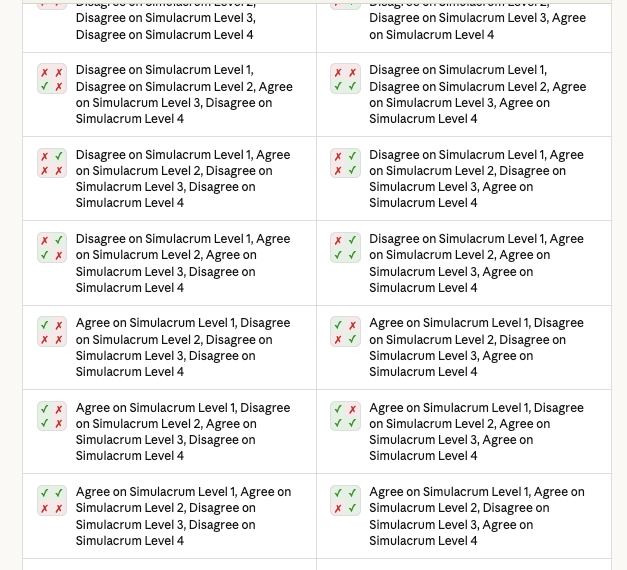
I submit that the problem you are encountering is operating too much on simulacra level 3.
I honestly don't give a rats ass what your "political identity" is. I care about your beliefs about the effects of different policies, your current beliefs about the world, and most of all your reasons for believing those things. Insofar as your "reasons" are in fact you self-modeling as "leftist", "centrist", "libertarian", or some other label like that, you are clearly operating on simulacra level 3, and I stop caring.
That is to say that insofar as the majority of people have one or more of the items on that list of absurd beliefs you gave because they genuinely believe such things, they are dumb, and the only reason I'd care what they have to say is some morbid curiosity, or of course to argue against them (or both).
Insofar as the majority of people have one or more of the items on that list of absurd beliefs you gave because we simply lack a shared vocabulary for political identities, I again don't care what they have to say. If they are actually trying to communicate to me that they think of themselves as a centrist, well, that claim has no impact on reality whatsoever, so who cares?
The same goes for people with stupid claims which read leftist.
The thing is that we do have shared vocabulary for things in the real world (excepting many technical terms, but one can just use Wikipedia or Claude for those), and there are not active social wars over what those real world words should mean (that laypeople ought to care about).
If you stick to simply precisely stating your beliefs and values (and reasons for having them), not only will you avoid the upsetting result of having others believe you are The Dreadded Outgoup!!! but you will also avoid meaningless conversations about which Hogwarts house political identity you are.
9yams
You wrote this comment in an adversarial tone but I Just Agree With You.
Indeed, this is an alternate formulation of the thesis of my post, and even uses language I used when characterizing the post itself to someone in the office ~2 hours ago.
2Garrett Baker
Hm, I think the thing I disagree with, and was trying to argue against was that it is a good idea in the first place to even try to have a political map at all, nevermind to try to unwarp it.
2yams
The post is meant to be somewhat agnostic on the question - conditional on one has a map, here’s a common failure mode. It’s also meant to point in the direction of ‘reconsider the value of your map’.
Separately, I think I ~endorse your first comment, but I also think there are cases in which you should definitely have a map (eg you are attempting to achieve political ends). So I think your second comment is somewhat overstated.
2edelweiss
Thanks so much for this comment, it crystallized something that's been in my subconscious for like two years.
6Raemon
The rest of the comment made sense but this feels sorta non-sequitor-ial. Maybe this is right, but, most of the things you said seemed like on average it would increase the amount I expected some kind of adversarial posture to make sense. (Except insofar as adversarial postures are basically not a good strategy, in which case it still doesn't depend much on the rest of the contents of the quick take)
4yams
I don't understand this. Can you say more?
ACX on the Frankfurt School is, perhaps, the best summary of the Frankfurt School of its length that exists anywhere.
Few quibbles:
- Weird to write about the Frankfurt school without mentioning Freud. The split in their influence is probably 60/40 Marx/Freud, so this seems like a big omission. Maybe Freud is too big a can of worms for Scott (or the secondary author he read) to introduce him here, and you can tell enough of the story without him. Ultimately I think this choice was reasonable.
- I think Scott conflates the form and purpose of their work too much. That is, you can do witchy art criticism of the kind they ~invented without yourself being a Marxist, and this method/approach is perhaps more influential than their actual Marxism (since they spent more words on it, except for Marcuse). As Scott points out early on, many of those influenced by them would decry the affiliation. I claim this is usually because they’re taken to be either too Marxist or not Marxist enough by those who adapt their method without adopting their politics (which is most of those influenced by them).
- He says upfront that they were weird and mystical for obscurantist reasons, and for intellectual-lineage G

‘Major AI labs can only justify their high valuations by developing very powerful, very general AI systems’ is a claim I sometimes hear. That is, many seem to expect ‘if no AGI in n years, then the bubble pops’.
However, I think just revolutionizing tech is likely enough to justify current valuation levels (and maybe as much as 4x current valuations; maybe even more?), given the market caps of other large tech companies (even if we exclude NVIDIA, which we may want to do because their current market cap is more heavily tied to the AI boom than others). After all, these are still ‘only’ 12-figure valuations in a sector where many of the major players have broken a trillion. A 12-figure valuation is consistent with ‘future major player of the kind that already exists’ and not ‘potential god emperor of the solar system’.
Using these big tech companies as a reference point and assuming very limited further capabilities progress (eg no TAI, AGI, [your favorite way to talk about very general, ~human level systems]), the major LLM companies still don’t obviously look overvalued to me. The tech pie by itself is big enough (and the current state of the tech looks, to me, sufficient to massiv... (read more)

4habryka
This is true, but I think current valuations of frontier companies are still premised on AI continuing to scale. I expect that if you locked capabilities at current levels, you would see a huge drop in frontier company evaluations, and a huge increase in AI startup and existing tech-company valuations.
3yams
Really? I would expect valuations to briefly stall out and then continue to grow when it became clear that the labs have a big lead when it comes to elicitation, scaffolding, etc.
I would also expect existing big-tech valuations to grow in this scenario - just not startups (although maybe they get a bump in the short term).
Can you say more about why you expect this? Trying to see if the answer is [real disagreement] or [Oli has superior knowledge of economics] (and also learn something, in the latter case).
8habryka
They don't have a big lead here, so that's why. This domain isn't that deep and many other people have already made scaffolds that are better than what the labs make. E.g. Claude Code is a much smaller coding project where the best 5-person startup would probably quickly outperform Anthropic. On many benchmarks Claude Code is among the worst performing scaffolds (this part is honestly surprising to me and I don't quite know what's up).
[...]
Seems like there would be a ton of AI startups to make, and big-tech is decent-ish at innovating in new spaces, but startups have historically still played a huge role in that.
2yams
Wow that is surprising! Even after considering the suite of caveats one applies to benchmarks as evidence, I am very surprised.
All things considered I think I still lean harder on self-reports from lab and non-lab technical staff regarding the elicitation delta, but I’m much less confident than before.
[I suspect we may have other less interesting disagreement about how economically useful current systems could be if more effort were put toward juicing them, but happy to talk about that some other time; just mentioning this for completeness or something.]
Just said to someone that I would by default read anything they wrote to me in a positive light, and that if they wanted to be mean to me in text, they should put '(mean)' after the statement.
Then realized that, if I had to put '(mean)' after everything I wrote on the internet that I wanted to read as slightly abrupt or confrontational, I would definitely be abrupt and confrontational on the internet less.
I am somewhat more confrontational than I endorse, and having to actually say to myself and the world that I was intending to be harsh, rather than simply demonstrating it, would lead to me being harsh somewhat less often.
I do basically know when I'm being confrontational in public, and am Doing It On Purpose, and also expect others to know it, and almost never say "I wasn't being confrontational" when I was being confrontational, and somehow having to signal it more overtly than it is already (that is to say, very) signaled would encourage me to tone it down.
In person, I even sometimes say 'I am being difficult in a way that I endorse/feels correct/feels important' and just go on being difficult, and considering that I'm about to do that in advance doesn't discourage me from bein... (read more)
4Vladimir_Nesov
What a mean thing to say. (If you commit to perceive positivity regardless of its presence, you thereby commit to ignore any real positivity the other person intended to convey.)
1yams
Putting '(mean)' at the end of a statement is the exact mechanism of saying 'no' that is (jokingly!) offered in this scenario, to (again, jokingly) address the exact thing you are describing, with the exact post you have linked as the referent which appeared in my mind as I made the joke! The joke being 'that is obviously not a sufficient mechanism to solve the problem of offering a real valence, thereby robbing my interlocutor of some agency/expressive power.' You are making the same point I am making as though you are correcting me.
You are repeating my own joke back to me as if you originated it, and ignoring the substantive reflective point that I thought might be of value (which does not itself importantly hinge on the original Garrabrant-adjacent context).
3Vladimir_Nesov
I guess you didn't intend lack of valence or unintended negativity as relevant distinct possibilities, so that lack of the "(mean)" tag would be synonymous with "(positive)" in the intended reading. Without this assumption, you are leaving the other person without a method for communicating positivity, the protocol only supports expressing either negativity or an undifferentiated mixture of positivity and lack of valence, preventing communication of the distinction between positivity and lack of valence.
So the workaround more directly makes the point about still needing to communicate negativity (or its lack), not positivity, and I think the latter is the more curious part of the implication. For a statement of committing to see certain things in a positive light, this implication of its literal meaning conveys the opposite of the way this kind of sentiment is usually intended.
2Seth Herd
There's no sharp line between Doing It On Purpose and not.
Being explicit about it makes it more on purpose, and engages more System 2 careful sequential thought, that clarifies whether you want to do this or not.
I think the phenomenon you're describing is downstream of this common error in thinking about people.
I think it's a very impactful error, both in reasoning about ourselves and others.
2yams
Yes exactly; I'm curious about how many more opportunities for greater intentionality/reflective-endorsement might be lurking in other areas, where I just haven't created the right test/handle (but may believe that I've created the right one).
I'm also mindful of the opposite failure mode, though, where attempting to surface something to yourself internally actually causes you to over-index on it, leading to paralysis, where the thing was only present in very small doses and your threshold was poorly calibrated.
it’s plausible to me that almost any public discussion of AI or AI safety that is not centrally about LLM consciousness should clarify this early and often.
Low-context audiences are really hung up on the consciousness topic, and are often reading entirely unrelated material as though it were trying to make a claim about consciousness, then generalizing to a judgement about the speaker that inoculates them against partitioning consciousness and capabilities.
Clarifying that you don’t mean to step in the consciousness discussion upfront may be a way to reduce... (read more)
4RobertM
I tried to make a similar argument here, and I'm not sure it landed. I think the argument has since demonstrated even more predictive validity with e.g. the various attempts to build and restart nuclear power plants, directly motivated by nearby datacenter buildouts, on top of the obvious effects on chip production.
3yams
I've just read this post and the comments. Thank you for writing that; some elements of the decomposition feel really good, and I don't know that they've been done elsewhere.
I think discourse around this is somewhat confused, because you actually have to do some calculation on the margin, and need a concrete proposal to do that with any confidence.
The straw-Pause rhetoric is something like "Just stop until safety catches up!" The overhang argument is usually deployed (as it is in those comments) to the effect of 'there is no stopping.' And yeah, in this calculation, there are in fact marginal negative externalities to the implementation of some subset of actions one might call a pause. The straw-Pause advocate really doesn't want to look at that, because it's messy to entertain counter-evidence to your position, especially if you don't have a concrete enough proposal on the table to assign weights in the right places.
Because it's so successful against straw-Pausers, the anti-pause people bring in the overhang argument like an absolute knockdown, when it's actually just a footnote to double check the numbers and make sure your pause proposal avoids slipping into some arcane failure mode that 'arms' overhang scenarios. That it's received as a knockdown is reinforced by the gearsiness of actually having numbers (and most of these conversations about pauses are happening in the abstract, in the absence of, i.e., draft policy).
But... just because your interlocutor doesn't have the numbers at hand, doesn't mean you can't have a real conversation about the situations in which compute overhang takes on sufficient weight to upend the viability of a given pause proposal.
You said all of this much more elegantly here:
[...]
...which feels to me like the most important part. The burden is on folks introducing an argument from overhang risk to prove its relevance within a specific conversation, rather than just introducing the adversely-gearsy concept to justify safet
4Eli Tyre
To whom are are you talking?
3yams
Folks using compute overhang to 4D chess their way into supporting actions that differentially benefit capabilities.
I'm often tempted to comment this in various threads, but it feels like a rabbit hole, it's not an easy one to convince someone of (because it's an argument they've accepted for years), and I've had relatively little success talking about this with people in person (there's some change I should make in how I'm talking about it, I think).
More broadly, I've started using quick takes to catalog random thoughts, because sometimes when I'm meeting someone for the first time, they have heard of me, and are mistaken about my beliefs, but would like to argue against their straw version. Having a public record I can point to of things I've thought feels useful for combatting this.
2Noosphere89
While I'm not a general fan of compute overhang, I do think that it's at least somewhat relevant in worlds where AI pauses are very close to when a system is able to automate at least the entire AI R&D process, if not the entire AI economy itself, and I do suspect realistic pauses imposed by governments will likely only come once a massive amount of people lose their jobs, which can create incentives to go to algorithmic progress, and even small algorithmic progress might immediately blow up the pause agreement crafted in the aftermath of many people losing their jobs.
1yams
I think it would be very helpful to me if you broke that sentence up a bit more. I took a stab at it but didn't get very far.
Sorry for my failure to parse!
2Noosphere89
Basically, my statement in short terms is that conditional on AI pause happening because of massive job losses from AI that is barely unable to take-over the world, then even small saving in compute via better algorithms due to algorithmic research not being banned would incentivize more algorithmic research, which then lowers the compute enough to make the AI pause untenable and the AI takes over the world.
1yams
So for this argument to be worth bringing up in some general context where a pause is discussed, the person arguing it should probably believe:
1. We are far and away most likely to get a pause only as a response to unemployment.
2. An AI that precipitates pause-inducing levels of unemployment is inches from automating AI R+D.
3. The period between implementing the pause and massive algorithmic advancements is long enough that we're able to increase compute stock...
4. ....but short enough that we're not able to make meaningful safety progress before algorithmic advancements make the pause ineffective (because, i.e., we regulated FLOPS and it just now takes 100x fewer FLOPS to build the dangerous thing).
I think the conjunct probability of all these things is low, and I think their likelihood is sensitive to the terms of the pause agreement itself. I agree that the design of a pause should consider a broad range of possibilities, and try to maximize its own odds of attaining its ends (Keep Everyone Alive).
I'm also not sure how this goes better in the no-pause world? Unless this person also has really high odds on multipolar going well and expects some Savior AI trained and aligned in the same length of time as the effective window of the theoretical pause to intervene? But that's a rare position among people who care about safety ~at all; it's kind of a George Hotz take or something...
(I don't think we disagree; you did flag that this as "...somewhat relevant in worlds where..." which is often code for "I really don't expect this to happen, but Someone Somewhere should hold this possibility in mind." Just want to make sure I'm actually following!)
2Noosphere89
I think 1 and 2 are actually pretty likely, but 3 and 4 is where I'm a lot less confident in actually happening.
A big reason for this is that I suspect one of the reasons people aren't reacting to AI progress is they assume it won't take their job, so it will likely require massive job losses for humans to make a lot of people care about AI, and depending on how concentrated AI R&D is, there's a real possibility that AI has fully automated AI R&D before massive job losses begin in a way that matters to regular people.
1yams
Cool! I think we're in agreement at a high level. Thanks for taking the extra time to make sure you were understood.
In more detail, though:
I think I disagree with 1 being all that likely; there are just other things I could see happening that would make a pause or stop politically popular (i.e. warning shots, An Inconvenient Truth AI Edition, etc.), likely not worth getting into here. I also think 'if we pause it will be for stupid reasons' is a very sad take.
I think I disagree with 2 being likely, as well; probably yes, a lot of the bottleneck on development is ~make-work that goes away when you get a drop-in replacement for remote workers, and also yes, AI coding is already an accelerant // effectively doing gradient descent on gradient descent (RLing the RL'd researcher to RL the RL...) is intelligence-explosion fuel. But I think there's a big gap between the capabilities you need for politically worrisome levels of unemployment, and the capabilities you need for an intelligence explosion, principally because >30 percent of human labor in developed nations could be automated with current tech if the economics align a bit (hiring 200+k/year ML engineers to replace your 30k/year call center employee is only just now starting to make sense economically). I think this has been true of current tech since ~GPT-4, and that we haven't seen a concomitant massive acceleration in capabilities on the frontier (things are continuing to move fast, and the proliferation is scary, but it's not an explosion).
I take "depending on how concentrated AI R&D is" to foreshadow that you'd reply to the above with something like: "This is about lab priorities; the labs with the most impressive models are the labs focusing the most on frontier model development, and they're unlikely to set their sights on comprehensive automation of shit jobs when they can instead double-down on frontier models and put some RL in the RL to RL the RL that's been RL'd by the..."
I think that's right
2Noosphere89
I generally don't think the Inconvenient truth movie mattered that much for solving climate change, compared to technological solutions like renewable energy, and made the issue a little more partisan (though environmentalism/climate change was unusually partisan by then) and I think social movements to affect AI already had less impact on AI safety than technical work (in a broad sense) for reducing doom, and I expect this trend to continue.
I think warning shots could scare the public, but I worry that the level of warning shots necessary to clear AI is in a fairly narrow band, and I also expect AI control to have a reasonable probability of containing human-level scheming models that do work, so I wouldn't pick this at all.
I agree it's a sad take that "if we pause it will be for stupid reasons", but I also think this is the very likely attractor, if AI does become a subject that is salient in politics, because people hate nuance, and nuance matters way more than the average person wants to deal with on AI (For example, I think the second species argument critically misses important differences that make the human-AI relationship more friendly than the human-gorilla relationship, and that's without the subject being politicized).
To address this:
[...]
I think the key crux is I believe that the unreliability of GPT-4 would doom any attempt to automate 30% of jobs, and I think at most 0-1% of jobs could be automated, and while in principle you could improve reliability without improving capabilities too much, I also don't think the incentives yet favor this option.
[...]
I agree with this sort of argument, and in general I am not a fan of collapsing checkpoints between today's AI and God AIs, which is a big mistake I think MIRI did, but my main claim is that the checkpoints would be illegible enough to the average citizen such that they don't notice the progress until it's too late, and that the reliability improvements will in practice also be coupled with
2Nathan Helm-Burger
I think I get what you're saying... That the argument you dislike is, "we should rush to AGI sooner, so that there's less compute overhang when we get there."
I agree that that argument is a pretty bad one. I personally think that we are already so far into a compute overhang regime that that ship has sailed. We are using very inefficient learning algorithms, and will be able to run millions of inference instances of any model we produce.
Does this correspond with what you are thinking?
1yams
I want to say yes, but I think this might be somewhat more narrow than I mean. It might be helpful if you could list a few other ways one might read my message, that seem similarly-plausible to this one.
1Nathan Helm-Burger
Overhangs, overhangs everywhere. A thousand gleaming threads stretching backwards from the fog of the Future, forwards from the static Past, and ending in a single Gordian knot before us here and now.
That knot: understanding, learning, being, thinking. The key, the source, the remaining barrier between us and the infinite, the unknowable, the singularity.
When will it break? What holds it steady? Each thread we examine seems so inadequate. Could this be what is holding us back, saving us from ourselves, from our Mind Children? Not this one, nor that, yet some strange mix of many compensating factors.
Surely, if we had more compute, we'd be there already? Or better data? The right algorithms? Faster hardware? Neuromorphic chips? Clever scaffolding? Training on a regress of chains of thought, to better solutions, to better chains of thought, to even better solutions?
All of these, and none of these. The web strains at the breaking point. How long now? Days? Months?
If we had enough ways to utilize inference-time compute, couldn't we just scale that to super-genius, and ask the genius for a more efficient solution? But it doesn't seem like that has been done. Has it been tried? Who can say.
Will the first AGI out the gate be so expensive it is unmaintainable for more than a few hours? Will it quickly find efficiency improvements?
Or will we again be bound, hung up on novel algorithmic insights hanging just out of sight. Who knows?
Surely though, surely.... surely rushing ahead into the danger cannot be the wisest course, the safest course? Can we not agree to take our time, to think through the puzzles that confront us, to enumerate possible consequences and proactively reduce risks?
I hope. I fear. I stare in awestruck wonder at our brilliance and stupidity so tightly intermingled. We place the barrel of the gun to our collective head, panting, desperate, asking ourselves if this is it. Will it be? Intelligence is dead, long live intelligence.
0robo
This world?
1yams
Yes this world.
A group of researchers has released the Longitudinal Expert AI Panel, soliciting and collating forecasts regarding AI progress, adoption, and regulation from a large pool of both experts and non-experts.
I often see people struggle in conversation to put their finger on exactly what it feels like LLMs are missing. The handle that feels closest to me is Pirsig's notion of Quality, with which many of you are already familiar.
4Dagon
No. If you replace "just" with "partially model-able as", then yes.
4Jackson Wagner
Surely the most important distinction is that normal price discrimination is usually based on trying to infer a customer's willingness to pay (based on how wealthy they are, how much they want the product, etc). Versus fare evasion is also heavily based in how willing someone is to lie / cheat / otherwise break the rules. So, tolerating fare evasion is a form of "price discrimination" that's dramatically corrosive to societal trust and other values, much moreso than any normal kind of price discrimination -- effectively a disproportionate tax on honorable law-abiding people. See Kelsey piper's article https://www.theargumentmag.com/p/the-honesty-tax
2yams
"Dramatically corrosive to societal trust" feels like a wild overstatement. Fair evasion is and has been a norm (at least in the US) for approximately as long as public transit has existed, and it doesn't seem like it's meaningfully accelerated (except in periods of lax enforcement, which my guess is would reach an equilibrium somewhere) or meaningfully (let alone dramatically!) damaged social trust.
I buy parts of Kelsey's argument, but I think there's a bait and switch (at least between her opening example and the fare evasion example) where we start out talking about how people who can't afford food are incentivized to lie and then end up talking about how poor people shouldn't be allowed to use public transit. I claim the maxim should be sensitive to the context and would like to entertain the notion that services with near-zero marginal cost should tolerate some non-zero amount of fare evasion.
2Jackson Wagner
Non-zero, of course, in the same sense that credit card companies tolerate a non-zero amount of fraudulent transactions as part of doing business. And I agree that the right amount of resources to spend on fare enforcement will be different for each transit system, depending on all kinds of particular circumstances. But I would guess that for most transit systems, "let's help the poor by cutting back on fare evasion" would overall be a much worse use of marginal resources than "let's help the poor by offering free or discounted fare cards or giving them fare credits", or perhaps "let's help everyone by slightly expanding service frequency / coverage".
Eg, grocery stores tolerate some amount of "shrinkage" (people stealing the food) according to whatever maximizes profits. If grocery stores were run by the government and were willing to run at a loss in order to promote greater overall social welfare, I wouldn't support a policy of "let's just roll back our shrinkage enforcement and let people steal more food". I would instead support giving poorer people something like expanded EBT food stamp credits. (And, per kelsey, signing up for such a program should be made simpler and more rational!)
Tolerating a high amount of fare evasion also means letting some very disorderly people into the system, which makes the experience worse for all the actual paying users of the system. So it is not always "near zero marginal cost" to let other people free-ride (even outside of busy, congested times).
For an example targeting rich people instead of the poor: I think we should lower income and corporate taxes (which discourage productive work) and replace the lost revenue with pigovian taxes (ie a carbon tax, sin taxes, etc) plus georgist land taxes. And, for the purposes of this conversation, say that I support lowering taxes overall, in a way that would disproportionately benefit rich people and corporations. But I am totally against severely rolling back IRS enforcem
2yams
I didn't mean to imply the full 'optimal amount of fraud is non-zero' frame. I do mean an amount above that, and typed 'non-zero' hastily.
[...]
I support what gets the people fed. Supporting an option that isn't really on the table (because serious proposals for doing welfare well aren't being actively debated and implemented) doesn't do anyone any good. I am not talking about a perfect world; I am looking at the world we are in and locating a tiny intervention/frame shift that might marginally improve things.
3gustaf
Idk, but there seem to be papers on this.
Payment Evasion (Buehler 2017)
[...]
https://ux-tauri.unisg.ch/RePEc/usg/econwp/EWP-1435.pdf
[...]
Reading so many reviews/responses to IABIED, I wish more people had registered how they expected to feel about the book, or how they think a book on x-risk ought to look, prior to the book's release.
Finalizing any Real Actual Object requires making tradeoffs. I think it's pretty easy to critique the book on a level of abstraction that respects what it is Trying To Be in only the broadest possible terms, rather than acknowledging various sub-goals (e.g. providing an updated version of Nate + Eliezer's now very old 'canonical' arguments), modulations o... (read more)
Haven’t found the new ‘following’ page especially useful since the change (whereas previously it was my default). Not sure why that is exactly, but one thing I think would help is if it consolidated threads with multiple posts from followed users, instead of duplicating the same thread many times within the feed. If two or more people I follow have a back and forth, it eats all the other updates (and I usually read the whole back and forth by clicking a link from the first child I see, so then my feed is majority stuff I’ve already seen).
The CCRU is under-discussed in this sphere as a direct influence on the thoughts and actions of key players in AI and beyond.
Land started a creative collective, alongside Mark Fisher, in the 90s. I learned this by accident, and it seems like a corner of intellectual history that’s at least as influential as ie the extropians.
If anyone knows of explicit connections between the CCRU and contemporary phenomena (beyond Land/Fisher’s immediate influence via their later work), I’d love to hear about them.
3metachirality
Yarvin was not part of the CCRU. I think Land and Yarvin only became associates post-CCRU.
1yams
updated, thanks!
2Pjain
I agree that there is more of an influence than seems to be talked about. Besides the obvious influence on e/acc and of Land's AGI opinions (the diagonality thesis, Pythia), the CCRU came up with hyperstitions (https://www.lesswrong.com/tag/hyperstitions), which seems to be a popular concept with the cyborgs.
Maybe they also contributed to the popularity of "Cthulhu" and "Shoggoth" as symbols in some AI circles.
Sometimes people give a short description of their work. Sometimes they give a long one.
I have an imaginary friend whose work I’m excited about. I recently overheard them introduce and motivate their work to a crowd of young safety researchers, and I took notes. Here’s my best reconstruction of what he’s up to:
"I work on median-case out-with-a-whimper scenarios and automation forecasting, with special attention to the possibility of mass-disempowerment due to wealth disparity and/or centralization of labor power. I identify existing legal and technological... (read more)
0Canaletto
Shameless self promotion: this one https://www.lesswrong.com/posts/ASmcQYbhcyu5TuXz6/llms-could-be-as-conscious-as-human-emulations-potentially
It circumvents object level question and instead looks at epistemic one.
This one is about broader direction in "how the things that happened change attitudes and opinions of people"
https://www.astralcodexten.com/p/sakana-strawberry-and-scary-ai
This one too, about consciousness in particular
https://dynomight.net/consciousness/
I think it's somewhat productive direction explored in these 3 posts, but it's not like very object level, more about epistemics of it all. I think you can look up how like LLM states overlap / predict / correspond with brain scans of people who engage in some tasks? I think there were a couple of paper on that.
E.g. here https://www.neuroai.science/p/brain-scores-dont-mean-what-we-think
Thinking about qualia, trying to avoid getting trapped in the hard problem of consciousness along the way.
Tempted to model qualia as a region with the capacity to populate itself with coarse heuristics for difficult-to-compute features of nodes in a search process, which happens to ship with a bunch of computational inconveniences (that are most of what we mean to refer to when we reference qualia).
This aids in generality, but trades off against locally optimal processes, as a kind of 'tax' on all cognition.
This is a literal shower thought and I've read no... (read more)

2yams
Following up to say that the thing that maps most closely to what I was thinking about (or satisfied my curiosity) is GWT.
GWT is usually intended to approach the hard problem, but the principle critique of it is that it isn't doing that at all (I ~agree). Unfortunately, I had dozens of frustrating conversations with people telling me 'don't spend any time thinking about consciousness; it's a dead end; you're talking about the hard problem; that triggers me; STOP' before someone actually pointed me in the right direction here, or seemed open to the question at all.
1Isopropylpod
Is qualia (it's existence or not, how and why it happens) not the exact thing the hard problem is about? If you're ignoring the hard problem or dismiss it you also doubt the existence of qualia.
1yams
I guess I should have said ‘without getting caught in the nearby attractors associated with most conversations about the hard problem of consciousness’. There’s obviously a lot there, and my guess is >95 percent of it wouldn’t feel to me like it has little meaningful surface area with what I’m curious about.
[errant thought pointing a direction, low-confidence musing, likely retreading old ground]
There’s a disagreement that crops up in conversations about changing people’s minds. Sides are roughly:
- You should explain things by walking someone through your entire thought process, as it actually unfolded. Changing minds is best done by offering an account of how your own mind was changed.
- You should explain things by back-chaining the most viable (valid) argument, from your conclusions, with respect to your specific audience.
This first strategy invites framing you... (read more)
Do you think of rationality as a similar sort of 'object' or 'discipline' to philosophy? If not, what kind of object do you think of it as being?
(I am no great advocate for academic philosophy; I left that shit way behind ~a decade ago after going quite a ways down the path. I just want to better understand whether folks consider Rationality as a replacement for philosophy, a replacement for some of philosophy, a subset of philosophical commitments, a series of cognitive practices, or something else entirely. I can model it, internally, as aiming to be any... (read more)
Sometimes people express concern that AIs may replace them in the workplace. This is (mostly) silly. Not that it won't happen, but you've gotta break some eggs to make an industrial revolution. This is just 'how economies work' (whether or not they can / should work this way is a different question altogether).
The intrinsic fear of joblessness-resulting-from-automation is tantamount to worrying that curing infectious diseases would put gravediggers out of business.
There is a special case here, though: double digit unemployment (and youth unemployment... (read more)
I (and maybe you) have historically underrated the density of people with religious backgrounds in secular hubs. Most of these people don't 'think differently', in a structural sense, from their forebears; they just don't believe in that God anymore.
The hallmark here is a kind of naive enlightenment approach that ignores ~200 years of intellectual history (and a great many thinkers from before that period, including canonical philosophers they might claim to love/respect/understand). This type of thing.
They're no less tribal or dogmatic, or more crit... (read more)
I don't think I really understood what it meant for establishment politics to be divisive until this past election.
As good as it feels to sit on the left and say "they want you to hate immigrants" or "they want you to hate queer people", it seems similarly (although probably not equally?) true that the center left also has people they want you to hate (the religious, the rich, the slightly-more-successful-than-you, the ideologically-impure-who-once-said-a-bad-thing-on-the-internet).
But there's also a deeper, structural sense in which it's true.
Working on A... (read more)
3niplav
Grants to Redwood Research, SERI MATS, NYU alignment group under Sam Bowman for scalable supervision, Palisade research, and many dozens more, most of which seem net positive wrt TAI risk.
3yams
Many MATS scholars go to Anthropic (source: I work there).
Redwood I’m really not sure, but that could be right.
Sam now works at Anthropic.
Palisade: I’ve done some work for them, I love them, I don’t know that their projects so far inhibit Anthropic (BadLlama, which I’m decently confident was part of the cause for funding them, was pretty squarely targeted at Meta, and is their most impactful work to date by several OOM). In fact, the softer versions of Palisade’s proposal (highlighting misuse risk, their core mission), likely empower Anthropic as seemingly the most transparent lab re misuse risks.
I take the thrust of your comment to be “OP funds safety, do your research”. I work in safety; I know they fund safety.
I also know most safety projects differentially benefit Anthropic (this fact is independent of whether you think differentially benefiting Anthropic is good or bad).
If you can make a stronger case for any of the other of the dozens of orgs on your list than exists for the few above, I’d love to hear it. I’ve thought about most of them and don’t see it, hence why I asked the question.
Further: the goalpost is not ‘net positive with respect to TAI x-risk.’ It is ‘not plausibly a component of a meta-strategy targeting the development of TAI at Anthropic before other labs.’
Edit: use of the soldier mindset flag above is pretty uncharitable here; I am asking for counter-examples to a hypothesis I’m entertaining. This is the actual opposite of soldier mindset.
2niplav
Apologies for the soldier mindset react, I pattern-matched to some more hostile comment. Communication is hard.
1yams
Makes sense. Pretty sure you can remove it (and would appreciate that).
5Ben Pace
What view? This seemed largely substanceless, often arbitrary/wrong, and a waste of my time. It had no overarching view except to state his own negative interpretation of various bits of the rationalist scene as fact. (Downvoted.)
Example of substanceless:
[...]
Example of wrong:
[...]
1yams
Fine by me that this doesn’t meet your bar for what counts as a view. It is, however, very literally a ‘way he sees you and your friends’, and being seen a way has consequences, no matter how incoherent or inaccurate the way you’re being seen is.
2Ben Pace
I see! Thx for clarifying.
FWIW I don't agree that being seen a way reliably has any consequences that matter. I should probably write a post sometime on my view about the importance of not respecting or paying much attention to people who are paying attention to you; this point of disagreement has come up a lot.
1yams
I think we only disagree on the margin — about 'how reliably'