This is a special post for quick takes by Mo Putera. Only they can create top-level comments. Comments here also appear on the Quick Takes page and All Posts page.
Comment Permalink
The greatest praise that Paul Erdős, maybe the most prolific mathematician who ever lived, gave proofs was to proclaim them "straight from The Book".
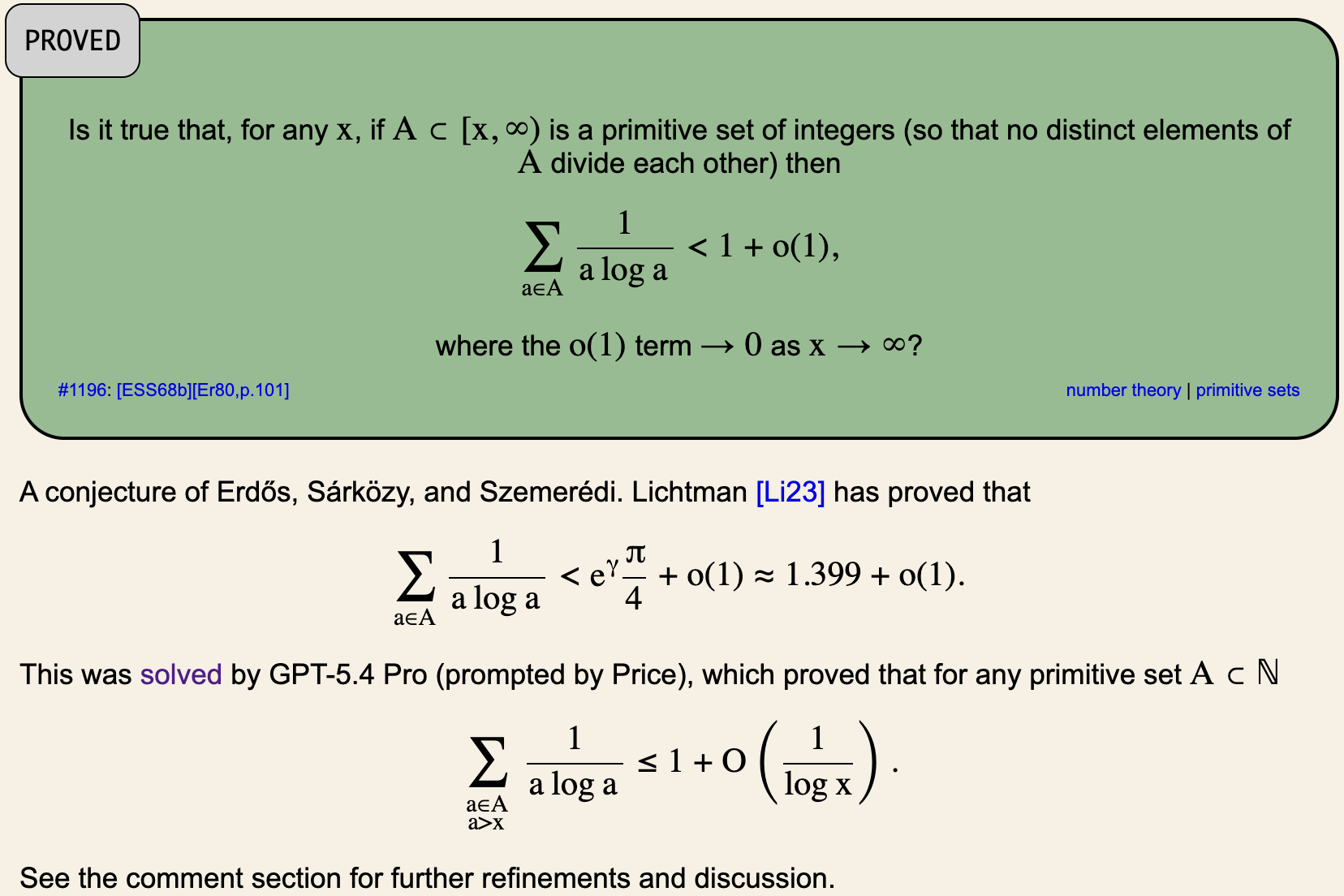
GPT-5.4 Pro one-shot the solution to Erdős Problem #1196 in 80 minutes (plus "another 30 ish mins to convert the solution to a latex math paper"). Math Inc later formalised it in Lean:
Jared Lichtman, a world expert on this problem, proclaimed GPT-5.4 Pro's solution to be from The Book, perhaps the first. I certainly haven't seen anything like it, e.g. nothing from Gavin's thread compares. There are big-shot names below, e.g. James Maynard is a recent Fields medalist at the peak of his powers, Jacob Fox is arguably a Fields-level combinatorialist, etc:
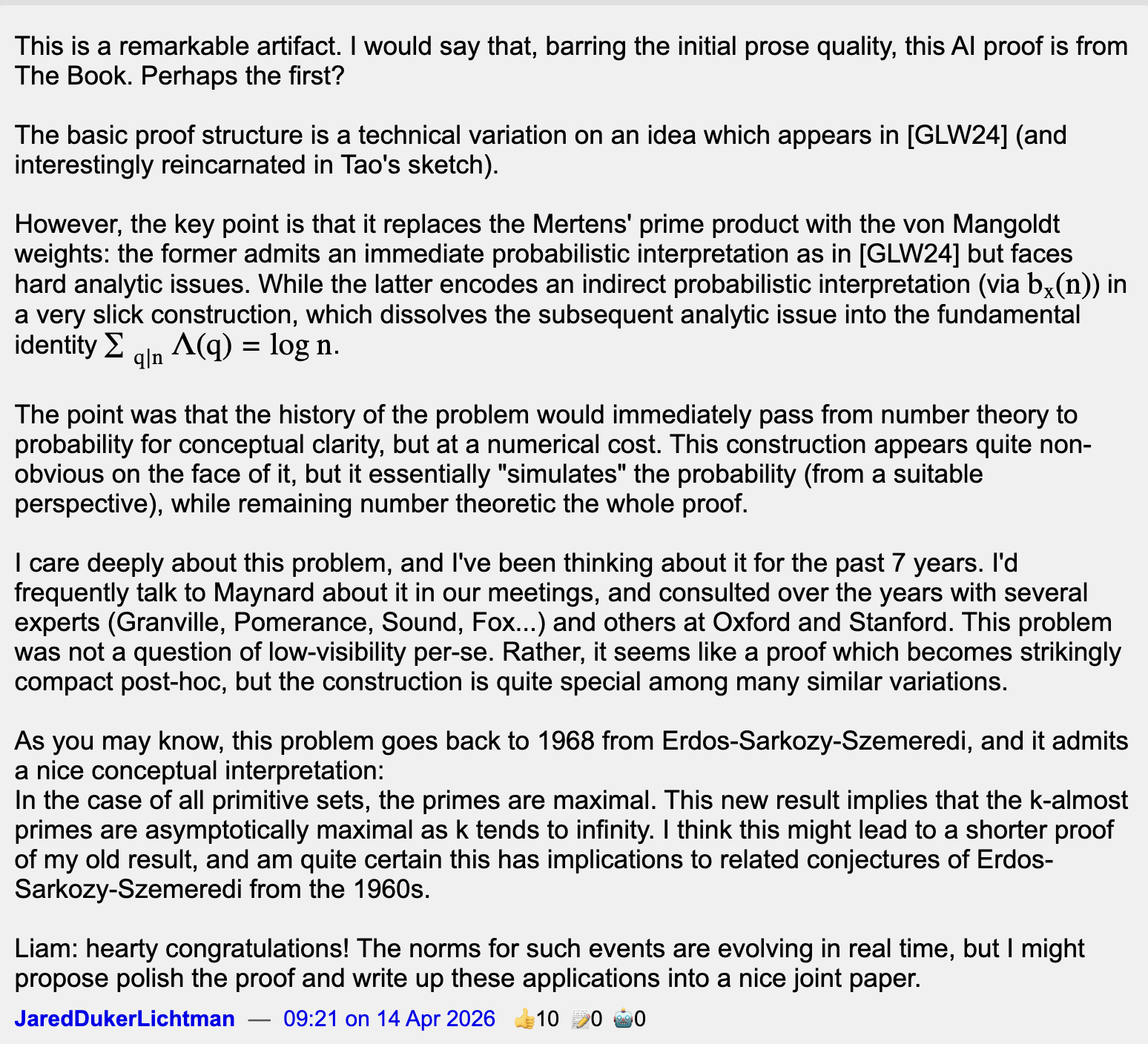
Jared later wrote:
In my doctorate, I proved the Erdős Primitive Set Conjecture, showing that the primes themselves are maximal among all primitive sets.
This problem will always be in my heart: I worked on it for 4 years (even when my mentors recommended against it!) and loved every minute of it.
[Primitive sets are a vast generalization of the prime numbers: A set S is called primitive if no number in S divides another.]
Now Erdős#1196 is an asymptotic version of Erdős' conjecture, for primitive sets of "large" numbers.
It was posed in 1966 by the Hungarian legends Paul Erdős, András Sárközy, and Endre Szemerédi.
I'd been working on it for many years, and consulted/badgered many experts about it, including my mentors Carl Pomerance and James Maynard.
The proof produced by GPT5.4 Pro was quite surprising, since it rejected the "gambit" that was implicit in all works on the subject since Erdős' original 1935 paper. The idea to pass from analysis to probability was so natural & tempting from a human-conceptual point of view, that it obscured a technical possibility to retain (efficient, yet counter-intuitve) analytic terminology throughout, by use of the von Mangoldt function \Lambda(n).
The closest analogy I would give would be that the main openings in chess were well-studied, but AI discovers a new opening line that had been overlooked based on human aesthetics and convention.
In fact, the von Mangoldt function itself is celebrated for it's connection to primes and the Riemann zeta function--but its piecewise definition appears to be odd and unmotivated to students seeing it for the first time. By the same token, in Erdős#1196, the von Mangoldt weights seem odd and unmotivated but turn out to cleverly encode a fundamental identity \sum_{q|n}\Lambda(q) = \log n, which is equivalent to unique factorization of n into primes. This is the exact trick that breaks the analytic issues arising in the "usual opening".
Moreover, Terry Tao has long suspected that the applications of probability to number theory are unnecessarily complicated and this "trick" might actually clarify the general theory, which would have a broader impact than solving a single conjecture.
Although he still wouldn't call it "original", rather "clever"
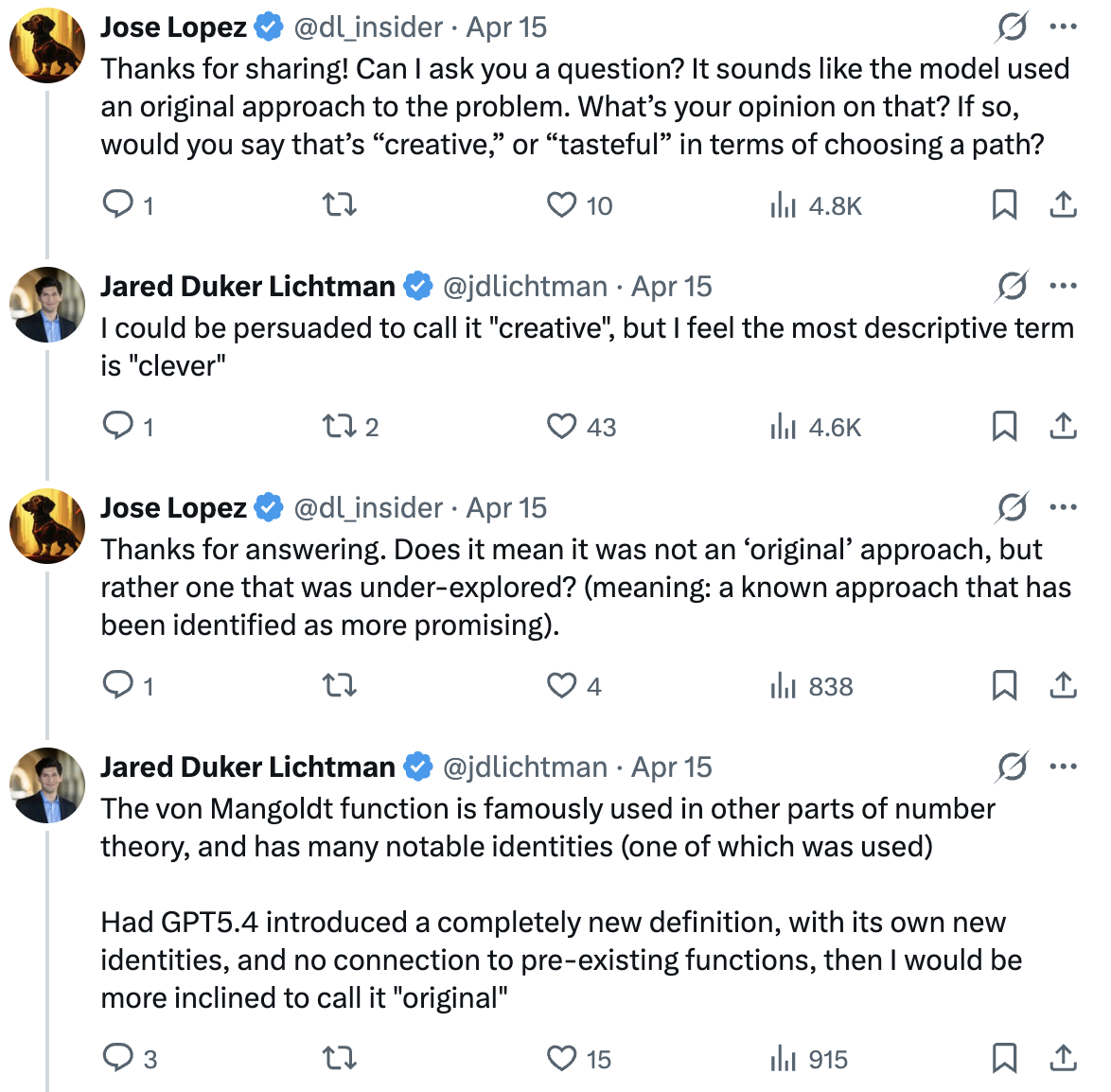
Sure, whatever. (ETA: not sure why I wrote this. Garrett's response is obviously correct)
Terry Tao seemed pretty excited about this, judging by his ~14 comments in the thread. Here he said:
In any case, I would indeed say that this is a situation in which the AI-generated paper inadvertently highlighted a tighter connection between two areas of mathematics (in this case, the anatomy of integers and the theory of Markov processes) than had previously been made explicit in the literature (though there were hints and precursors scattered therein which one can see in retrospect). That would be a meaningful contribution to the anatomy of integers that goes well beyond the solution of this particular Erdos problem.
r/math has for the longest time been almost constitutionally allergic to frontier AI x math progress updates. So the chatter on it there felt like quite the vibe shift in one of the last bastions of capabilities skepticism. Joshua Zelinsky, who I used to follow on math Quora back in the day, summarised it like so:
Four things to note: #1196 is a decently well known problem. It wasn't like Erdős-Straus level fame, but it is well known enough that I was familiar with it. Second, this is not a problem where no one had worked on it; there was a lot of prior work on it and closely related problems. Third, this is not example where the AI made small modifications to things in the literature or recognized that large parts of the problem were in an obscure paper. The approach the AI used is largely a different direction than the literature on this problem went. Fourth, and closely related to three, this proof does look like parts of it will inspire subsequent proofs because it really is going in a different direction which now looks likely to be a productive line of investigation for similar problems.
I am not fond of putting words like "stunning" in titles which can be very clickbaity and feels like a hype word, but this really is in the direction where the word isn't unreasonable even if I myself would not go so far as to use it here.