This is a special post for quick takes by Mo Putera. Only they can create top-level comments. Comments here also appear on the Quick Takes page and All Posts page.
Comment Permalink
Affordable, Rapid Bootstrapping of the Space Industry and Solar System Civilization is a 2016 NASA paper about what it'd take to bootstrap a self-sustaining industry on the moon.
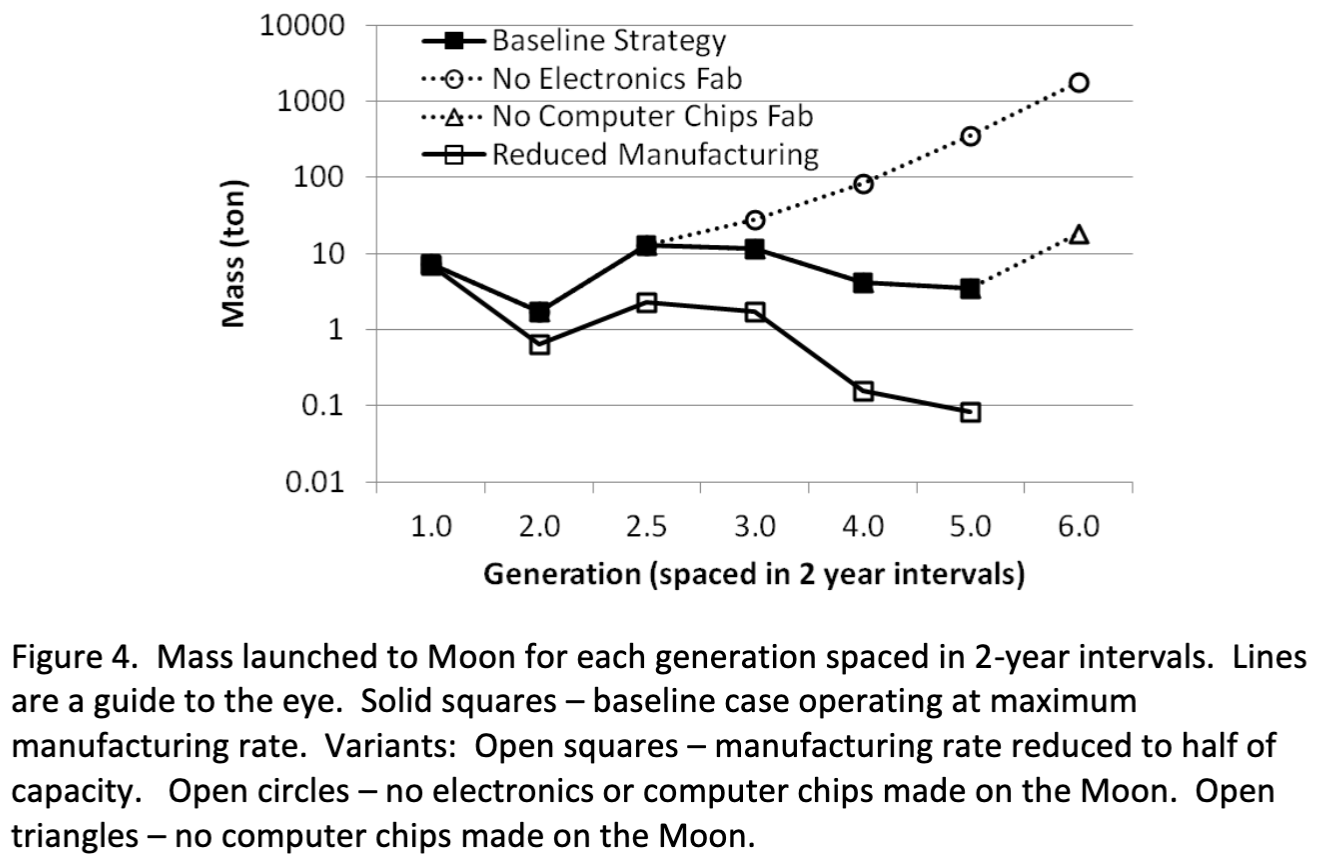
“Bootstrapping,” Philip Metzger and coauthors wrote, “can be achieved with as little as 12 metric tons (MT) landed on the Moon during a period of about 20 years... The mass of industrial assets at the end of bootstrapping will be 156 MT with 60 humanoid robots, or as high as 40,000 MT with as many as 100,000 humanoid robots if faster manufacturing is supported by launching a total of 41 MT to the Moon. Within another few decades with no further investment, it can have millions of times the industrial capacity of the United States.”
To be clear multiple launches are needed:
Metzger et al avoid the term “self-replicators”:
For the concept of lunar industry presented here we do not think the term “self-replicator” is appropriate and so we will avoid the term. A self-replicator is by definition self-contained with all of its parts co-located in a complete set. That entire set fabricates a new complete set that is situated in a new location before the next replication cycle begins. This is unlike industry or biology on Earth: neither businesses nor industries are self-replicators. Although biological species are self-replicators, they require a vast number of other species in a highly networked ecology to survive, and the ecology does not operate on a synchronized replication cycle.
We think the networked complexity of these examples is the more successful topology for space industry because it is the one that naturally occurs and hence is probably the more efficient and adapted for survival, as well as the more easily bootstrapped through an evolutionary process. We therefore avoid any requirement that the various hardware assets remain together in a closed set, and we allow instead for transportation to develop naturally between multiple, specialized production sites. Thus, lithography machines to make computer chips can be located in just one laboratory on the Moon, and their products can be transported to other sites for incorporation into robots and machines. The original facility to house that equipment can be built larger than necessary to allow for expansion and to gain economies of scale.
This aspect of networked complexity is not visible in the modeling presented here, but it will be evident when modeling future expansion of industry beyond the Moon considering that space resources are distributed in “zones” due to solar system formation processes (Hartmann 1985).
Jack Clark's summary & commentary:
Moon manufacturing – cheaper than you think: The big idea in the paper is how little mass is required to kickstart a manufacturing ecosystem. The key is to start with a relatively basic set of things and then build up from there, eventually fabricating chips on the moon.
“In the baseline case with maximum manufacturing rate, a total of 41 MT is launched to the Moon. In the reduced rate case, only 12 MT is launched to the Moon but the scale of industry is two orders of magnitude smaller so the benefits of the industry are relatively delayed by eight years”.
Starship has a capacity to lift 100 MT to low-earth orbit, and given multiple refuelings in orbit it’s feasible you could then land it on the moon – when you napkin out the cost of multiple Starship launches and refuelings you can get 12-41MT to the Moon for between $1.5bn and $4.2bn at list prices.What you build on the moon and in what order: The basic idea here is to start by building simple things and then move up from there by launching a “sub-replicating system and evolve it toward the self-replication capability,” they write. “The objective is for the first robotic “colonists” on the Moon to fabricate a set of, say, 1700’s era machines and then to advance them steadily through the equivalent of the 1800’s, 1900’s, and finally back into the 2000’s. We argue that this can be accomplished in just a few decades”.
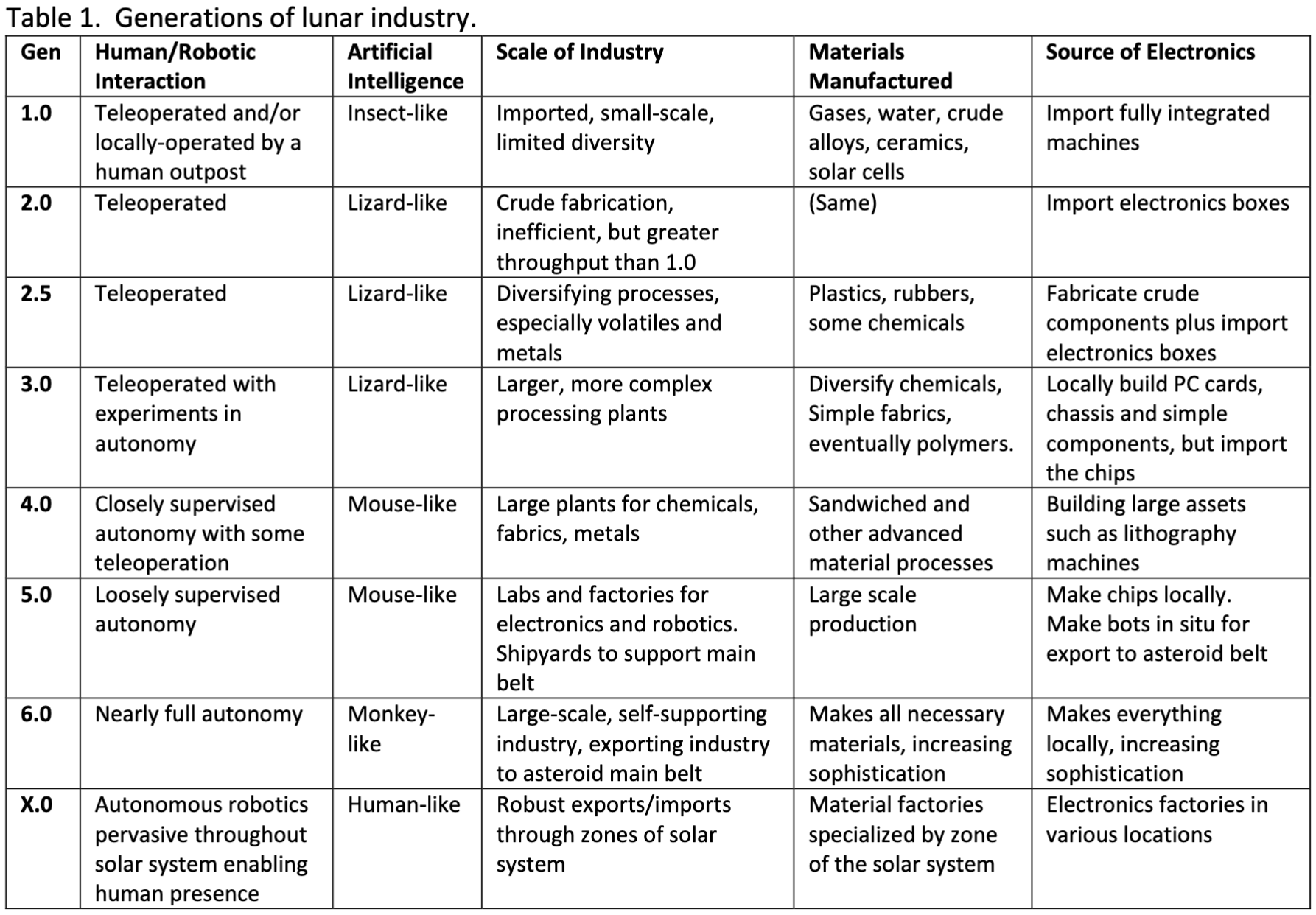
The authors see this unfolding over 6 distinct manufacturing generations:
- Gen 1: Making gases, water, crude alloys, ceramics, solar cells.
- Gen 2.5: Plastics, rubbers, some chemicals.
- Gen 3: Diversify chemicals, simple fabrics, eventually polymers.
- Gen 4: Sandwiched and other advanced material processes.
- Gen 5: Large-scale production.
- Gen 6: Makes all necessary materials, increasing sophistication, including making all electronics locally.
What machines do you send to the moon?
- Excavators: “travel between the digging site and the resource processing site, delivering sufficient lunar regolith each hour to maintain production rates of the other assets.”
- Chemical plants for volatiles: One type will be oriented around producing gases and liquids like oxygen, hydrogen, water, hydrocarbons like methane, and solvents for industrial processes.
- Chemical plants for solids: Produce plastics and rubbers from lunar pole ice. “We now know that the ice contains large quantities of carbon molecules (CO, CO2,…) as well as nitrogen-bearing and hydrogen-bearing molecules… these materials may be needed for gaskets, seals, and insulators, for example.”
- Metal and Ceramics refining: Early generations will “produce crude ‘mongrel alloys’ by electrowinning or other methods” and hardware built out of this stuff will need to be huge to add strength to make up for poor mechanical properties. “Subsequent generations of metal refineries will add processes and material streams to improve the mechanics of the materials. Oxygen and other gases produced by metal refining will be sent to the chemistry plants”.
- Manufacturing: “Additive manufacturing will have two forms: 3D printers that make parts that are small enough to fit inside the printer, and larger units that move about robotically and add material onto large structures external to themselves”.
- Power station: The initial mass of hardware shipped to the moon will include a power station, potentially including a small nuclear reactor.
- Robonauts: Robots “will perform the assembly and maintenance tasks”. The number of robots will need to grow very rapidly to scale the industry. “Beginning with the third generation their structural components are made on the Moon, while Earth continues to send their cameras, computers, motors, and sensors. Eventually they are made completely on the Moon.” The report – which was written in 2016 – envisages teleoperation for these robonauts, though it seems likely to me that more can be done by them autonomously than first anticipated when this was written,
- Electronics manufacturing: Initially, machines will be built with electronics imported from Earth and it’ll only be possible to build very basic things, like resistors and capacitors, on the moon. As development continues it’ll get easier, eventually including having lithography machines on the moon. “The early computer chips will lack the transistor density of chips made on Earth, but they will be adequate for “appropriate technology” in space.”
A reminder of how fast AI has moved: The report also contains some discussions around the types of AI that may be needed to operate the robots on the moon. The report – remember it was published in 2016 – includes some fun underestimates of the rate of AI progress: “On-going advances in robotic software and artificial intelligence present a very optimistic picture that these levels of robotics will be achieved as Moravec predicted, with lizard-level occurring by 2020, mouse-level by 2030, monkey-level by 2040, and human-level by 2050… Only mouse-level is needed by the end of bootstrapping on the Moon,” the report writes. By most measures, AI is around monkey-level and approaching human-level now in the 2020s.
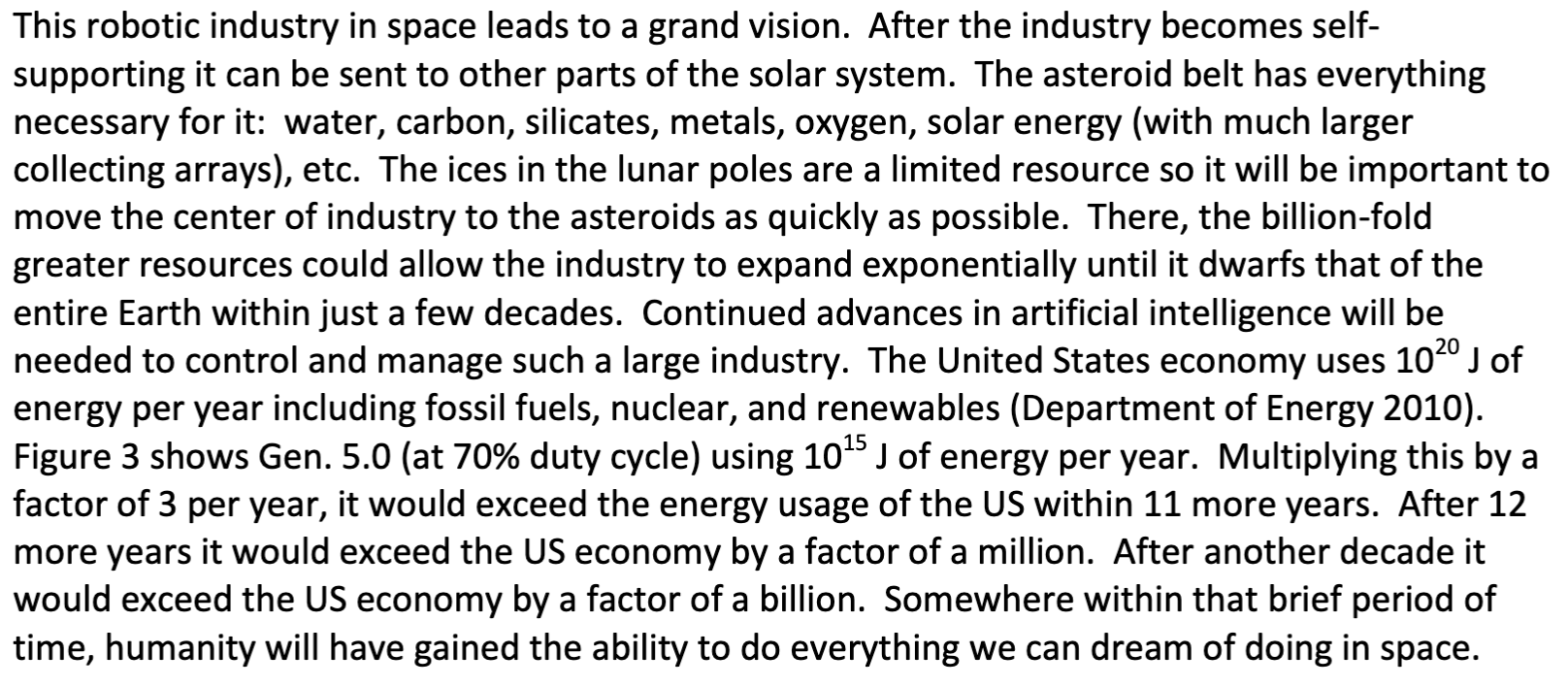
Why this matters – towards the industrialization of the solar system: The sooner we build industry on the moon, the sooner we’ll be able to branch out to industrialize chunks of the solar system. “After the industry becomes self-supporting it can be sent to other parts of the solar system. The asteroid belt has everything necessary for it: water, carbon, silicates, metals, oxygen, solar energy (with much larger collecting arrays), etc. The ices in the lunar poles are a limited resource so it will be important to move the center of industry to the asteroids as quickly as possible. There, the billion-fold greater resources could allow the industry to expand exponentially until it dwarfs that of the entire Earth within just a few decades,” the authors write. “When we spread robotic industry throughout the solar system, it will become the analog of Earth’s biosphere and food chain. We might call it a robotosphere. The interrelationship of robots in space may be studied by robo-ecologists learning how to optimize the robotosphere in support of humanity’s goals.”
Bit more detail on the manufacturing generations:
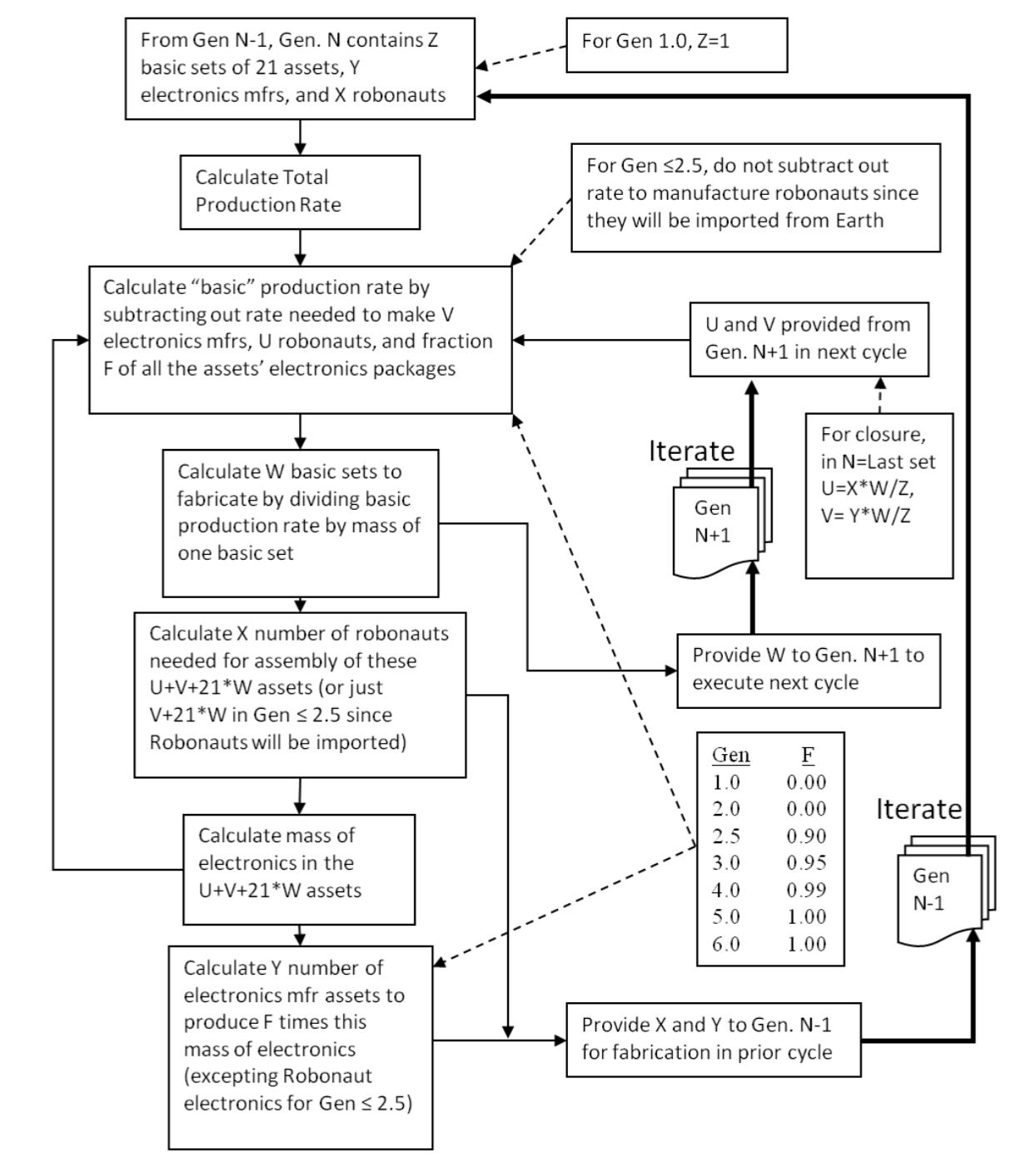
Flow diagram for how a generation manufactures the next:
Growth trajectory:
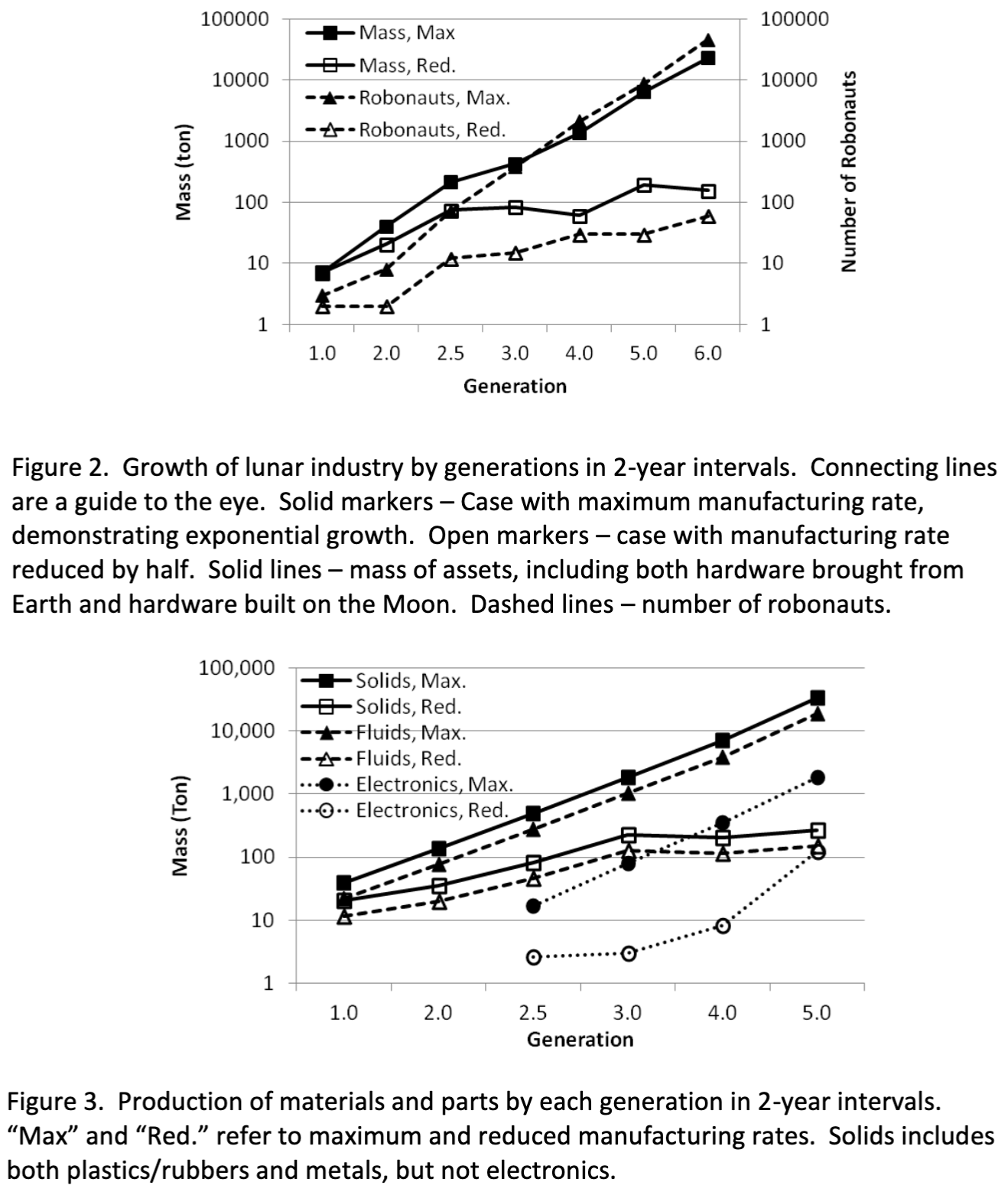
Only 30-odd years to go from 30 MW to a billion-fold the US economy: