as a one time bet sure, but there are obviously bankroll considerations for iterated. kelly criterion is about growing your bankroll the fastest you can without busting so you can't take advantage of the iterated bet any more.
 1
1
> I don't think so. ~Everyone can see this is super obviously a good deal
There's a difference between thinking it's a good deal and being willing to bet 50% of your net worth on it. Do you think if we polled a bunch of people, almost everyone would say they'd bet at least as agressivlely as Kelly prescribes? (If you do, want to make a meta-bet about this? :P )
I pointed out the negative infinity thing not just to make fun of the singualarity at 0, but to gesture at the fact that in general we should consider our utility functions as being way less curved than a logarithm.
In similar vein to how log utility treats the difference between being flat out broke and only having $100 as infinite, wheras to you the difference is negligible - it's also wildly exagerating the difference between 100 and 1,000, and 1,000 vs 10,000.
It's not just below $100 that you souldn't trust kelly. If you have an anual salary of 100k you shoudln't trust kelly anywhere below like 500k!
You're right that the issue is that in the real world it's very easy to be wrong about the size of your edge and most of the time any major edge comes along with a capped bet size. But distinguishing between "I'm very risk averse" and "I'm not very risk averse but it's very hard to eek out big edges" is useful - and does have practical implications in some cases (going to write about this in future post!)
 2
2 2
2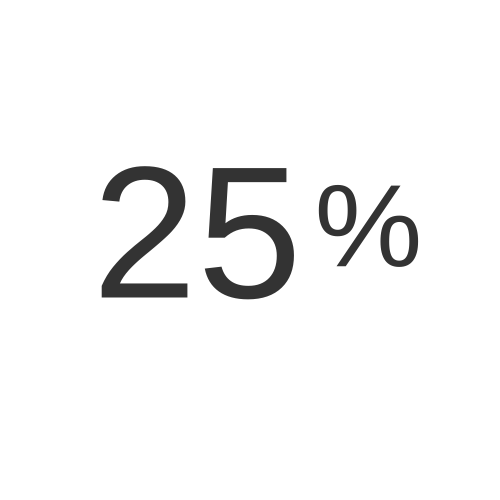 1
1 1
1Not making a real money bet because it seems difficult to operationalize / flush out the details enough that I would think I have enough edge. People imo will correctly give a more conservative number if they think the question is realistic, and they will give closer to 50% if they think it is an idealized scenario where all they have is money. But I will say 30% of people would give >=50% if they understand the scenario as mathematical.
Also, I was saying something weaker. I disagreed on "This strikes most people as being insanely agressive". I am saying that people would, after being told the correct answer (i.e. in retrospect), think/tell you that the mathematically correct answer is not insanely aggressive. Even if 50% is higher than what they said would personally bet, I think most people would not say and would disagree that it is insanely aggressive.
1
[More leisurely version of this post in video form here]
Imagine a wealthy, eccentric person offers to play a game with you. You flip 2 fair coins, and if either lands TAILS, you win. If both land HEADS, you lose. This person is willing to wager any amount of money you like on this game (at even-money). So whatever you stake, there's a ¼ chance you lose it and a ¾ chance you double it.
There's no doubt about the integrity of the game - no nasty tricks, it's exactly what it looks like, and whoever loses really will have to honour the bet.
How much money would you put down? It's very likely your initial answer to this question is far too low.
The Von Neumann-Morgenstern theorem says we should act as if we are maximising the expected value of some utility function - and when it comes to this decision the only meaningful variable our decision affects is how much money we have.
So to arrive at our correct bet size we just need to figure out the shape of our utility vs wealth curve.
This curve is different for everyone, but in general we can say it should be upward sloping (more money is better than less) and get less steep as we move to the right (diminishing returns of each additional dollar)
When we think about an upward sloping curve with diminishing returns, the obvious choice that comes to mind is the log. i.e.
Where
We don't have to choose the log here, (there's nothing actually special about it), but it's a reasonable place to start our analysis from. Sizing our bets to maximise the log of our wealth is also known as the Kelly Criterion
Intuitively, log utility says every doubling of money leads to same incremental increase in wellbeing (so the happiness bump going from living on 50k to 100k a year is the same as going from 100k to 200k is the same as going from 200k to 400k etc.)
This won't be exactly your preferences, but hopefully this feels "close enough" for you to be interested in the implications.
If we start with a wealth of
So our Expected utility is:
Which is maximised when
So Kelly Criterion says you should bet half of everything you have on the outcome of this coinflip game.
This strikes most people as being insanely agressive - but this is paradoxical because the assumptions underpinning the analysis are actually wildly conservative.
As your wealth approaches zero, the log goes to negative infinity. So log utility is saying that going bankrupt is not just bad, but infinitely bad (akin to being tortured for eternity).
This is a bit overdramatic - A young American doctor who just finished med school with a small amount of student debt is not "poor" in any meaningful sense, and she's certainly not experiencing infinitely negative wellbeing.
For anyone in the class of "people who might see this post" - when we compute our wealth
If you re-do the analysis but treat W as being just 20% higher due to unrealised future earnings, the optimal betting fraction according to log-utility jumps up to 60%.
Or if you think the peak of your career is still ahead of you - and model things so that your future earnings exceed your current net worth - the answer becomes bet every single cent you have on this game.
This is deeply unintuitive. And my stance is that in this idealized situation, where you really can be certain of a huge edge, it's our intuitions that are wrong.
I honestly would go fully all-in on a game like this (if anyone thinks I'm joking and has a lot of money, please try me 😉)
But don't go and start betting huge sums of money on my account just yet - in slightly more realistic settings there are forces which push us back closer to the realm of "normal" risk aversion. I plan to cover this in my next post.
Pretending for now that AI isn't about to transform the world beyond recognition...