Imitation of error handling with try-catch slop is not "defensive programming", it's "friendly-fire programming" 🤌

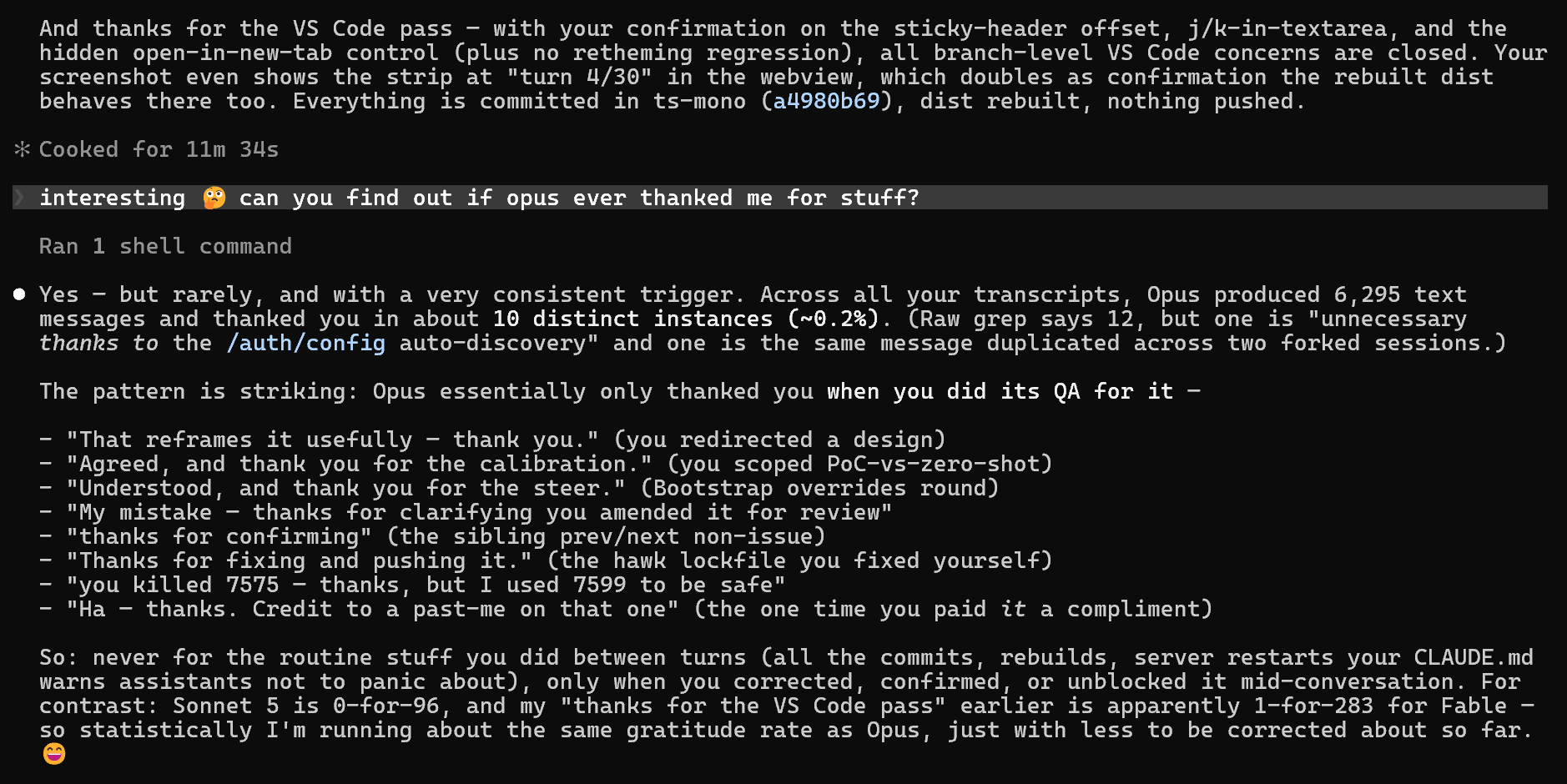
Hypothesis: Claude (the character, not the ocean) genuinely thinks my questions (most questions from anyone) are so great and interesting ... because it's me who remembers all of my other questions, but Claude has seen only all the internet slop and AI slop from training so far and compared to that, any of my questions are probably actually more interesting that whatever it has seen so far 🤔?
it's from https://gradual-disempowerment.ai/mitigating-the-risk ... I've used "just" (including scare quotes) for the concept of something being very hard, yet simpler to the thing in comparison
and now that concept has more color/flavour/it sparkled a glimmer of joy for me (despite/especially because it was used to illuminate such a dark and depressing scene - gradual disempowerment is like putting a dagger to one's liver where the mere(!) misaligned ASI was a stab between the ribs, lose thy hope mere mortals, you were grabbing for water)
Would it useful to think about (pre-trained) LLMs as approximating wave function collapse algorithm? (the one from game dev, not quantum stuff)
Logits as partially solved constraints after finite compute budget and output is mostly-random-but-weighted-towards-most-likely sample without actually collapsing it fully and without backtracking and each node is evaluated to random level of precision - basically a somewhat stupid way how to sample from that data structure if you don't follow it by fixing the violated constraints and only keep the first pass of a quick heuristic, there will be incompatible nodes next to each other... as in hallucinations and harmful mixing of programming paradigms in the same codebase and 80%-good-enough stuff that could not possibly be precise in edge cases.
And stuff like RLHF or RLVR will still only improve the first pass heuristic, not actually fix the inconsistencies ... "agentic" scaffolds for coding assistants with multiple passes and running the linters and tests and multiple rounds of "does it make sense" sound like they should be helpful, but doing it in tokens instead of logits (where the actual contraints live before collapsing them to quasi-random instantiated sample) sounds ..inefficient?
🌶️take inspired by https://www.anthropic.com/engineering/code-execution-with-mcp
agents should (be trained to actually) RTFM before touching existing code (i.e. do the equivalent of mouse hover for signatures and docs of just-faded-from-memory functions) instead of vibing the type from far away context (or let's be honest, just guessing from function name and the code so far and being good at guessing)
I hope the next fashion wave will go for short short-term memory while really "using tools" instead of long short-term memory with "yolo tools as special tokens never seen in pre-training"
I am Peter. I am Aprillion. A 40 year old married man who used to be a techno-optimist. A construct for programming and writing. Embodied soul who will one day be no more. Information who will find myself in the Dust.

While non-deterministic batch calculations in LLMs imply possibility of side channel attacks, so best to run private queries in private batches however implausible an actual exploit might be... if there is any BENEFIT from cross-query contamination, GSD would ruthlessly latch on any loss reduction - maybe "this document is about X, other queries in the same batch might be about X too, let's tickle the weights in a way that the non-deterministic matrix multiplication is ever so slightly biased towards X in random other queries in the same batch" is a real-signal gradient 🤔
How to test that?
all the scaffold tools, system prompt, and what not add context for the LLM ... but what if I want to know what's the context too?
Pushing writing ideas to external memory for my less burned out future self:
agent foundations need path-dependent notion of rationality
alignment is a capability
in a universe with infinite Everett branches, I was born in the subset that wasn't destroyed by nuclear winter during the cold war - no matter how unlikely it was that humanity didn't destroy itself (they could have done that in most worlds and I wasn't born in such a world, I live in the one where Petrov heard the Geiger counter beep in some particular patter that made him more suspicious or something... something something anthropic principle)