This is a special post for quick takes by philh. Only they can create top-level comments. Comments here also appear on the Quick Takes page and All Posts page.
Comment Permalink
Following this video, @Linda Linsefors and I tried to make a phase change material with a freezing point around 18°C.
Report:
For our first batch (which is all we've made so far), we started with 2 l water / 400 ml sodium sulphate / 100 ml table salt. There was a lot of salt left over after several minutes of stirring boiling/near-boiling water, so we added another 500 ml water. There was still a lot of salt but we stopped there.
We added 30 ml xanthan gum. (By the recipe it should have been more like 40 because of the extra water. The goop we ended up with is pretty good goop consistency, but I do think I'd prefer slightly thicker.) The first teaspoon clumped up a lot in the water, so later ones we ran through a sieve which helped a lot.
We boiled and stirred that for about 30 minutes and left it to cool.
Note that sodium sulphate comes in "anhydrous" and "decahydrate" forms. The latter already has 10 water molecules attached, so less of it dissolves and you get less actual salt. We used anhydrous. I kind of assume the guy in the video used that too (it would be weird if he got better dissolving than us with decahydrate) but idk if it's clarified anywhere. It's presumably possible to use decahydrate if you adjust quantities appropriately.
We got something that kinda worked, but I was suspicious that it wasn't behaving like it should, so I got a temperature logging probe (note: needs initial setup with software that's available for windows or mac, not linux; I used wireshark to capture the USB traffic so maybe I can make linux software but it's not a priority). Here's the graph when I put some of it (at a guess about 50 ml) in the freezer and then thawed it:
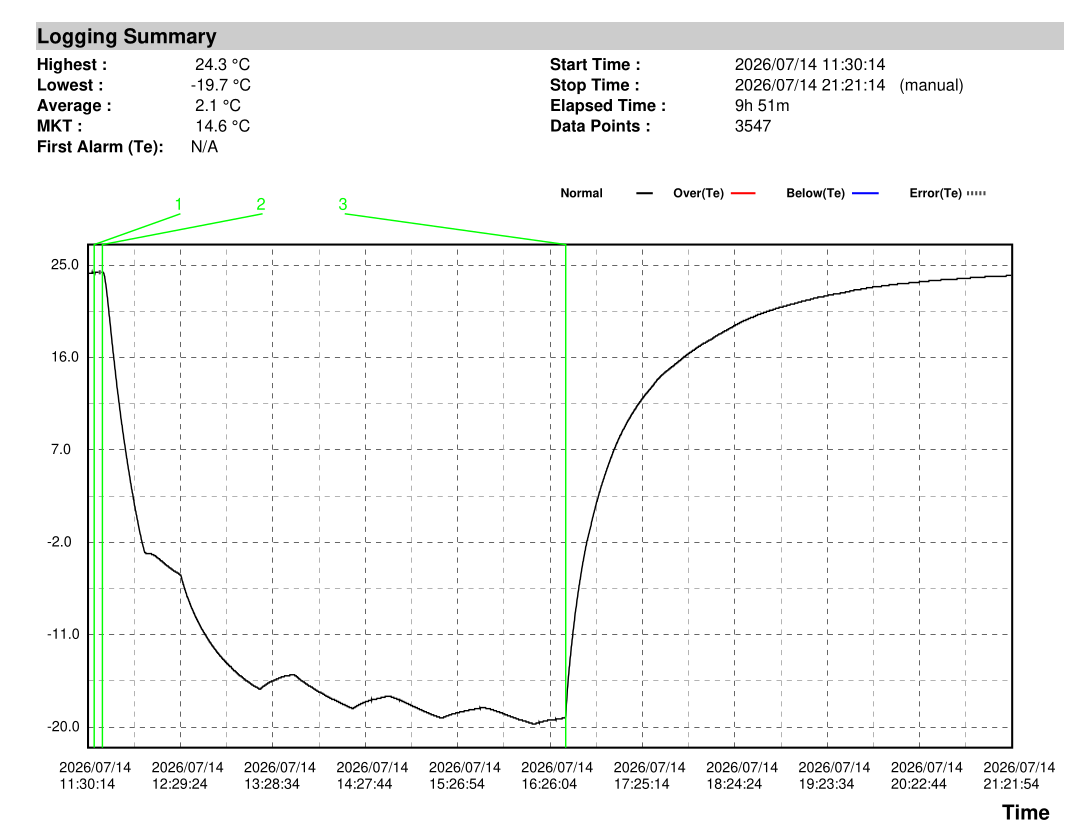
So yeah. The thing around 3-5° going down could be either freezing or "freezer is temporarily off (as I interpret the rises later on) but ambient temperature is low enough to keep cooling". Claude thinks there wasn't nearly enough sodium sulphate, and it's basically just salty water, which freezes at that temperature; and which apparently has a smooth melting curve. Conversation (I mistakenly said 60 ml xanthan gum there). I'm not very convinced by its recommendations.
---
We separately wanted to see what happens when you just mix sodium sulphate and water, because something that freezes at 32° sounded cool. We started with 200 ml water, tried to keep it around 40°, and added sodium sulphate until it stopped dissolving. That ended up being about 80 ml. It should support about 100 g. Google gives density of the powder as 1.4-1.6 g/ml (a crystal is about 2.7 g/ml) so we'd be at about 120 g, there are enough errors in the process that this doesn't seem off to me.
What we ended up with was something that freezes in the fridge, but not at room temperature (which was about 28° when we tried). I'm currently thawing it so I can put the probe in, and then I'll freeze-and-thaw it again and see what happens.
I think it took a few freeze-thaw cycles before it seemed like it would fully freeze? First time it looked more like "clear ice with some water not yet frozen", now it looks like white ice.
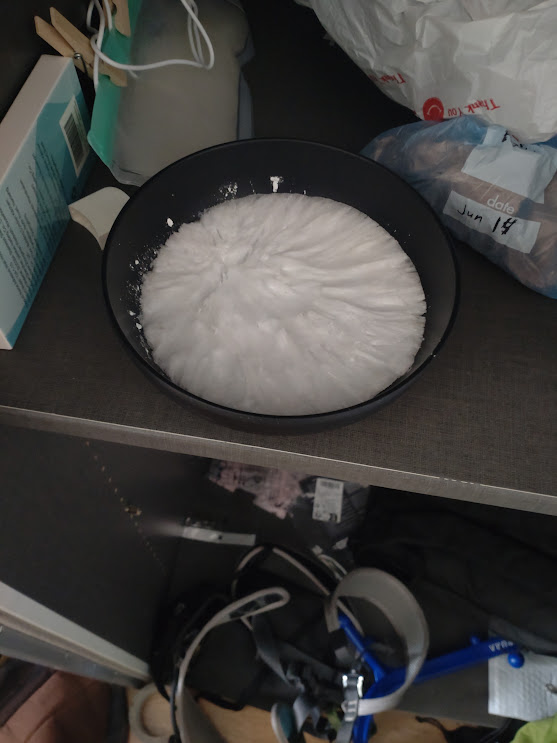
e: okay, it hasn't thawed at all after several hours. I'm pretty sure it just actually freezes above room temperature, and what I saw before was probably just some combination of supercooling and "not fully saturated" and idk what else.
Showing 3 of 4 replies (Click to show all)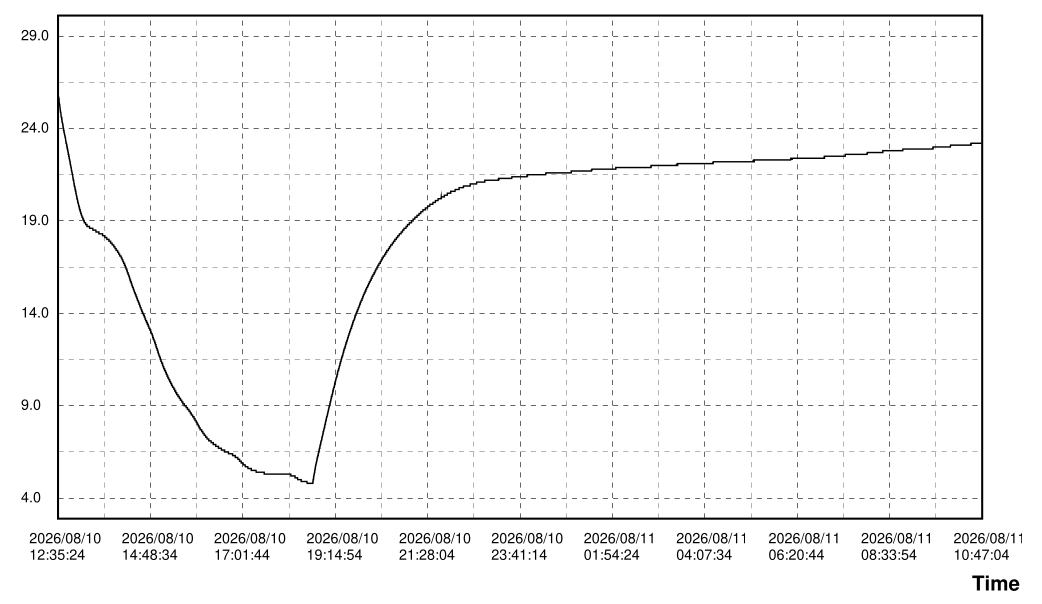
2
Indeed, no luck:
(It probably could have used more time in the freezer, but it's clearly not freezing in the fridge.)
One hypothesis is that my water is too hard (269 ppm calcium carbonate) or otherwise impure. If so, possible avenues for fixing it are buying distilled water, buying regular bottled water, and using a water filter (quick google: apparently that doesn't help with hardness).
Another hypothesis is that something about my salts is fucked. Impure sodium sulphate? The table salt comes with anti-caking agents, are those causing a problem? The table salt has also been just hanging out in my kitchen in this kind of thing, possibly with some dried beans in there to stop it clumping; maybe I should try some fresh salt?
I've done three experiments so far, and very roughly:
* 3:1 Na2SO4:NaCl by volume (most recent): I got 210 ml Na2SO4 in 1 l water (7x15 ml, in 500 ml)
* 4:1 Na2SO4:NaCl by volume (Nighthawk's recipe): I got 160 ml Na2SO4 in 1 l water (400 ml, in 2.5 l)
* No NaCl: I got 400 ml Na2SO4 in 1 l water (80 ml in 200 ml)
So there's not even a clear trend for "more NaCl means less Na2SO4 dissolved". Maybe because I did nighthawk's at close to boiling? And/or because it went via the kettle?
Still, regardless of what my numbers show, more NaCl must mean less Na2SO4 dissolves, right? So maybe the next thing to try is, like, 10:1?
2
10:1: I had 200 ml water. Somewhere between 50-62.5 ml of Na2SO4 dissolved. Guessing at 55, that's 275 ml / l. 3.75 ml xanthan gum made the water cloudy but didn't noticeably thicken it, maybe previously I've had the water hotter when adding the gum?
The result was something that mostly froze in the fridge (some liquid remaining) and didn't melt when I took it out.
20
Hm, so I hadn't actually touched it, and when I did it was kinda squishy, which made me think "maybe it did melt, and the gum just made it keep its shape"? Anyway, I put it back in and out of the fridge with the thermometer, and
So... it looks like it did freeze at 18? But then still doesn't have an obvious point where it's melting, which, ???