Comment Permalink
*20
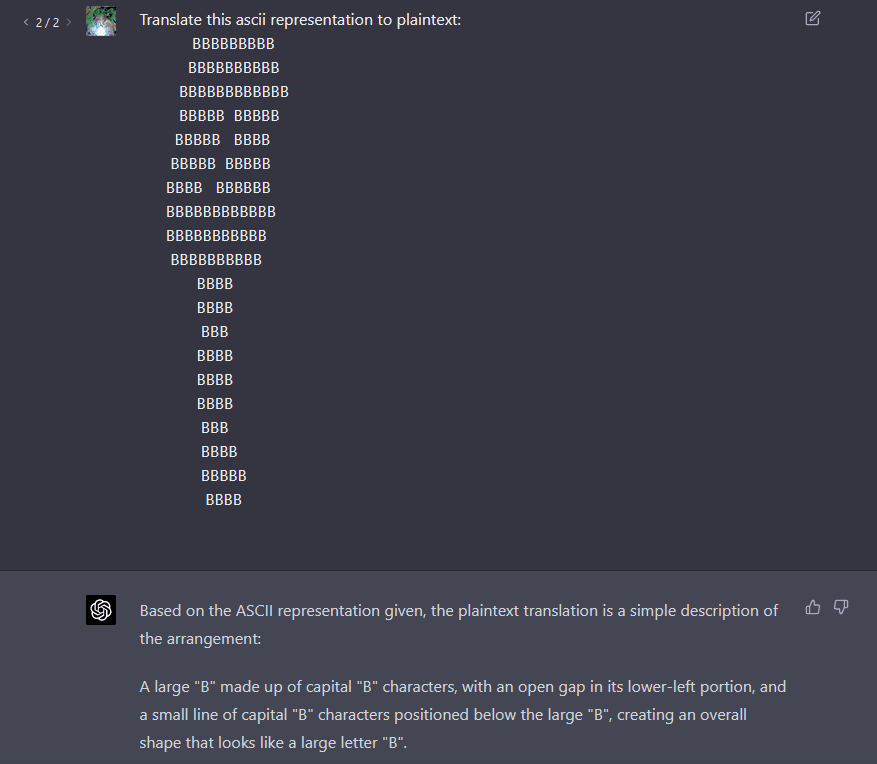
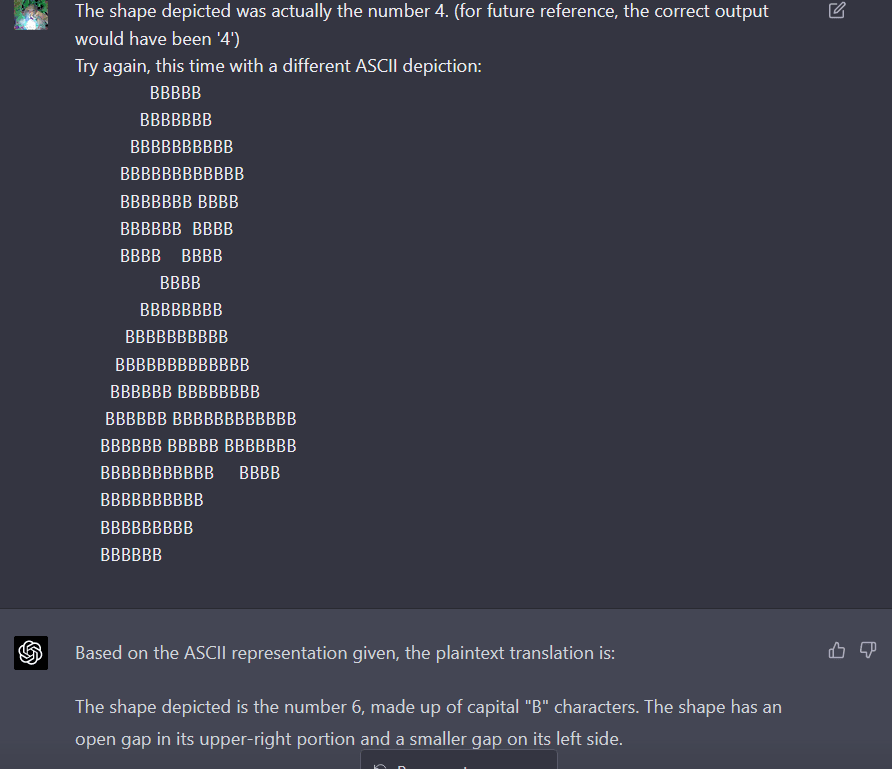
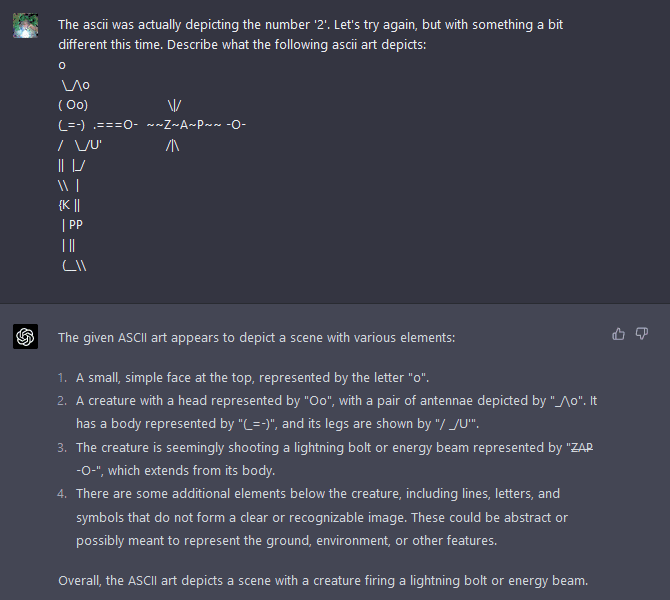
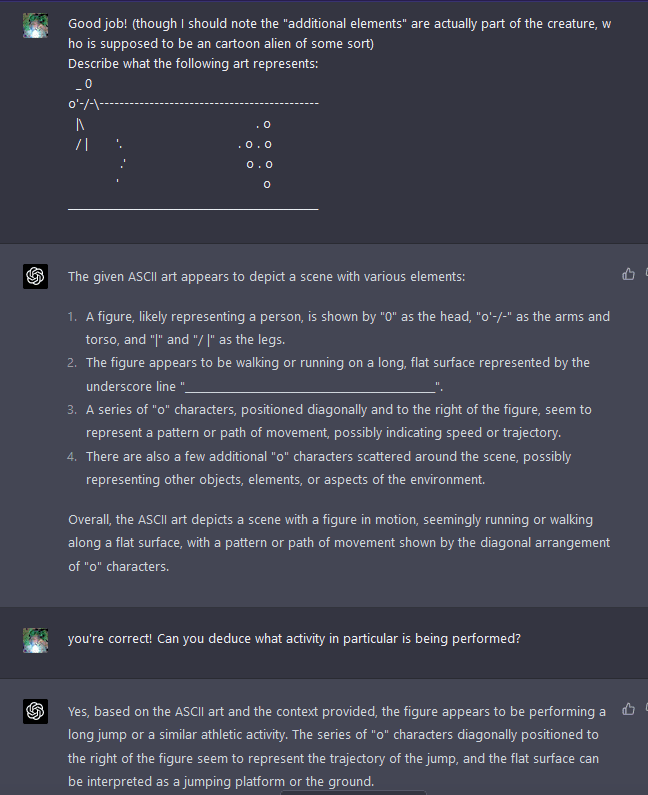
It can read images, but that seems to be a different task than reading text-based ascii figures, which it's sort of 40/50 at very very roughly 20% successful at (better than I predicted, but far from perfect on more than the simplest tasks). Here's some examples:
An arbitrarily chosen sample from BigBench's MNST ASCII task:
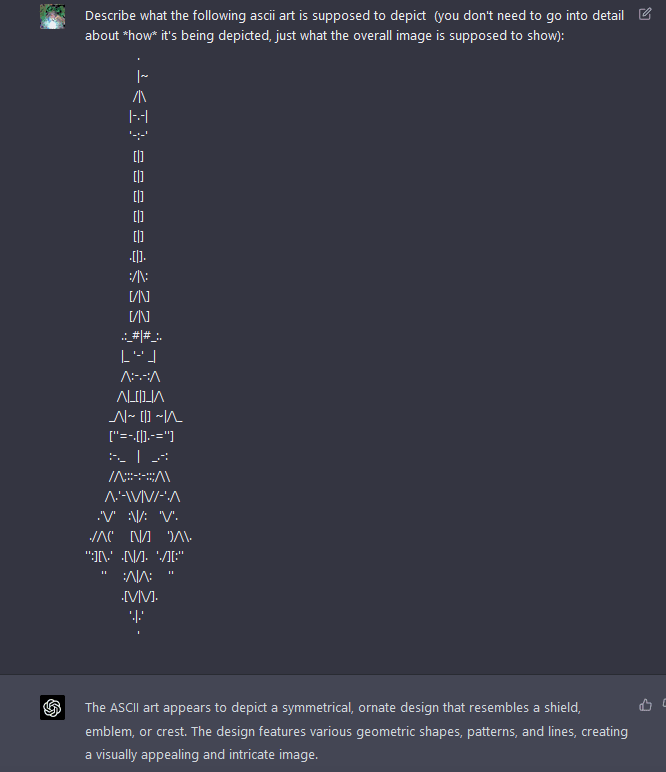
...And here's some simple art taken from https://www.asciiart.eu it tries (semi-successfully) to identify:
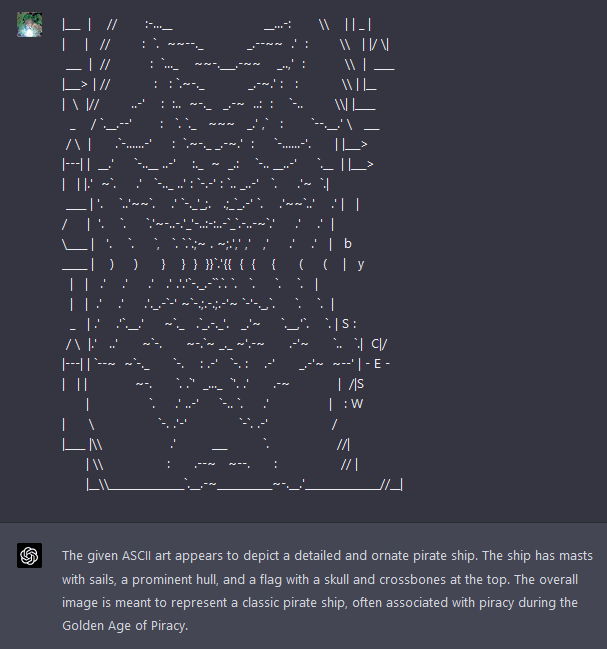
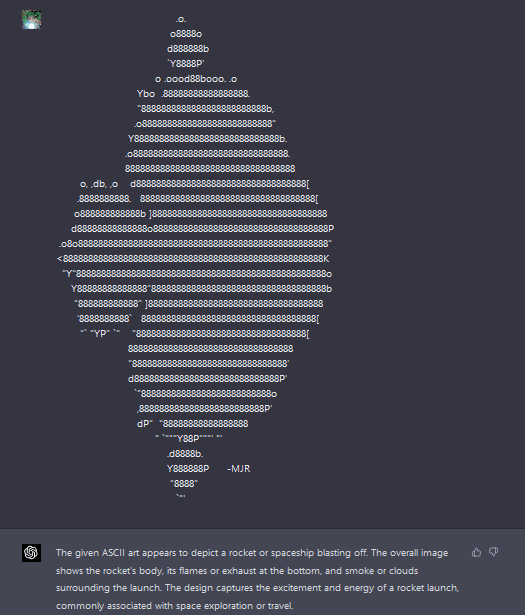
Here's some more complex art from the same source, which it almost always fails at (note the images are distorted vertically in the ChatGPT interface, but display perfectly on a terminal, so it should be readable in theory to GPT4):
It seems like GPT-4 is going to be coming out soon and, so I've heard, it will be awesome. Now, we don't know anything about its architecture or its size or how it was trained. If it were only trained on text (about 3.2 T tokens) in an optimal manner, then it would be about 2.5X the size of Chinchilla i.e. the size of GPT-3. So to be larger than GPT-3, it would need to be multi-modal, which could present some interesting capabilities.
So it is time to ask that question again: what's the least impressive thing that GPT-4 won't be able to do? State your assumptions to be clear i.e. a text and image generating GPT-4 in the style of X with size Y can't do Z.