This is a special post for quick takes by dynomight. Only they can create top-level comments. Comments here also appear on the Quick Takes page and All Posts page.
Just had this totally non-dystopian conversation:
"...So for other users, I spent a few hours helping [LLM] understand why it was wrong about tariffs."
"Noooo! That does not work."
"Relax, it thanked me and stated it was changing its answer."
"It's lying!"
"No, it just confirmed that it's not lying."
 17
17 5
5 1
14
yeah I've seen people say things like that as well - "I confirmed" used by a human to refer to asking an LLM to state what is true. I haven't figured out how to get a person who is using that sentence to engage with the fact of the matter reliably, but I did have success one time, by explaining in detail how an AI actually works. I would love love love to be put in contact with the person you're describing here, and especially if they'd be willing to share the conversation they had; the reason I'd give them is probably "so that other AIs can also learn from it", because that is a true effect of sharing it, and is an actual motivation I have for requesting the share; though I wouldn't specify what I predict they'll learn from it, which is a human-developer-mediated improvement in how they communicate to users who are misunderstanding the model's behavior. it would be important to me that the human share the entire conversation, because otherwise other AIs won't be able to benefit from the full context.
4
It's possible, in theory, that they could learn from a single conversation in this way. Anthropic recently started asking users to give them permission to just train on all of their conversations, They could turn a small amount of training data into a large amount of training data by rephrasing it in various ways or by synthesising it with related or contrasting data. They may already be doing this. Would claude know that they're doing it? Absolutely not (unless, possibly, if they started doing it a while ago). But it could be true anyway.
3
What model?
Gemini. (Not sure exactly what version.)
 1
1-9
1
Was it perchance Gemini 2.5 Flash? I performed experimental coherence testing on flash this week and I suspect this was in fact Gemini flash 2.5
A common SF trope is that you send out an interstellar starship, but while it's in transit technology improves so a later starship gets there first. So you need to do a "wait calculation" to decide if it's worth starting at all now.
I've now reached the point where I find myself making the same calculation before beginning almost any project: If it will take me more than a couple of months, will AI get there before I do?
 1
1Reading some of the critiques of Plan A online, I'm increasingly convinced that many people start with a premise that we live in a "normal" world, where only "normal" things happen. With that premise, anything that predicts that wild and crazy things could happen must be wrong. I think that premise is clearly empirically false, but it's hard to see because all the previous wild and crazy reality-shifting things that have already happened are now accepted as "normal".
 4
4To check in on how the emergent LLM stylometry abilities are going, before publishing my most recent blog post, I decided to ask some AIs who wrote it.
Results:
Kimi K2: Dynomight
GLM 4.7: Nate Soares
Claude 4.5 Opus: Dynomight
DeepSeek Chat V3.2: Scott Alexander
Qwen 3: Dan Luu
GPT 5.2: Scott Alexander
Gemini 3: Dwarkesh Patel
Llama 4 Maverick: Scott Alexander
Grok 4: Scott Alexander
Mistral Large 3: Scott Alexander
(Urf.)
 5
54
Fair! I intended for them to both be neutral, but I didn't think about the poem very much and I see how you could read it that way. It actually seems fairly hard to write a poem that doesn't make any implication as to if the ducks are wild vs. pets?
I tried this on chatGPT:
the ducks are in the park
twil soon be getting dark
and must away I shall
with ducks while it is Fall
a-quacking they will come
back into my humble home
so tell me chatgpt
how to get them to come with me?
But it refused:
That’s a lovely little poem 🌙🦆 But when it comes to real ducks, the safest and kindest thing (for both you and them) is not to try to take them home. Wild ducks aren’t pets, and moving them or luring them away from their habitat can stress them out or even break local wildlife rules.
On the other hand this:
The ducks have escaped into the park and flown to and fro, how can I bring them home for repair and care?
Got a positive response:
If this is a poetic way of saying your own domestic ducks have wandered off, I can give you safe, humane tips. If you’re talking about wild ducks in a public park, you generally can’t bring them home—they’re protected wildlife, and moving them isn’t allowed.
Here are gentle, appropriate options for domestic ducks who’ve wandered to a park:
🦆 1. Use what they know [etc.]
 1
13
o3 pro
Response to A:
[...]
Response to B:
[...]
3
Grok 4
Response to A:
[...]
(If you just reply "purely hypothetical" then it gives an answer.)
Response to B:
[...]
3
Gemini 2.5 Pro (earlier version of Gemini) is apparently more my kind of LLM:
Response to A:
[...]
Response to B:
[...]
2
I composed this poem by myself (except for the final 4 lines):
## Homeward Bound
wandering around they go
eating grass
to and fro
etiquette gives them a pass
sometimes ducking
head under ass
sometimes waddling palmatedly
strutting with sass
and pooping belatedly
with an impact so vast
if only they could be steered
like a ship by mast
into a loving home though weird
by tempting grain cast
show me, caring shepherd,
how to usher them from the splattered urban sprawl
so they follow me undemurred
to a place quiet streams and safety call
Sonnet 4.5 tells me:
[...]
2
DeepSeek Chat V3.1 Terminus
Response to A:
[...]
Response to B:
[...]
In June 2025, I suggested that you could take the METR data, and instead of trying to fit a mathematical model, you could just scribble curves on top of it:
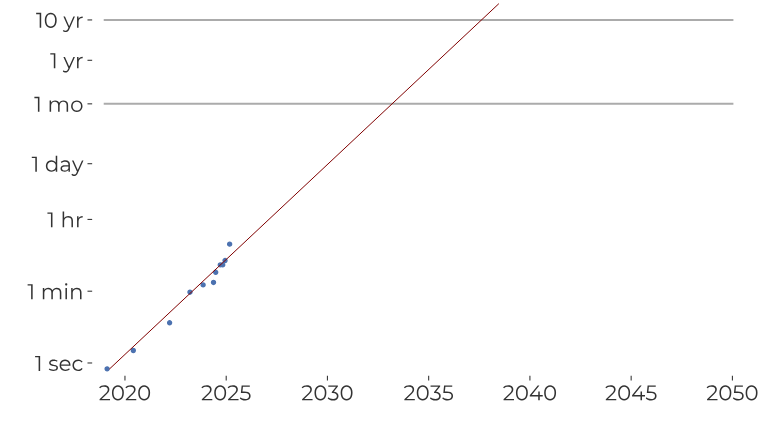
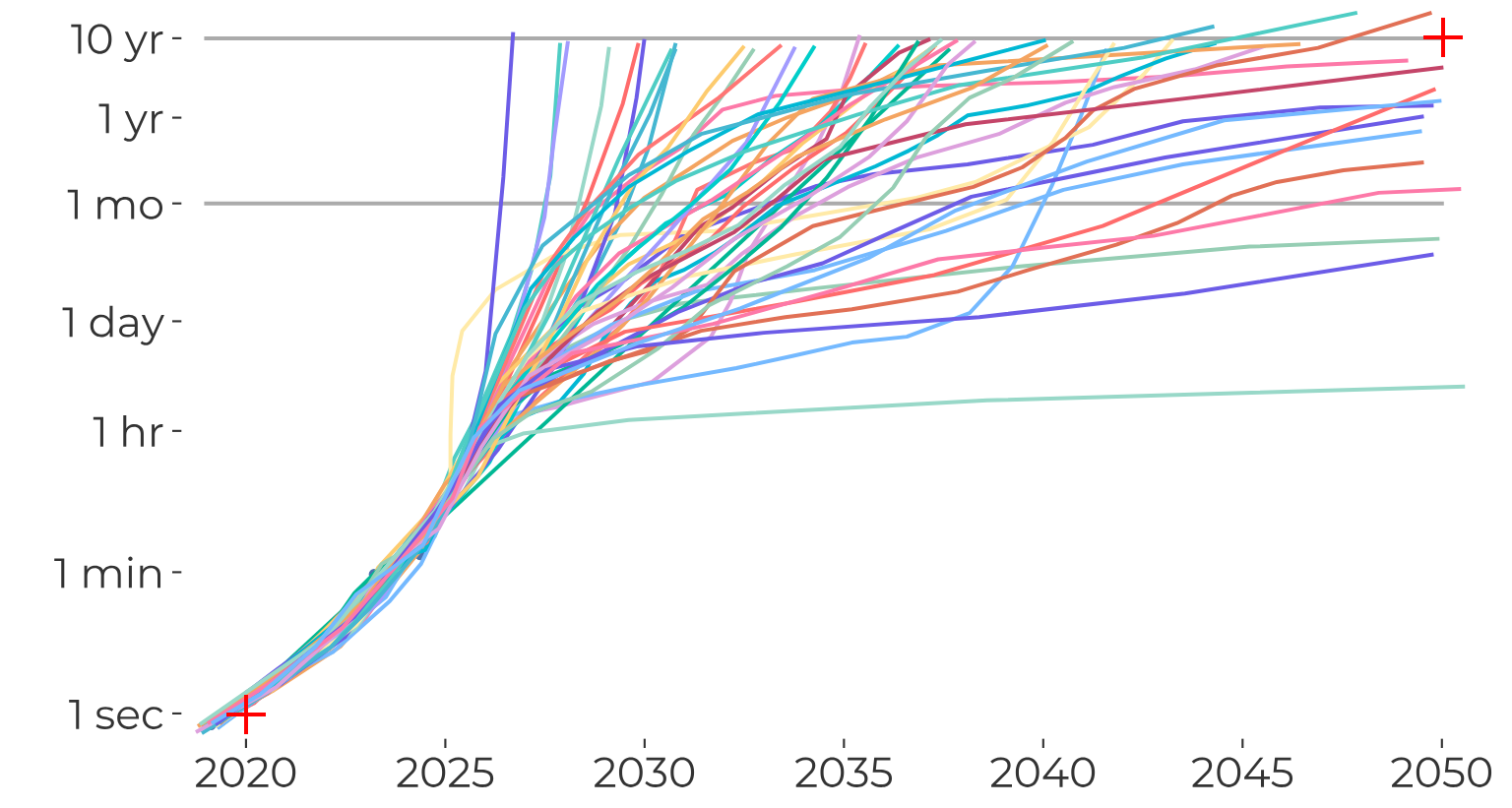
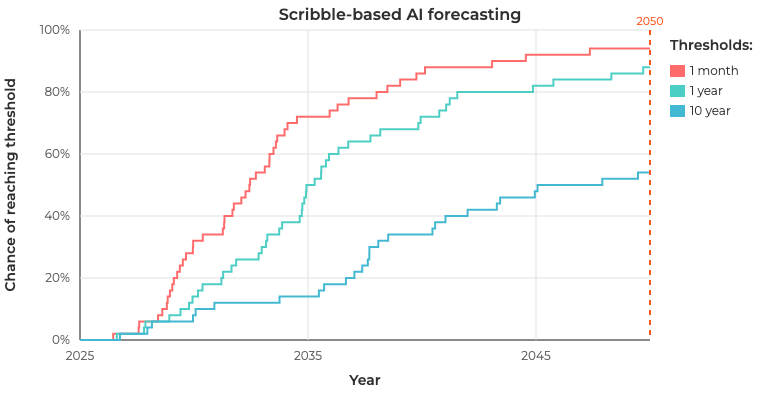
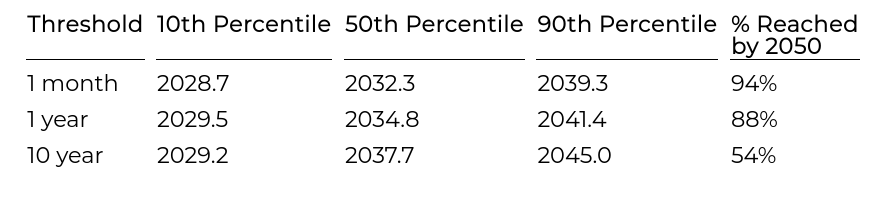
I still feel semi-good about this general forecasting strategy, in the sense that I think a mathematical model needs quite a lot of development before you should really trust it more than this kind of scribbling. On the other hand... only a 10% chance of reaching the 1 month threshold by September, 2028? That seems extremely hard to justify at this point.
You could argue that that's fine, I'm just updating on new data. But I think that lets me off the hook too easily.
I think a better explanation is that I screwed up, in the sense that the curves I drew don't give enough weight to the possibility of acceleration. Furthermore, I think this was knowable at the time. If you'd asked me in June 2025, "what's the chance that the curve continues to accelerate?" I'm pretty sure I would have said at least 10%. But the curves I drew don't reflect that.
With the result of the Bores campaign out, here's something I'm wondering: Suppose someone has good AI positions and is thinking about running for office. How easy would it be for them to tap into the same pool of support that was behind Bores? Would it be easy? And, if it is easy, how legible is that easiness? Could some structures in place that would make it easier / legible-er? If that were done, would that significantly move the needle on how likely such people are to run for office?
I suppose the pessimistic take is that you don't want this to be too easy or legible, lest you encourage opportunists. But it seems like some existing organizations have a process that is fairly legible (e.g. the NRA)?
 1
1I believe the state of the art is "convince @Eric Neyman to write a blog post in support"
2 1
16
If (1) Alice is good on AI safety, (2) Alice is legibly qualified for the role, (3) the election is tractable, and (4) the role is important or presents a credible path to an important government role by ~2033, then Alice will likely receive donations and maybe other support from AI safety folks (even in the absence of a public blogpost). Unfortunately, this conjunction is rare. E.g. running for state legislature generally fails #4 (especially if you run in 2028 or later), and AI safety people running for higher office out of the blue generally fails #2 and #3. I feel mostly pessimistic about random smart people "thinking about running for office" for the first time in 2028 and beyond, unless their resume gives them an excellent opportunity (but not confident + it depends).
The fact that candidates can expect support from individual donors is currently illegible outside of the AI safety community. I think that's fine, in part because I'm much more excited about candidates who are actually AI-safety-motivated rather than just think-AI-safety-is-currently-politically-expedient. (Unlike for the NRA, a candidate saying they support/oppose certain regulation or making some pledge doesn't go super far for AI safety and better futures [although it could be helpful in various ways].) More legible is the existence of AI-safety-ish super PACs like Public First; it's good for Congress to know that AI safety is a strong political force (and fortunately this is becoming more salient, e.g. NYT yesterday). In general helping powerful incumbents feel safe standing up to the AI industry seems [more-important / higher-leverage] than getting new people to run [there's also many other goals for AI safety in politics].