The middle of this post also reminds me of Original Spin, in the sense of there being some sensation and then the sensation gets labelled in a particular way that obscures things. In the case of spin, we talk about there being some attachment disturbance or social disconnect that is hard to bear, which then gets labelled as "something wrong with me" (rather than "something happening that I don't like). Which then makes the problem impossible to solve because you're looking in the wrong place.
It's also relevant to Peter Singer's classic psy-op where he frames your desire to help the drowning child in the pond next to you as an obligation, which then logically "should" propagate to helping any dying child, even if they're on the other side of the planet in a totally different situation.
Unlike "I know I'm not in danger, yet I feel afraid", which sounds totally reasonable.
This is part of why I get a lot out of the word "trust", which cleaves the second half of that very cleanly across more situations than having to tag a particular emotion in contrast with a thought. It's just referring more
Your trust is the map that forms your actual sense of reality. I was going to say "the map that you're steering by" but that's incorrect; lots of people who are scared of planes still fly in them. But your trust is what you can tell for yourself is so. Someone who thinks they shouldn't be afraid of planes but still is, is attempting to take someone's word for it that planes are safe, which doesn't produce trust. Whereas the same words from someone else can under some circumstances cause someone to notice "huh, I know several people who've been in car accidents, but I don't actually know anybody who's been in a plane accident" at which point it starts to affect their bodily sense of things.
But yeah, "I know I'm not in danger" is misleading here because it's ambiguous whether it's supposed to be about your actual embodied trust vs (what it actually is in this case) your internalized conceptual model made up of stuff other people said, that you think you should believe but on some level don't know how to integrate with your actual sense of things. In practice, ironically, people usually only say "I know X" when they actually don't trust X but have some reason to think that they should.
Trust is what truth feels like in first-person. When something in fact is true we just assert it: eg we just say "2+2=4" not "it is true that 2+2=4" (unless we're specifically trying to do predicate logic). Likewise, when we trust something, by default we don't emphasize our trust in it, we simply say that it is fine. "Travelling on planes is safe", we say, not "I know travelling on planes is safe". "I know" protests too much in such situations. (The only situation in which it doesn't protest too much is when you're not emphasizing the "know" but the "I"—if you don't know that there are an infinite number of primes, and I do, I might say "well I know that". Although for interpersonal situations like "Jack would never crash a car" I would still recommend "I trust" over "I know", for reasons described in 100% confidence + 100% humility.)
And maybe also we acknowledge the lingering discomfort with "I feel a bit of a loss of control when I'm trapped in a box I'm not steering, knowing that if there were a problem I wouldn't be able to do anything about it. But I don't expect there to be a problem."
This is part of why I get a lot out of the word "trust", which cleaves the second half of that very cleanly
Yeah, that's a good point. That word does work very well for exactly that. Thanks for reminding me.
I think the reason I don't tend to use the word "trust" is exactly this though. It works so well that it side steps the problem, which is great if you want to help people see one specific fear differently, and gently dissolve the pattern of confusion as fast as they're comfortable. But obscures the issue when you're going right for the jugular epistemic foundation and trying to undermine the load bearing pillars right from the get go.
"Trust" is probably a better approach in many/most cases, heh. I find the more aggressive version defensible and more fun, but it's harder to get the trust needed for people to offer their foundations like that. I originally wrote out the stuff in my sequence under the title "Downshift, stupid" -- poking at myself for exactly this kind of failure mode :)
Your trust is the map that forms your actual sense of reality. I was going to say "the map that you're steering by" but that's incorrect; lots of people who are scared of planes still fly in them.
Yeah, that's an interesting little wrinkle which I was intentionally avoiding in writing this post.
I think the way I'd describe that is that people trust their beliefs about what they're supposed to believe more than they actually trust their own object level beliefs. They're fundamentally navigating a socially constructed reality map rather than using that map to help navigate the underlying reality itself. Which is kinda a huge deal, and everywhere.
But your trust is what you can tell for yourself is so. Someone who thinks they shouldn't be afraid of planes but still is, is attempting to take someone's word for it that planes are safe, which doesn't produce trust. Whereas the same words from someone else can under some circumstances cause someone to notice "huh, I know several people who've been in car accidents, but I don't actually know anybody who's been in a plane accident" at which point it starts to affect their bodily sense of things.
You can absolutely trust someone's word, if they convey that their word is worth trusting.
People rarely put themselves on the hook for that though. It's not just "I shouldn't be afraid of planes" used to weasel out of having to face "Am I going to be okay?", it's also "You shouldn't be afraid of planes" used to weasel out of having to say "You're going to be fine. I promise".
Holding the line on the object level addresses the gravity of the situation head on. You don't get to dismiss it away and then have an excuse for why it's not on you that they don't believe you. You have to sit with their fear, and know "If this person gets hurt because they trusted me and jumped off this cliff, I did that. I hurt them". No "But statistics, so it was rational" to deflect with, because who decided to trust that the statistics applied here, and what was the result?
So like... how sure are you anyway? Maybe you want them to see it for themselves rather than trusting you, and that's often wise.
But it's not strictly necessary.
In practice, ironically, people usually only say "I know X" when they actually don't trust X but have some reason to think that they should. [...] Trust is what truth feels like in first-person.[...]for interpersonal situations like "Jack would never crash a car" I would still recommend "I trust" over "I know", for reasons described in 100% confidence + 100% humility
Yep.
The last line points out a substantive difference between "trust" and "know". When I say that I "know" 2+2=4, it means I'm not even tracking the possibility of being wrong here. When I say I "trust" jack would never crash the car, but won't say "know", it shows that I'm tracking the possibility and accepting the risk anyway. "Trust" really is a good word for this move.
Becoming clear on this pays off in concrete ways. If your friend laments that knowing her belief to be irrational is not changing her belief and your first thought is "Map territory confusion", you've identified the problem. If she then updates, you've identified the solution.
If you haven't, let's find it.
You hear a bear in the woods
Understandably, you feel a jolt of fear. You anticipate getting mauled if you don't play your cards right. Or maybe even if you do.
But wait. We're in Hawaii. How many bears are there in Hawaii? How many drunk uncles do I have who scare me at every opportunity they get? Where did John go anyway? Okay, now what do I anticipate running into if I look behind that bush? Okay, just John. What a relief.
But why this no work with air travel statistics?
The flight back home is gonna be scary though, because "What if we crash into the ocean!? We'd die!". This is irrational, because have you seen the statistics? No matter how much I know that plane crashes are rare, no matter how much evidence I have that my fear is irrational, I still feel it.
Why did the statistic of "No bears in Hawaii" have an effect on our fear, but the statistic of nearly no airline crashes doesn't affect our fear of flying?
It is raining, but I do not believe that it is raining
To say, simultaneously, that it is raining and that we do not believe that it is, sounds absurd. It is absurd, because it is transparently contradictory.
Unlike "I know I'm not in danger, yet I feel afraid", which sounds totally reasonable. Heck, I'm pretty sure we've all been there, even. Maybe you know that the rope will hold you, but you’re still afraid it will break.
Yet...
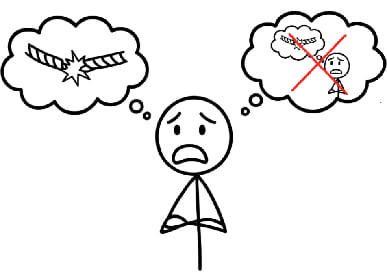
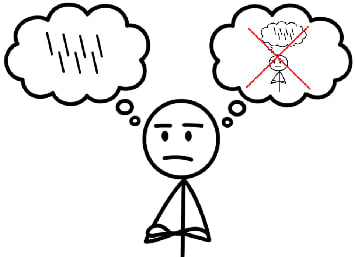
These are the same structure. One person anticipating p (rain/danger) while also claiming to believe ~p (no rain/no danger).
It kiiinda looks like an attempt to launder irrationality from ourselves so that the source of the problem isn't so damn difficult to miss.
Beliefs are revealed by actions
If you see a duck grab an umbrella as it leaves its house, look up at the clear blue sky and show the universal facial expression for surprise, then turn around and put their umbrella away, this is swimming, walking, and quacking like a duck that believed it was raining. The map that this duck is navigating by clearly predicted rain -- before updating to predict clear sky.
If this duck happens to say "Oh heavens no, I didn't think it was raining!", then color me skeptical. Oh yeah, Mr. Duck, how else do you explain these observations? Absent a surprising explanation (maybe the umbrella was for the sun, and he just happened to remember that he was wearing sunblock?), the most likely explanation is that the words spoken about the belief just aren't true. Mr. Duck might be lying. Or bullshitting. Or simply wrong about his own beliefs.
Object level beliefs are experiential
When you look out into the forest and see a tree, your visual experience is not that of the tree, but of an internal representation of a tree. This is why "hallucinations" are a thing, as well as simple blindness. If your eyes or brain aren't working right, you will not have this experience of a tree, yet the tree will still be there, blocking your path in this direction.
When you see what looks like a real tree that is actually there, this is what it feels like to experience your object level belief. Yes, the tree is really out there (you believe), and the belief is there to represent that. But the belief itself isn't the tree, and isn't circularly defined as "what you think you believe". When you believe there to be a tree there, by definition, what that is like from the inside is seeing the tree as actually there. When you believe that it is raining, you expect to get wet.
And so are meta level beliefs
If you catch yourself jumping in fear over a butterfly, what’s that like? Funny, maybe? Embarrassing? Shameful?
What’s that shame about, if not the way you’re mapping the world and how it differs from the way you think you should?
When someone is wrong on the internet that’s not “merely words”. Both object level and meta level maps are about the way things are. That jerk is wrong, yet the sentence “that jerk is wrong” is about his beliefs. Your response to the butterfly is irrational, yet the sentence “your response to the butterfly is irrational” isn’t about the butterfly. Both object and meta level maps point to real things, and as a result, both evoke emotions just fine when the things we experience as real matter to us.
Words are just pointers
The difference between our object level maps and our meta level maps isn’t of kind, but of referent. They point at different things.
It's not that "Fears are based on experience, which is why rationality is not enough and we need Exposure Therapy to change fears. It's only by exposing ourselves incrementally that we can unlearn our fears". When someone told you that it’s just John behind the bush, those are just words. The words pointed at the outside world, and changed your experience of it because they describe a different reality, but the pointing was done with plain words. There are no bears in Hawaii. Where's John, anyway? Lol.
You can point with words or you can drag the person outside and point with your fingers. Or you can point with screams and disturbed facial expressions. It's not the type of pointer that matters, it's what is being pointed at.
What is it that is being pointed at?
You only answer what you ask
What do you notice when you look at this picture? Probably that there are gummy bears in the bowl. So, also that there is a bowl. Probably that they're red, etc.
But did you notice that the number of gummy bears is prime? Or that it isn't? Without going back, counting, and checking if the counted number is prime, can you report your preexisting belief about the primeness of the number of gummy bears in that bowl?
Of course not, because you weren't paying attention to whether the number of gummy bears is prime. Or even the number of gummy bears at all, with precision greater than "a decent amount, I guess".[1]
The questions we attend to determine what we notice, and therefore what we update on. The picture conveys very strong evidence that the number of gummy bears in that bowl is prime -- but if you're not asking that question the corresponding beliefs will not update, because you won’t notice.
What are we asking when we answer with “They’re being irrational!” or “My fear is irrational!”?
What will we therefore not notice?
The sneaky little trick
The question "Am I in danger?" sounds like the same question as "Is my fear justified?". Ask someone with an irrational fear "Are you in danger?" and they're likely to say "No, my fear is irrational."
But notice what just happened. You asked about danger. They answered about their fear.
"The rope might break and I'll die" vs "This fear is not justified" - these are claims about different things. One is about ropes. The other is about fear.
Which map does each answer live in?
Yes, "my fear is unjustified" implies the rope won't break. But that propagation doesn't happen automatically, by act of the Ego-god, which keeps us just as rational and coherent as we tell ourselves we are. We have to do that propagation, and ask that question, or we will not update on the answer.
To change the map, look at the territory
When you stopped fearing the bear, it's because you realized there is no bear. The danger isn't real. Just imaginary. You can stop pretending whenever you want.
If your fears of air travel are to update, it's going to be because you made the same move and noticed the same thing about the territory. Not "I realized that it's true that airliners don't crash much", but "I realized this plane is not going to crash". Just like you realized "I'm not going to find a bear behind that bush".
What do airline safety statistics imply about what experiences are coming up next?
A long boring flight and uneventful landing? That doesn't sound very scary.
A violent and almost certainly lethal crash? That would certainly be scary, but is it going to happen?
Not "No, this fear is irrational", because there's that sleight-of-mind again.
Either
"Actually, it might. We might land uneventfully, or we might crash into the ocean at mach 1"
Or
"No. Realistically speaking, this plane is not going to crash. What is going to happen is that I'm going to spend three hours listening to music kinda bored, and then we're going to land and I'm going to have to deal with baggage claim losing my shit"
When your object level beliefs are that you only need to prepare for baggage claim, fear will not be the dominant emotion. Maybe dread, but it's a reality-facing kind of dread.
Sometimes it really is obvious that the danger is fake, which makes the update trivial. Other times it's not so clear if those unlikely-but-devastating consequences really are an acceptable rounding error. When it isn't so obvious that the danger is fake, at least you learned to stop telling yourself it is.
The rent, paid
When my friend told me she didn't know how to stop overthinking in Jiu Jitsu, I talked to her about what the cues are that I use to determine what kind of thinking is worthwhile in the moment. Things like "Sometimes I stop in a stable place to remind myself what my options are and choose which I'd like to work on. Because I have time. But when things are going fast and I'd rather not give things up I'll just let my limbs do their thing and not try to micromanage. Because I don't have time to micromanage". Just, in more detail. The explanation made sense to her and she started following the same cues. The next day she lost track of time and rolled with her instructor for 45 minutes before they were surprised to notice everyone else had left. She asked me what I did differently, since previous attempts to "talk about it" hadn't helped.
The answer is that I pointed at the territory when I had something to show her which could improve her map. That's it.[2]
I pointed at what the territory is, instead of pointing at what her map should say it is or letting her misinterpret "Here's what I see, out in the territory" with "Here's what you should see. If you don't see it, try to change your map until you do". Nuh uh uh, over here. Forget your map, look at this thing in the territory.
This ability to get underneath our self talk and speak straight to the object level belief network that generates the fear/overthinking/etc is very useful in mundane ways, but the limit is not mundane.
In Scott's review of "12 rules for life", he describes Jordan Peterson's ability to do this with "cliches" as a "superpower". Specifically, he says:
This captures the preternatural quality of the results that are sometimes obtained by very simple things. How can it be that people like Jordan Peterson can say stupid cliches and have them sound meaningful, when to most of us the mere possibility of people taking them at face value seems ridiculous?
The answer is right under our noses.
Bad feels are in the map. Bad feels are the map saying “Reality no good”.
So if you’re trying to stop someone from feeling so bad… and you’re trying to figure out what you should say… and you’re flipping through your rolodex of cliches in order to do it…
Do you see it?
You’re telling them “Here is the relevant cliche you should put in your map”. When you find the words to say and report them, they will be inside quotation marks. You’re telling them “These are the words to say here. Look at these words”. Of course whatever you pick is going to come off cliche. Even if people believe you, it’s not going to be in their object level map
Cliches become meaningful when we mean them. When we stop pointing at the words themselves, and use the words to point underneath our maps, gazing with our own eyes towards something real. If, when we look at the power of tracking the truth, what we see moves us to tears, people will notice[3]. What have we experienced, which gives weight to cliches such as "That thing we call 'Truth' is important, or something"? When we attend to that, the words that come out may match a cliche, but it sure won't be cliche. And the recipient will be too busy attending to territory to dwell on the shape of the messenger.
People often mythologize this process, with talk about "superpowers", "auras", and the like. The entire existence of "hypnosis" is a mythologization of our object level beliefs as "unconscious" as if they require "special methods" to influence. The "magic" of hypnosis, is that it gets around our meta-beliefs of impossibility, and allows us to attend to experiences outside our normal ability to conceive (Not feel pain!? Can't remember my own name!? Hallucinate!?[4]). Yet everything that can be done with hypnosis can be done without hypnosis, and inductions aren't necessary. This is well known among hypnotists.
From the mundane ability to help people figure out how much to think while rolling, to the awe inspiring ability to get young men to voluntarily clean their rooms, to far more bizarre (yet in hindsight normal) things like hypnotic anesthesia, One Weird Un-Trick that enables results is the fact that you can just say things. And if, in the most literal sense, you know what you're talking about, often that is enough. This insight doesn't unlock all doors, but it does point out that these are doors, so when it's not enough you get to wonder why not[5].
Next time you're talking to someone and your words just aren't having the effect you'd like -- or you don't even try because it's too predictable that they won't -- or you catch yourself taking a stance of "humility" when you're secretly afraid your words won't connect and therefore pretend not to believe them...
Stop and consider whether maybe they are updating. Just not in the map you're pointing at.
And if you think the take-away message is “I should attend to the territory not the map”...
Would that be pointing at the way things are?
Or are you already back to thinking about how you should map things[6]
You probably missed the gorilla too.
A subtle hangup that can persist even once you mostly get it, is that you might be pointing at the territory instrumentally in attempt to control the map.
For example, if you're trying to help someone overcome a flinch when shooting, you might think:
"Have them hold the gun. 'Does your hand hurt? No? So holding it is fine. When you pull the trigger, what changes? Your hand pushes back a bit. Does that hurt?'"
If you look at the purpose of "So holding it is fine", it's to justify "SO YOUR MAP SHOULD SAY THIS". It is genuinely pointing at the territory, only to immediately pull back and imply at the map before they have a chance to update their map. This is a subtle error because the same words can work if delivered with a different emphasis.
If "So holding it is fine" is delivered only after checking in and verifying that they actually experience holding it as fine, as a neutral confirmation of what has been learned, then it serves a different purpose. "Does that hurt?" can be asked, but only if you're actually using it to point at the experiential uncertainty rather than to imply at "So it'd be stupid to fear it, right?".
In more pure form, all you need is "Pay attention to what is about to happen in the immediate future if you continue to press the trigger, and only proceed when you want that to happen."
And then once their mind has actually changed, if you want, you can circle back with "See, you tend to change your mind when you see reasons to change your mind".
These things can be really subtle, can call for very careful distinctions.
Even if they can't tell what they are picking up on. There's that meta level distinction again
Here's a quick citation for each, but these particular articles are not load bearing. Refer to The Oxford Handbook of Hypnosis for a more thorough summary of the literature and set of references.
https://jamanetwork.com/journals/jama/article-abstract/319327
https://royalsocietypublishing.org/rstb/article-abstract/352/1362/1727/19174/Hypnosis-memory-and-amnesia
https://pubmed.ncbi.nlm.nih.gov/34146711/
Maybe they don't realize you're serious. Maybe they don't take you seriously. Maybe they're afraid of what would happen if they did.
The solutions have to do with looking at whether we are serious, whether we are worth taking seriously, and whether it is safe to look — actually, on the object level — rather than in the narrative puff pieces we like to write for ourselves on the meta level. It’s far from trivial (which is why my sequence on the subject isn't exactly short), but there are real answers to these questions and systematic understanding helps to reveal pragmatically useful answers.
If you want to learn how to perform "hypnotic superpowers" on even harder cases by systematically cutting through anti-rational narratives -- for example, by using the insight that pain is just information to actually resolve pain-induced-suffering, or how to help your friends overcome their "irrational fears" by realizing there's no such thing -- the path becomes visible when you see the constraints that lie Beneath Psychology.
If you notice yourself habitually retreating to the meta level, even as you consciously nudge against this, it might not be such a trivial problem.
This requires dealing with the stuff mentioned in the previous footnote.[5]