This is a special post for quick takes by Stan van Wingerden. Only they can create top-level comments. Comments here also appear on the Quick Takes page and All Posts page.
Comment Permalink
Here's a quick interesting-seeming devinterp result:
We can estimate the Local Learning Coefficient (LLC, the central quantity of Singular learning theory, for more info see these posts / papers) of a simple grokking model on its training data over the course of training.
This yields the following plot:
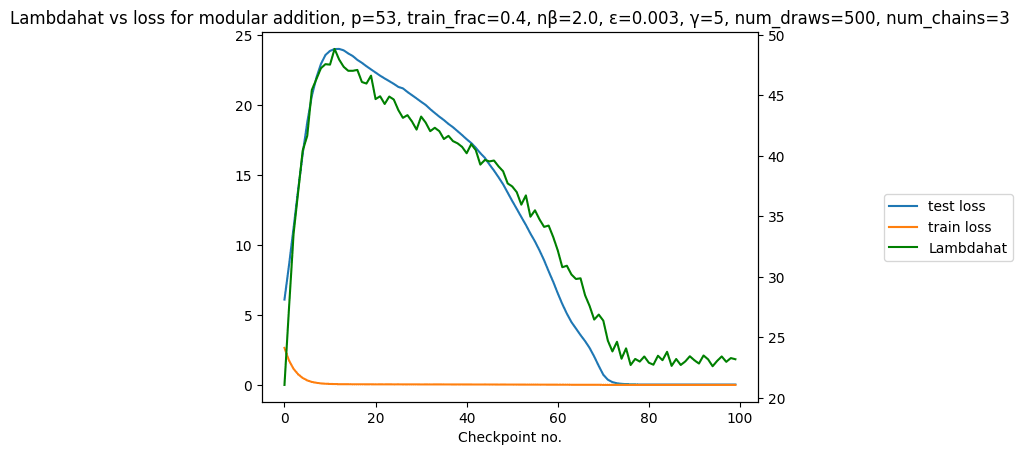
(note: estimated LLC = lambdahat = )
What's interesting about this is that the estimated LLC of the model in this plot closely tracks test loss, even though it is estimated on training data.
On the one hand this is unsurprising: SLT predicts that the LLC determines the Bayes generalization error in the Bayesian setting.[1] On the other hand this is quite surprising: the Bayesian setting is not the same as SGD, an increase in training steps is not the same as an increase in the total number of samples, and the Bayes generalization is not exactly the same as test loss. Despite these differences, the LLC clearly tracks (in-distribution) generalization here. We see this as a positive sign for applying SLT to study neural networks trained by SGD.
This plot was made using the devinterp python package, and the code to reproduce it (including hyperparameter selection) is available as a notebook at https://github.com/timaeus-research/devinterp/blob/main/examples/grokking.ipynb.
Thanks to Nina Panickserry and Dmitry Vaintrob, whose earlier post on learning coefficients of modular addition served as the basis for this experiment.
- ^
More precisely: in the Bayesian setting the Bayes generalization error, as a function of the number of samples n, is λ/n in leading order.
Showing 3 of 7 replies (Click to show all) 1
30
IIRC @jake_mendel and @Kaarel have thought about this more, but my rough recollection is: a simple story about the regularization seems sufficient to explain the training dynamics, so a fancier SLT story isn't obviously necessary. My guess is that there's probably something interesting you could say using SLT, but nothing that simpler arguments about the regularization wouldn't tell you also. But I haven't thought about this enough.
14
I'm curious about what you think is "causing" what. For example, does the LLC lead to both the L2 norm and the test loss, or does the L2 norm lead to the LLC and the test loss, or is there a third factor leading to all 3 things. (Or is this question confused and it doesn't make sense to talk about these things "causing" each other?)