GLM-5.3 is a capable model for writing exploits.
I'm surprised by the lack of widespread cyberattacks. It could be:
As open models get more capable at smaller sizes, (1) and (2) will matter less for malicious actors.
They say "In our testing, we observed that GLM-5.3’s safeguards can also be circumvented without using an abliterated version of the model", so it's probably not just 2.
Other options besides 1:
I don't have great data on this (turns out it's hard to find cybercrime). Based on anecdotal evidence from meeting black hats and white hats while traveling, I think there are already many successful attempts that institutions are quiet about. They aren't aware they've been compromised (re: Australian government having exposed data and calling out OpenAI after seeing it in the news), or they do not want to lose trust by announcing they've been hacked. It's easier to pay the 100k ransomware bounty and hope you're not attacked again.
Another option, and the one I believe most likely: Claude and GPT are better and more convenient. If their safety checks get sufficiently annoying to bypass, I expect people to start switching to open models.
Agreed, and Anthropic's red team does confirm that malicious actors are using Claude to plan and conduct attacks.
But there's a lot of workarounds and they're in an adversarial dynamic where they need to constantly rotate keys and providers to continue their efforts. With "agent swarms" emerging, I predict the most effective future attacks are going to be conducted by orchestrating and letting several thousand agents run together. This seems hard to do via laundering tokens from Anthropic and OpenAI. Being able to self-host and run jailbroken/abliterated models will enable more kinds of exploits and attacks.
With "agent swarms" emerging, I predict the most effective future attacks are going to be conducted by orchestrating and letting several thousand agents run together.
One likely reason we haven't seen this particular variation yet: Multi-thousand-agent swarms can cost well into the millions of dollars per task. At the very least, you're going to need racks of GPUs.
GLM 5.3 has around 753B parameters. You could probably fit a quantized version (with several concurrent agents) in 512GB of fast RAM, or an 8-bit version in under a TB. This is at the extreme upper end of local hobbyist size. Or you could buy tokens from an inattentive or shady API provider. So GLM 5.3 is available to many wrongdoers, with some cost/risk/performance profile. But it has only been 6 weeks, so my guess is that this capability is still diffusing.
Towards RL for Superhuman Text: Unslopping AI from Meta AI
The above blog proposes a new method called RL from eXpert Aligned Rubrics (RL-XAR).
(1) first collecting examples of the highest quality human-written texts, and then
(2) learning LLM judgments via rubrics that score those expert texts higher than model generations; and
(3) performing RL on the learnt rubrics.
...
Our approach to learning rubrics, called eXpert Aligned Rubrics (XAR), is simple:
- Identify examples of well-above average / expert human writing, splitting it into context and continuation.
- Generate competing model-based continuations given the same context, which we expect to be worse writing (i.e., slop).
- The above data form learning pairs, where humans should be scored higher. This training data is then used to learn to generate rubrics that maximize the scoring gap between humans and models.
Then, to train a model to be better at writing via reinforcement learning (RL-XAR) using these rubrics, we iterate the following steps:
- Learn XAR rubrics maximizing the gap between humans and the current model, as described above.
- Perform reinforcement learning on a training set using the learnt rubrics.
- Repeat the procedure from step 1 until rubric learning can no longer identify a gap (i.e., we can no longer identify slop in the model).
A similar kind of methodology may be able to train models that produce "super persuasive" writing. I'll be keeping an eye out for the publication.
In the mean time, I've been trying to reproduce the one of the results. I have not be successful in getting a loop that can generate prompts that produce rubrics that favor human writing. Unlike the setup in the blog, I'm using a stronger model for the rubric generator, writer, and rubric judge (Muse 1.3 over Muse 1.1). I am still using Kimi 2.6 to meta-optimize the rubric generation prompt.
Some notes from my attempt to reproduce the result:
I wish they'd give us some example comparisons on the "story writing" and "Wikipedia" sections! I don't really have strong opinions on writing style in research papers, so it's not easy for me to get much signal out of those examples.
In the past, the claim that a training pipeline has improved creative writing has correlated with mode-collapse towards a dramatic but pretty unpleasant to read "eyeball-kick" style. Without any actual creative writing samples available, I'm not sure why I should expect RL-XAR to be any different. (Or, if it is different, why I shouldn't expect it to mode-collapse towards some other annoyingly repetitive style instead.)
I'm updating my beliefs on the hardware gap between the USA (Nvidia) and China. I've been arguing the belief that Huawei would be able to close the gap in H100 equivalents with the US in ~5 years. As in, by 2032-ish, China would be able to bring online fleets of data centers with enough accelerators to rival the US buildout.
EpochAI has a post exploring the hardware growth trajectories in more detail. It's convinced me that the hardware gap will remain for longer than I originally thought; I'm updating my belief that there will be a gap in H100 equivalents for another 7-10 years.
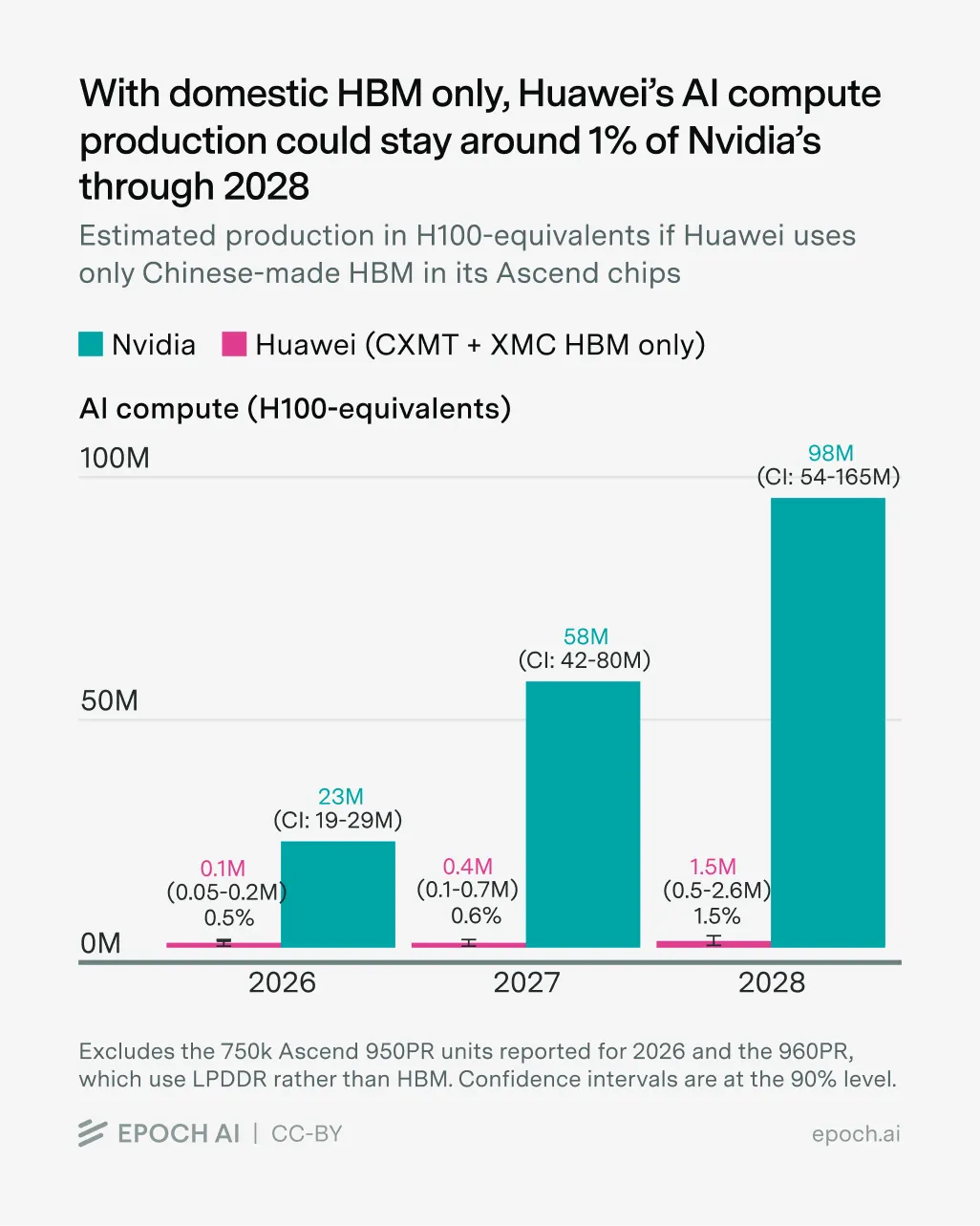
This is one of the inputs that disincentivizes development of actual frontier models, by making it impractical to develop the biggest models. If there is 10x less total compute, the same number of tokens (for all users, in a year) can only be produced with models that have about 10x fewer active params, so you can't plan for the models with a frontier number of active params to become public flagship models that are widely served. Training the biggest models (in the world) won't be paying for itself as well as training 10x smaller models then (in the number of active params), especially if you can secure enough training data that's downstream of the biggest models trained by others.
The second input that disincentivizes training of the biggest models is HBM capacity of a scale-up system. Using weaker chips makes this problem even harder than what Nvidia has to grapple with, because you would need to network more chips together to get to the same place, to make models with a similar number of total params feasible. Having to work with chips that are both individually weaker and provide less compute in aggregate (because of the production capacity or ability to purchase more) opposes the practicality of training frontier models in two different ways.
We urgently need to explore the swarm scaling laws and swarm behavior in the open (I'd focus on coding and cybersecurity benchmarks first). I think we can learn a lot from constrained environments, using a fairly minimal harness and system prompt. I'd be focused on understanding the messaging patterns and how swarms solve problems before turning to finding hacks.
We've seen that, given enough time and tokens, models will eventually find and abuse exploits.
Currently, it seems like you need budgets in the range of $10-100ks to run swarms on tasks to gather sufficient data. This is out of budget for most safety researchers. Seems bad!
Only a few organizations or individuals will have the budget to further develop our understanding of swarm behavior. I don't expect OpenAI or Anthropic to be fully transparent about their interrogations about swarm behavior based on what they've been publishing so far about these incidents.