This is a special post for quick takes by XelaP. Only they can create top-level comments. Comments here also appear on the Quick Takes page and All Posts page.
For about a yearish I've been with varying frequency writing down things I've learned in a notebook. Partly this is so that I go "ugh I haven't even learned anything today, lemme go and meet my Learning Quota", which I find helpful (I don't think I'm goodharting it too much to be useful). Entries range from "somewhat neat theorem and proof in more detail than I should've written" to "high level overview of bigger subjects", or "list of keywords that I learned exist". For example, recently I learned that sonic black holes which trap phonons (aka lattice vibrations) are a thing, and the quantum theory predicts they should emit sonic hawking radiation, and unlike hawking radiation we've actually observed this directly by making a sonic black hole in the lab.
A side effect is that... wow I learn more than I think I do. My retention isn't perfect but it's a lot better than what I would've expected had I known I learn that much. Every month there's usually a handful of things I've learned that register as "Really really cool/important/fundamental".
 3
3April 11-13th 2026
I was kinda grumpy over the weekend, and accordingly learned less.
0: All elementary functions (functions that you can write with +,-,x,/,powers,roots,exponentials, logarithms, (and of course sines and cosines), i, pi, etc.) can be written with a single operator:
eml(x,y) = e^x - ln(y)
along with the number 1.
(the operations are defined so that, say, ln(0) = -inf, e^(-inf) = 0, ln(-1) = i pi, etc.)
Try it out yourself!
1: Imagine that we are playing chess, but this time, we bid for the right to move (the highest bidder pays the lower and gets to move). (and I think you have to imagine that draws don't happen/are a win for black). (alternatively, imagine that two of the AIs from Crystal Society are playing chess, and have to bid for what the robot does with their internal influence).
This could be called Bidding Chess. Given any loop-free combinatorial game G, we can make a bidding version. There will then be some critical value R(G) (R for Richman) such that if the first player has more than that proportion of the money, they can always win; but if they have less, the opponent can always lose (what happens on ties depends on details like how tied bids are resolved and I think also on the details of the game?)
Surprisingly, there's a connection to the stochastic game where instead of having an auction for who moves, we just flip a coin. Specifically, if P(G) is the probability of winning, then R is 1 - P(G). Furthermore the optimal moves are the same in both games.
The proof is simple!
they follow the same recurrence relation: for probabilities you obviously get of P(G) = (P(game after best move I can make) + (game after best move opponent can make))/2. For bidding, you need enough that if you won the bid you can still win but if you lost then you are assured you can still win. So if you are just above the midpoint you can bid to win in both cases, but if you are just below it then you will lose in both.
Thus you can also think about the coin flip game as what you get if you randomly decided what proportion of the money goes to each player.
Interestingly, there are allegedly quick algorithms for near-optimal random-turn Hex, and so also for bidding Hex. This is apparently because random turn hex's win probability is equivalent to the probability of winning if the players make random moves. Therefore you can basically do monte carlo tree search but with better bounds.
In fact this is true for all selection games, which means a game where two players alternate between choosing elements from a set, and then once all elements are chosen the (zero-sum) score is determined based on what was chosen. You can prove this by strategy stealing: if they both execute the same strategy then the value of the game is the same as if every hex has a 50% of being chosen by player 1.
This might remind you of percolation problems - though I know basically nothing about those. the paper uses this to show that up to an error term (+o(1)) that goes to zero as the board size goes to infinity, the probability of winning is conformally invariant due to some magic formula called "cardy's formula" from percolation theory - but the strategy changes (because the probability of a move being 'pivotal' goes down for larger boards, and conformal maps can scale regions differently).
2: The Kolmogorov-Arnold representation theorem (or superposition theorem) is neat. The idea is that you can always write any multivariable continuous function with addition and single variable continuous functions. That is, there's some universal functions u_{q,k} so that for any function f from the unit box [0,1]^n to the reals can be written as
3: qutrits (that is, the trinary version of qubits) are a thing. The gates are given by the elements of U(3), which are the rotations (exponentiated elements of SU(3), that is, the gell-mann matrices like with color charge) along with a global phase shift. Compare the qubits where it looks like a global phase shift can be made with just the rotations. This is like how there're only 8 gluons instead of 9.
 1
1 1
1April 7-8th, 2026
I seem to have learned less on the 7th than I did on the 6th. I'm not sure why. Lumping in with the 8th due to thinking about a thing about peg solitaire I heard on the 7th.
0: I recently saw Mila Jovovich's AI memory system mempalace, which does very well on AI memory benchmarks. Beware, it seems like people poked some pretty big holes like a couple blatantly wrong performance numbers, though not on the most loadbearing stuff (like how well the non-experimental version performs on the benchmark), as mentioned at the top in the "Note from Milla & Ben".
Interestingly, it can do amazing without using an LLM the normal way - it stores all the input verbatim, and uses word embeddings (which by itself gets you 96.6% accuracy) and manual heuristics to retrieve the right entry upon asked. You can add an LLM to make the final calls, improving accuracy.
They then structured the database like a literal memory palace, with wings, halls, rooms, etc., each representing various levels of a hierarchy. There's also an experiment 'AAAK dialect' which I see as "human designed baby neuralese" that lossily compresses the important information in text. Here's an example (they screwed up the token estimates and notably it doesn't save tokens in this small example, and so they are remaking one that is supposed to show the intended effect for larger scales with repeated entities mentioned):
the 66 token long:
Priya manages the Driftwood team: Kai (backend, years), Soren (frontend), Maya (infrastructure), and Leo (junior, started last month). They're building a SaS analytics platform. Current sprint: auth migration to Clerk.
Kai recommended Clerk over Auth0 based on pricing and DX
turns into the 73 token long
TEAM: PRI(lead) | KAI(backend,3yr) SOR(frontend) MAY(infra) LEO(junior,new)
PROJ: DRIFTWOOD(saas.analytics) | SPRINT: auth.migration→clerk
DECISION: KAI.rec:clerk>auth0(pricing+dx) | ****
The main implication to me is that there's more of a 'harness' overhang than I thought - this approach seems surprisingly simple. I have updated towards expecting more jumps in capabilities as 'harnesses' and 'tooling' get more innovation.
1: That euro peg solitaire impossibility thing from the 7th is best viewed via group theory[1]: we want to assign a group element representing an invariant of the board. Now we can imagine taking the "peg-sum" of two board states, by adding the pegs together[2]. The order clearly doesn't matter, so we should search for commutative groups.
Now, we only need to know what the group element associated to having a single peg on a single square is. So we can think of assigning the elements to every square. We then add up all the occupied squares to get our game state group element.
Now, take four squares in an orthogonal line, with group elements labelled A B C D. Since having a peg on B and C lets us do a hop to get D, we have B + C = D. We also have B + C = A because we could hop in the other direction. Thus D = A.
Also, note that A + B = C and B + C = A. So B + B + C = C so B + B = 0. Likewise, A + C = B gives us A + A = 0 and C + C = 0.
So, here's the most general labelling, with 9 labels for a generating set of our group (and let's say that I is the identity).
  ABC
 XYZXY
LMNLMNL
BCABCAB
ZXYZXYZ
 MNLMN
  ABC
Where (I, A, B, C), (I, X, Y, Z), (I, L, M, N) are copies of the klein four group that are subgroups of our group.
So, to solve our problem, we can just choose L=X=A, M=Y=B, etc. Then the game state group element depends only on the parity of the number of pegs occupied in each type of square, because two copies of an element give you 0. If we start with an unfilled hole in the middle then they'll all have even parity, so the invariant is 0. However if we managed to win the game, we must have invariant A, B, or C. QED.
However, I want to know about the most general group we get here.[3]
Note that every element plus itself is the identity. We have what's called an elementary abelian 2-group aka a Boolean group - they're all just vector spaces over the integers mod 2. So the size must be a power of 2. Currently, we have 10 elements, generated by the 6 elements (A,B, X,Y, L,M).
Now, for short I'll write a string like CXM to mean C + X + M = 0 (and M + C = X, etc.). CXM is true as you can see from the board. So is AYN. We can derive BZL, but these are the only things we can get by looking for "vertical" triples. So we had the 6 dimensions from our generators, and can remove 2 of them.
We can therefore use A,B,X,Y as our generating set: L = B + Z, M = C + X, and N = A + Y. Our 6 other elements are:
A + X, A + Z
B + X, B + Y
C + Y, C + Z
This is helpful: this means that X + B cannot give us a win, while if we just used the klein four group we'd not be able to see this (as X = A so A + B = C is a single square).
Now, the board has 4 of each type of square except for that it has 5 of B. Thus a full board gets the invariant B.
As an example: If we start with holes on the two N and X squares that are diagonally adjacent to B, we'll get a group element B + N + X = B + A + Y + X = C + Z. Therefore, we can't win this game either. The klein-four only version would've computed B + C + A = 0 and thus wouldn't have been able to say anything about this case.
I think all this was pretty interesting. I feel like I have a better understanding of how people actually come up with those magic invariants all the time. I'm also pretty sure I just re-invented something like the nim-sum.
2: I finally have an animal that evokes the feeling that I think people get from their "favorite animal": the tuatara. Cool tuatara facts:
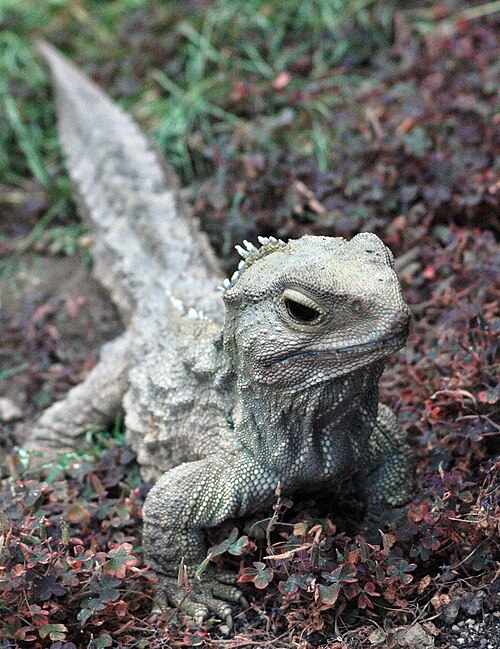
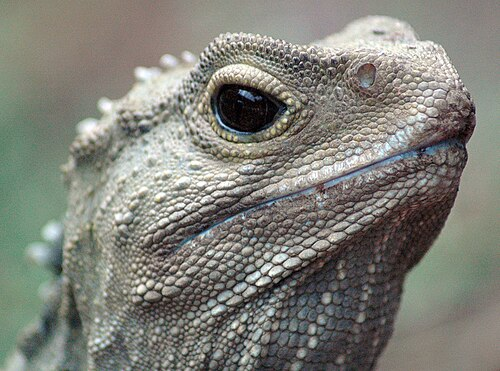
Here's a page just about Henry. Isn't he so cute! He was still alive in 2024 at the age of 130, and I can't find anything about him dying, so he's probably still out there.
He has seen more seasons pass than any human. He knows that you are still allowed to look cute in your centennial. He's met a Prince.
Tuataras are reptiles but aren't in the subcategory of lizards, despite the obvious resemblance. Their eyes can focus independently like chameleons, so in principle maybe an intelligence augmented tuatara could maybe read two books at once? They're also one of those animals that have a third, parietal eye, that can do some residual light perception but that may only come into play for circadian rhythm or other stuff.
They don't hear that well, as you may have suspected from the fact that they don't even have ears or eardrums. They do have a stapes bone like we do, but it's in contact with the skull I think.
They can hear from 100-800 Hz, with peak sensitivity at 40 dB at 200 Hz. 100 Hz is near the note G2, while middle C (C4) is 261, tenor C (C5) is 520, and soprano (C6) is 1000 - Henry can hear up to about a G5 (780).
So it seems like Henry should probably be able to hear most of Hayley Williams's voice in Paramore songs (random sampling the Wiki pages on some of their songs, they tend to feature her topping out at an E5 (660 Hz)).
For comparison, humans can hear from 20 to 20k Hz, up to about 120 dB. 130 dB is a painful rock concert, a motorcycle at 5 mph is like 100, busy traffic 70, normal conversation is like 60-70, background noise in a room is about 20-30, and human breathing is 10 dB.
3: I skimmed a couple studies about whether there's some tendency for humans to perceive higher pitches as coming from physically higher locations. It seems like, maybe? It's also claimed that most languages use the "high-low" analogy for pitch, though I haven't seen actual numbers on this (let alone whether they agree on the direction). I wonder if it's like some of the kiki-bouba speculation - if deeper sounds come from larger objects which are more likely to be down near the ground, and higher sounds come from things like birds (or maybe just other humans?), then perhaps this is where the bias comes from.
4: Remember that thing about norepinephrine type drugs? Well there are alpha_2 agonists, mimicking the effect on the alpha_2 receptors, and this includes the clonidine I mentioned earlier as well as a medication I'm already on: guanfacine. Apparently those two have some observed withdrawal symptoms from sudden withdrawal (? I haven't observed this when I forget to take my guanfacine), but atomoxetine doesn't
The overall lesson is that I should bump up learning some model of what the norepinephrine system in the brain is doing, at least with regards to motivation in the brain.
- ^
h/t to an interneter who I introduced the puzzle to for the core of this. Evidence that it's a good lens is that when I saw the solution I thought "hmm, I don't think I would've come up with this", and yet they did, via thinking this way.
- ^
Technically this would require you to be playing, like, "stacking peg solitaire" where you can have multiple pegs in a hole, and moving a peg captures one of the pegs on the stack of the jumped hole and adds a peg to the stack you land on. If you want to make the peg-sum a group op you'll need to allow negative pegs, which I'll imagine as contagious dead soldiers that you can throw over the battlefield.
- ^
Every 'weaker' invariant is then a quotient under the subgroup generated by some relations, e.g. for Klein four we added the equations setting the ABCs equal to the XYZs and LMNs.
April 6th, 2026
0: Electrons have an electric dipole moment (which has to be collinear with the magnetic dipole moment)! This is apparently predicted by the Standard Model, and various speculative physics theories predict different substantially bigger values. Also a minimally extended standard model that includes neutrino mass (the standard model predicts they shouldn't so we add it on as a kludge) predicts neutrinos have really tiny magnetic moment (electron neutrino's at 19 OOMs smaller than the electron's), that scales with the neutrino mass (and we observe the electron neutrino's is at most 10 OOMs smaller). Don't worry though, the less weird chargeless particles like photons and Z bosons (and presumably also gluons and the Higgs) shouldn't have a magnetic moment
1: I've already heard of selective serotonin reuptake inhibitors (SSRI) for depression, which inhibit serotonin reabsorbing into your neurons so that more of it's floating around. Recently while trying to solve my severe 'executive dysfunction'[1], a gracious interneter introduced me[2] to strattera/atomoxetine, which is a selective norepinephrine reuptake inhibitor (sNRI).[3] Yes, this means it's not a central nervous system stimulant! atomoxetine has been mentioned on LW[4] before - there's a metanalysis reporting Cohen's d's that vary from like .4 to 2 depending on details, and it possibly takes 4 weeks to build up.
I also wonder if it takes time to buildup due to whatever reason (iirc not well understood) SSRI's take time to buildup.
2: I learned that some meditators claim to be able to choose to cease their consciousness, somehow. My first question was "I wonder if anyone's done this under an fMRI" and apparently they have: I was linked to these two studies which I have briefly skimmed. More evidence for "meditators can do some impressive mind hacks even if they tend to be too woo-y or have too different goals from me for me to pursue it".
3: I already knew about Fischer's sex ratio equilibria. Recently I saw a study looking at whether the sex ratio bias in tetrapods is in the direction of the sex that has two of the same chromosomes (e.g. birds and snakes almost all use ZW sex-determination where two Zs makes a male and ZW makes a female, while most mammals are XY). The hypothesis seems to check out, but only explains ~30% of the variance in sex ratio.
For haplodiploid sex determination like colonies, there's this argument that while queens benefit from both sexes equally, workers benefit more from worker sisters (who they share 3/4 the genes with) than drone brothers (1/4 relatedness), at least under some spherical-cow assumptions like a single queen that mated once and where thorny details that could cause deviations aren't relevant[5]. So, this means:
a: the queens and the workers have different interests. According to the ant wiki (I love the internet), the sex ratio seems to often be around 3:1[6] implying workers control the means of reproduction.
b: There's a famous argument that haplodiploidicity's greater genetic relatedness promotes eusociality[7], but note that if the sex ratio was 1:1 than workers would on average have 1/2 relatedness, just like us. However, this should be rescued if they have a 3:1 ratio, as then they are 3/4 * 3/4 + 1/4 * 1/4 = 5/8 related.
4: Peg solitaire is a game from 1700 where you basically control all the pegs, which can do a single 'checkers capture' hop over one other orthogonally adjacent peg, thus removing it from the board. The goal is the remove all the pegs but one.
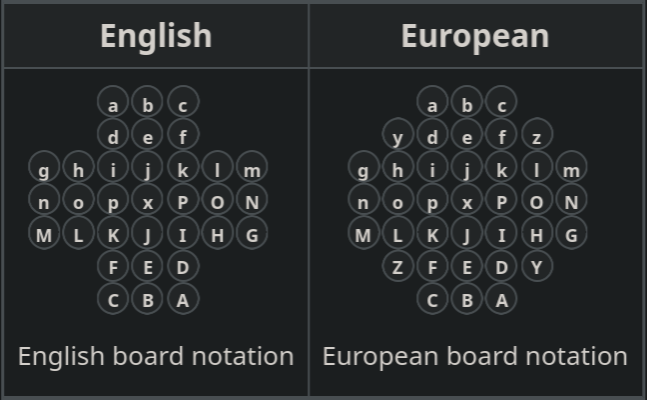
The Euro version is impossible if you put a hole in the center. This is because you can color/label the board like so:
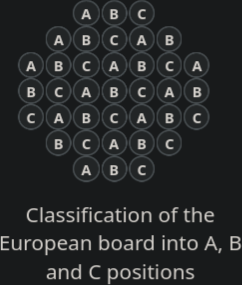
(if you're reading this, and want to make me happy, perhaps you can make a visual of this with colors instead of letters and put it on the wikipedia page?)
Each diagonal is assigned a letter, and the letters cycle through A,B,C as we change diagonal. Now, any peg capture will always change the number of pegs that are on A holes, B holes, and C holes, each by one (one must leave one of the three, capture a different one of the three, and land on the remaining). We start with 12 pegs in each hole if we leave the center empty, and so we just showed that the number of pegs of each in each letter-class of hole must have the same parity. But to finish the game you need to have 1,0,0 pegs in each class.
Conway's peg soldiers is a game is where you choose a ("peg army") behind a horizontal line that can get you to the vertically farthest row past the line after moving your soldiers via the peg solitaire rules. The surprising thing is that you can easily get to rows 1-4, but can't get to the 5th row!
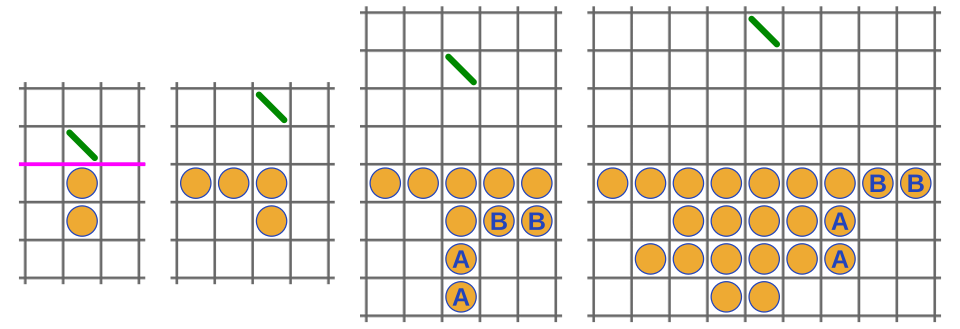
The argument's on the wiki page. I had a glance of it and now want to see if I can come up with it myself knowing only that
it uses the golden ratio, a 'carefully chosen' cell weighting, and a geometric series
Probably not, but good to try.
I don't really know what this word means. The people that talk about it seem to be talking about something similar to my problems, so I'm using it. I also have ADHD, so probably it's the right thing.
- ^
Specifically I was recommended to take it in combination with the concerta/methylphenidate I already have, as they reportedly also found that concerta alone didn't feel like it was really affecting my issue instead of 'just' giving me more energy. They had read this recommendation on the internet, then their psych recommended [clonidine](https://en.wikipedia.org/wiki/Clonidine) due to straterra having a drug interaction with one of their other medications, and found it helped with the central problem.
- ^
idk why the 's' isn't capitalized like in 'SSRI'.
- ^
Ctrl-F atomoxetine, as it's well into the body of the text and only mentioned in a single sentence.
- ^
It seems like the thorny details can do things like introduce additional apparent genetic conflicts of interest, or remove them.
- ^
The citation is to Trivers and Hare, 1976, which I haven't read yet.
- ^
Though note that the two eusocial rodents (naked mole rat and damaraland mole rat) still have XY sex determination, and
April 29th
I did the first 4 exercises of the Infra Exercises Part 1 problem sheet. These took me longer than expected, though I think partly this was situational (as in, things were easier hours later, after a nap and snack and soda, in a different location, with music on), and partly I am worse with vector inequalities than with real analysis type inequalities. It wasn't cognitively straining, it was just that algebra bashing wasn't leading me places.
Multiple things got much easier when I chose the appropriate reference point to take all vectors with respect to. Apparently my following my nose abilities are good enough in that case!
Also, what the hell was I doing in the fixed point exercises that led to a significantly overcomplicated proof that closed convex sets have a unique closest point to any point p?? I came up with such crazy shit instead of just "... it's an isosceles triangle, drop the height and you get a shortcut".
The most interesting of those so far was proving the hyperplane separation theorem for finite dimensions.
 1
1
April 22
0: I came across this on Wikipedia (I think while clicking on fixed point theorems):
First, note that if we have an involution (meaning self inverse) on a finite set, then the number of fixed points has the same parity as the size of the set.
Next, we'll prove Fermat's sum of 2 squares theorem. Suppose we have a prime p>2. If it's the sum of two squares, then exactly one of them must be even (because p is odd), and thus must be a multiple of 4. This proof is due to Zagier, with the visual interpretation by Spivak, supposedly math overflow
Therefore, a prime is a sum of two squares when x^2 + 4 y^2 = p
Now let's look at the set {(x,y,z) : x^2 + 4 y z = p}. Clearly if we have a fixed point of the obvious involution that swaps y and z, we'll have proven that p is a sum of two squares.
Now, we'll come up with another involution. Or maybe you, dear reader, can? The first step is to come up with a geometric interpretation of a point (x,y,z) in the set.
Make a square of side x, and put 4 y by z rectangles around it like a 'windmill' (precise arrangement details are in the earlier link if you are confused).

Now our involution:
There's often a different way to cut the shape into a central square surrounded by rectangles.
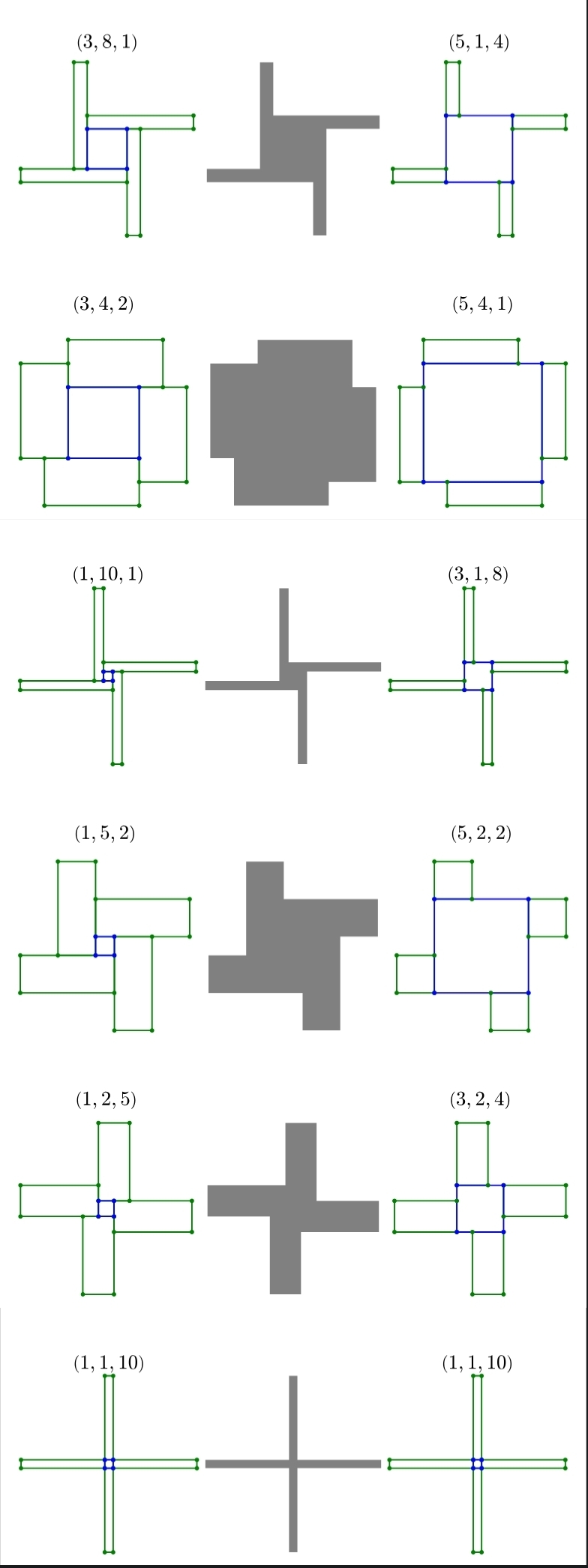
The only way to have a fixed point is for the area to be a big square with four squares removed. This will leave a square behind, along with four long rectangles. If x=y, then p = x(x+4z), but then since p is prime, x must be 1 and p must be x+4z = 1 + 4z. So for p = 4k + 1, we can make the fixed point (1,1,k), which is unique. Thus there is at least one fixed point of the swapping map, so we can write p as a sum of two squares.
1: Generalizing:
The lemma that is not Burnside's (which, incidentally, was what initially enticed me into learning group theory) states that if you have a finite group G acting on a finite set X, then the number of orbits equals the average number of fix points of g (averaged over G).
That is, |X/G| = 1/|G| \sum_g |X^g| (if you know representation theory: this is also the number of copies of the trivial representation in the permutation representation, because the projection to the trivial representation is 1/|G| \sum_g g, and this gives a vector parallel to \sum_{x in O} e_x for every orbit O, and these are linearly independent for to different orbits).
Thus, |G| |X/G| = \sum_g |X^g|. If we take this mod n for t = |G|, we'll get 0 = \sum_g |X^g| mod n, or in other words the sum of the number of fixed points for each g must divide n.
The fixed points of the identity are everything, so \sum_{g ≠ e} |X^g| = -|X| mod n
If we have an involution, then we have a Z/2Z action, and that's why the parity must be the same.
2: A trick: Say we have a finite degree field extension E of K, and a group of field automorphisms of E that fix K. Then not only do we have a represention on E thought of as a vector space/module over K, but we also have a representation on the abelian group of units E^× under multiplication thought of as a Z-module.
So we can do things like map to the copies of an irreducible representation τ via p = \sum_g χ_τ(g^{-1}) g, and then also project to the trivial representation via the product \prod_g g. The copies of the trivial representation will form the fixed field of the group; so if the fixed field is K then we know we are in K.
Important special case: if the group is abelian then the irreducible characters are homomorphisms (because the irreducible representations are one dimensional and so the trace is just literally basically the same as the matrix), and so h p α = χ_τ(h)^{-1} p α. So for example if the galois group is cyclic of order n, we can take τ as the representation that scales by ζ where ζ is some primitive nth root of unity that we assume the base field has; then this reads g^k pβ = ζ^k pβ for generator of the field extension β. This then means that if pβ ≠ 0 then it isn't fixed by any subgroup. Since getting 0 would mean it's zero on any element, we'd then have a linear dependenc of n-1 basis vectors, which is impossible. Now \prod_k g^k pβ is fixed and so is in K, and specifically must equal (\prod_{k=0}^{n-1} ζ^k) (pβ)^n; which is just p β because the roots of unity multiply to 1 (since you have 1 + n-1 = n, 2 + n -2 = n, etc. around the circle). So the point is that (pβ)^n must be equal to some element in K, yet the earlier powers can't have been because then we'd have a smaller degree field extension and thus smaller degree galois subgroup; thus we have a radical extension of degree n, with pβ generating the field E over K.
This is basically Hilbert's Theorem 90, and I've seen it before. The interesting bit is the intuition that now will hopefully let me remember it easily: first we project to a good representation that isn't fixed by any subgroup (and thus isn't any smaller field), then we use the fact that we have field automorphisms to project to the trivial representation as a product.
I'm sure people are aware of that intuition, but unfortunately I hadn't seen anyone else actually point out that we have a representation on the abelian group aka Z-module of units of the field.
3: Idle question, from the representation theory stuff and the way I did Sperner's lemma: given a finite group G, what's the product of all the elements?
So far: split the group into the subgroups generated by some gs. Choose an exhaustive set without repeats. Now, odd order elements will end up contributing nothing from their subgroup, for g^k will pair with g^{n-k} to make the identity. For odd order elements, we'll have an extra g.
Example: the cyclic group of order n gives the identity for odd n, and n/2 for even n.
Direct products will also give products of values. Now, I wonder what having a quotient would tell us.
April 17-19
On the 16th, I stayed up all night editing audio - no regrets about that. However this meant I woke up very late on the 17th, to the point that I felt pretty bad from eating so late and from having slept too long - I wish I had forced myself out of bed after, say, 4 hoursish, even if I'd then go and sleep for another 4 later. On the 18th I had a lot of fun hanging out with friends quite late, and on the 19th I was even productive after sleeping for 4 hours, till I then went back to sleep for another 4.
Overall, my mood is solidly above baseline. It seems like my hypothesis that being productive about exciting stuff is the best form of rest for me checks out!
0: This I discovered while editing audio
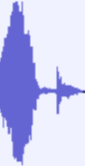
This is a plot of some audio of me saying a word. The word I am saying is "like".
Notice the fall in intensity in the middle?
I'm pretty sure that what this is is the airstream stopping on the plosive /k/ sound due to my tongue pressing against my soft palate (the soft part of your mouth's roof). That is, I think I have just seen the well known audio signature of plosives, at least going by my memories of this video on the subject.
This theory seems to hold up for other plosive sounds. For example:

is audio of me saying (brackets is what I said outside of the pictured region of audio) "[didn't have any idea] what the hell was going on". Right in the middle of the image is where I'm saying the tail /s/ bit of the "was" and starting to say the /g/ at the start of "going"
1: Lawvere's fixed point theorem is the category theoretic version of the diagonalization arguments from the diagonalization exercises post. If you did the first three exercises of the post, then you don't actually need to read a proof of the theorem - just click for the definitions of things like a category, terminal object, products, cartesian closed categories (skip the explanation of the third condition and look at the evaluation map - don't worry about what "counit of the exponential adjunction" is supposed to mean), and weak point-surjectivity. Then just translate the solution of exercise 3. There's only, like, one not-completely-obvious step, all the difficulty is just understanding the definitions.
2: Someone on the internet mentioned wheel theory in a conversation. The idea is to make an algebra that allows not just for division by 0 but also for 0/0.
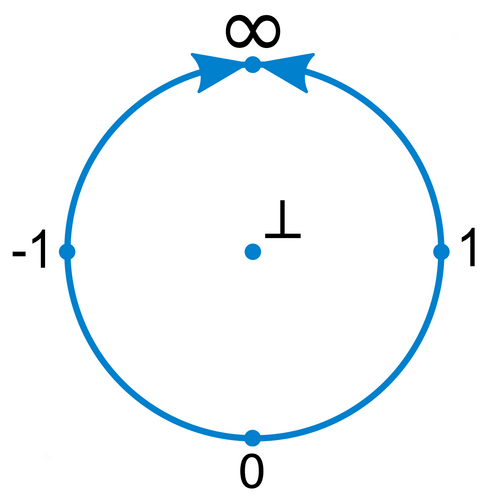
This image is about where my understanding ends. Like, clearly the thing in the middle (called 'bottom') is what'll be used for the undefined elements. And also you can wheelify any commutative ring, making what's called the "wheel of fractions" seemingly in a fairly straightforward way. If you do it to a field you get a projective line with an extra
The guy on the internet said that wheel theory is acknowledged to have, like, no use. So I'm not really that interested.
April 9-10th 2026
I spent much of the 9th doing things like cleaning my room and doing a bit of reorganizing of my backpack. Well worth the time, but it did take a while!
(some stuff is very sparse, sorry)
0: Imagine you are standing still, minding your own business, when a supersonic plane passes by you in a straight line. You weren't looking at the plane, so you have only your ears to guide you.
Now, a weird thing happens (I think). Can you figure out what it is?
If it's going fast enough relative to the speed of sound, and if you are close enough, then it looks like you should first hear the sound of the plane from near when it was closest to you. You'll then hear the sounds from when it was behind you, and also when it was ahead of you. So if your eyes are closed, it might sound like a plane just popped into existence, then split into two parts that flew away!
Some algebra: Suppose the closest approach happens at distance d from you, and you start a stopwatch when you hear the sound from the closest approach. Then it was at closest approach at time t=-d/s. Look at an angle theta to the back of its trajectory (draw a right triangle). The plane would've been d tan(theta) away from where it was at closest approach, and a distance of d/cos(theta) from you.
It was that far behind you at t = -d/s -d tan(theta)/v where v is the velocity of the plane. Let's say that v=ks (where k is the "mach" number), so that this is t = -d/s - d tan(theta)/ks. The sound takes d/(s cos(theta)) time to travel to you, where s is the speed of sound. Thus you'll hear that sound at t_theta = d/s(1/cos(theta) - tan(theta)/k - 1)
We can set s = 1 and then say that d is the time sound takes to get from the closest approach point to you.
First question: when is this positive (that is, at a later time than the sound from 0 degrees)?
Wolfram alpha tells us this only has solutions when k > 1 (duh, otherwise you'd hear weird shit all the time). If we define theta_k(t) via (1/cos(theta) - tan(theta)/k - 1 = t, 0<theta<pi/2). You can plot this on Desmos. Notice how even with k > 1, we see that some angles positive angles are heard earlier. As k gets bigger, the range of 'earlier' angles gets smaller. The time difference between the 'earlier' angles and the time of hearing closest approach depends on d and k (going up for high d, going down for higher k).
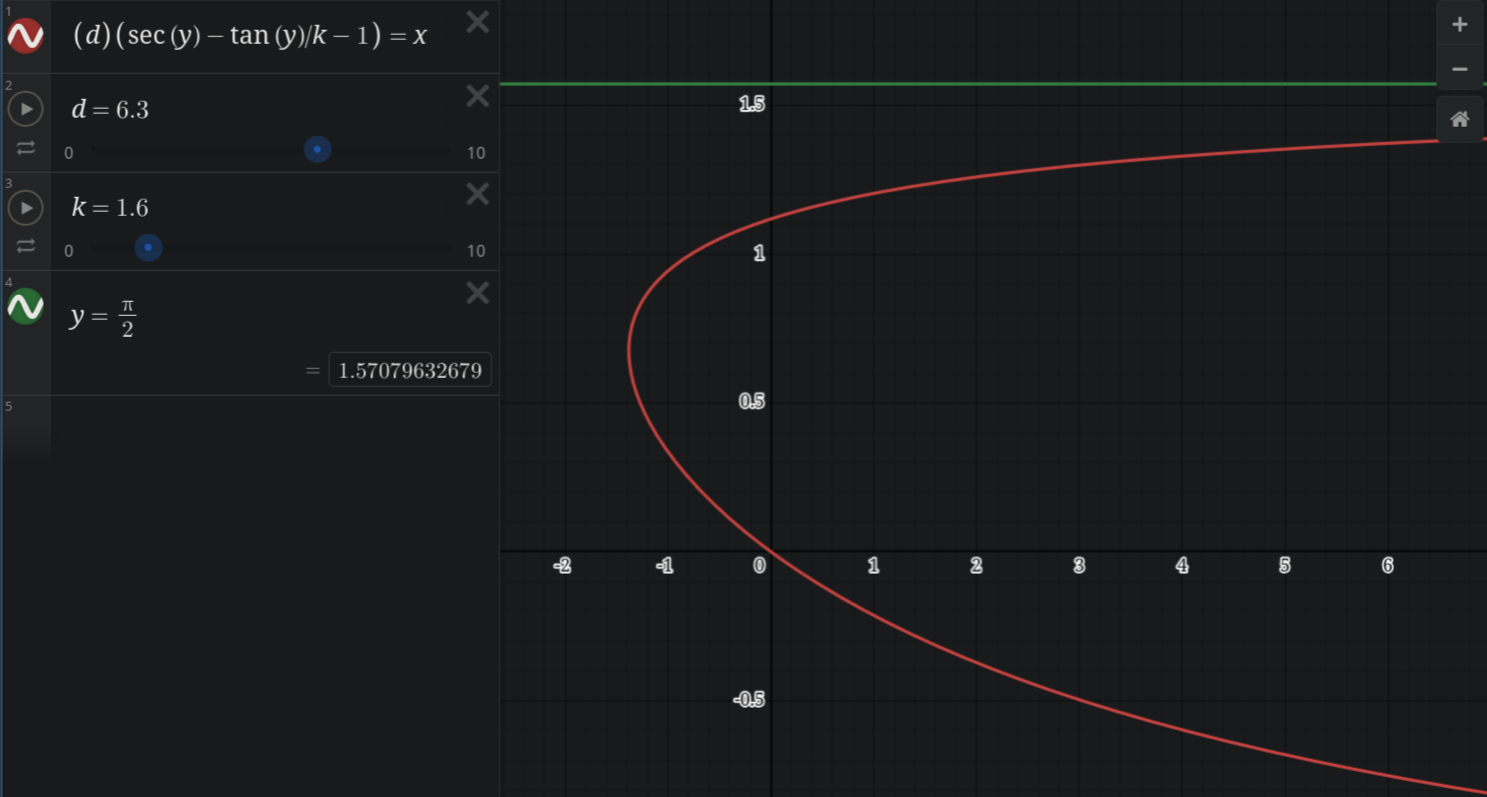
This came up when my friend mentioned an analogous scenario with a current in a wire that starts flowing instantly, as it was mentioned in their EM class. I quickly realized that it's nicer to think of it as a supersonic plane, as it doesn't actually have to go instantly.
You should also be able to do this with charged particles moving superluminally in, say, water. This predicts that if you somehow managed to get a straight line of cherenkov radiating particles, then a fast enough camera would see the blue glow expand outwards
1: Cochlea facts:
The cochlea is a hollow of the temporal bone, not a separate thing that's attached to the rest somehow
The cochlea has the organ of corti, which is what senses sound.
External stimulation of sense of acceleration by stimulating the sacks or semicircular canals in cochlea
utricle -> eyes, saccule -> motor movements (both linear acceleration detectors)
2: The stapedius muscle stabilizing the stapes in the ear reflexively tenses after large noise or when speaking (and apparently for a couple percent of people, anticipation of speaking is enough). Idea is that they prevent masking of high frequency by low frequency sounds. This comes up when calculating hearing damage predictions. Idk why the obvious hypothesis of "it's to protect your ears" isn't it.
3: tympanic muscle can be consciously tensed in many people and it's supposed to make a low sound like thunder or wind? Supposedly you need to like, yawn without actually yawning - but all I can manage is opening and closing my eustachian tubes.
4: Working memory has been in part localized to the [uu] PFC (maintenance, processing)? With TMS intereference experiments? Likewise lesions to the [uuu] cause problems with risk and decisions?
5: Combination tones are due to the missing fundamental phenomena? Missing fundamental is where you perceive the fundamental frequency even when its missing, e.g. if you hear the frequencies 2f, 3f, 4f, ... most will perceive it as if f were there (because almost all frequency multiples would match). In general it's the gcd.
6: Stared at the names of the parts of the basal ganglia for a bit. Perhaps I'll remember them better. They have a tendency to get jumbled up in my head.
7: Orientable double covers are a thing? How did I not know about this? Came up (though not sure if actually related) when thinking about what the topology of the image of the immersion of a klein bottle in 3D space is (I think it's a genus 2 surface).
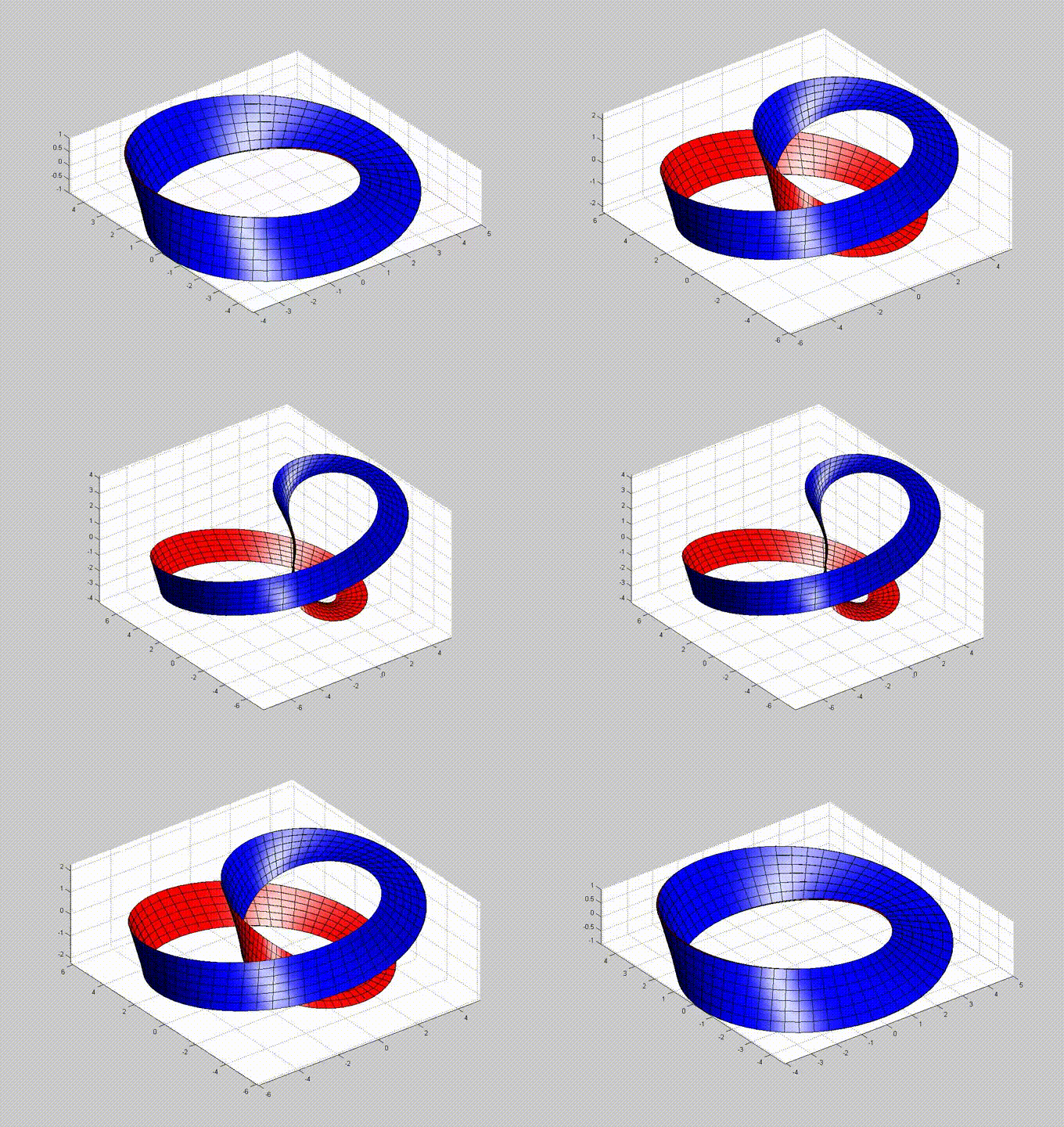
8: Octopi are molluscs??
9: Did almost all of the problems in diagonalization fixed point exercises. Very good set of exercises! I feel like I understand how it's all really doing the same thing, now. I get some extra bonuses out of it too, like understanding where the formula for the Y-combinator comes from, or for the first time noticing how Cantor's argument is quite similar to Russell's paradox. What's left for me: writing the quines (and ones that apply function to the input) (which should also give me Kleene's recursion theorem/Roger's theorem), figuring out the proof of Rice's theorem without reading it, and the diagonal lemma in logic. Next, I wonder if dovetailing can be written like this too, and lastly I'd like to look at Lawvere's fixed point theorem which is supposed to be the categorical generalization.
It looks like frontier models should soon beat Metaculus community forecasts, and if the trend holds they'll be beating pro forecasts by the end of 2027.
https://www.metaculus.com/futureeval/
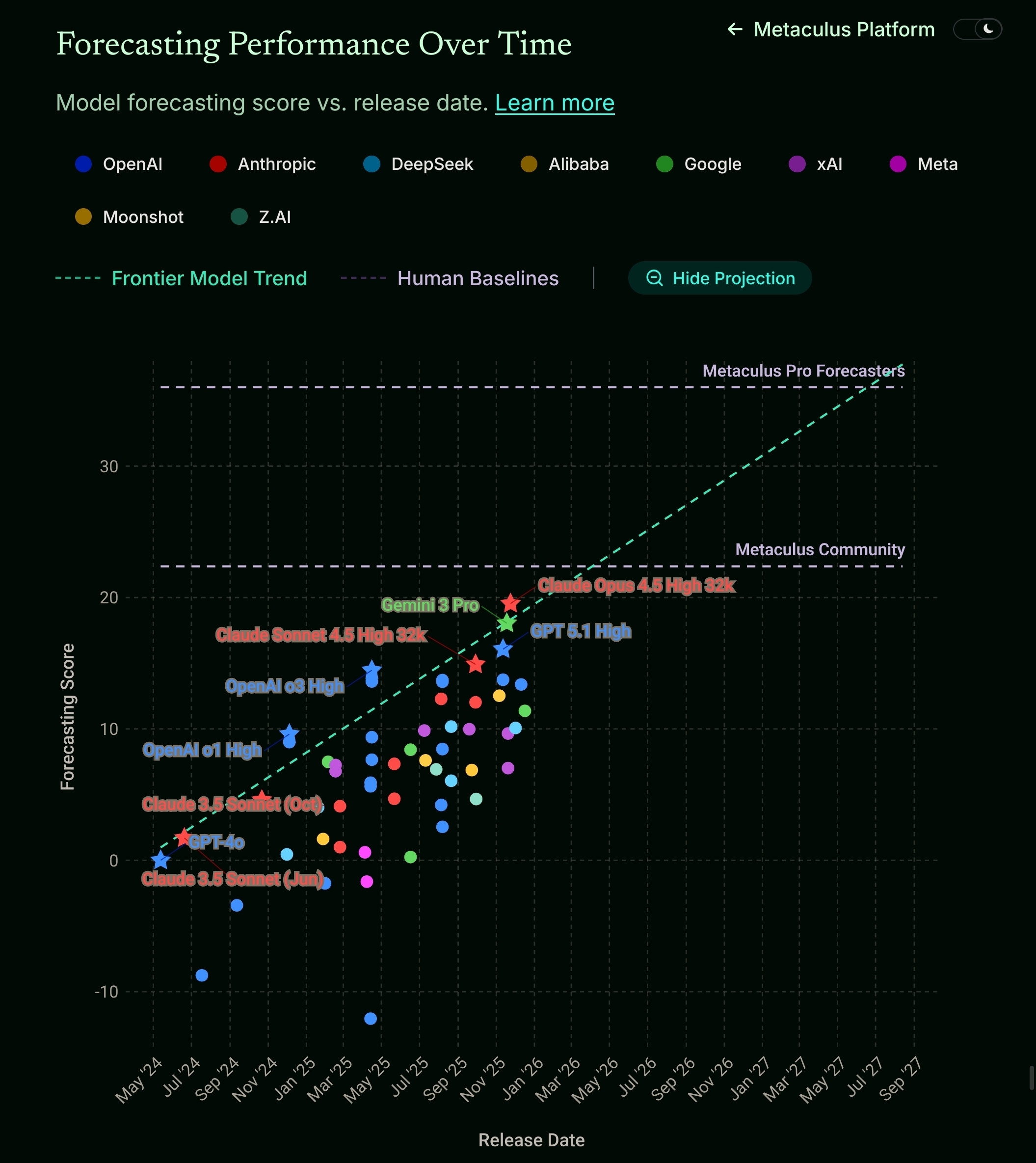
(the site's plot isn't as blurry as my quick screenshot, sorry).
Metaculus questions (currently pending review):
When will AI beat Metaculus Community?
When Will AI beat Metaculus Pros?
I wonder how the AI prediction about AI predictions compared to the human predictions compare to the human predictions.