This is a special post for quick takes by TurnTrout. Only they can create top-level comments. Comments here also appear on the Quick Takes page and All Posts page.
Comment Permalink
One of my friends tweeted that he thought steering vectors were discovered by trying a bunch of random stuff. I think it's a shame for that to be the perception, because my team and I discovered[1] steering vectors using shard theory reasoning.
In late 2022, I had posted a lot about shard theory. Andrew Critch, my mentor, advised me to stop arguing on the internet. If shard theory was actually good, he said, then I should be able to do something that other people didn't know how to do. Then I could share the new technique and impress upon people the practical utility of that way of thinking.
In the beginning of the project of Understanding and Controlling a Maze-Solving Policy Network, I didn't know how to approach the problem. We had this opaque-seeming pseudo-ResNet in an RL setting. We knew the policy was reinforced for reaching the cheese during training.
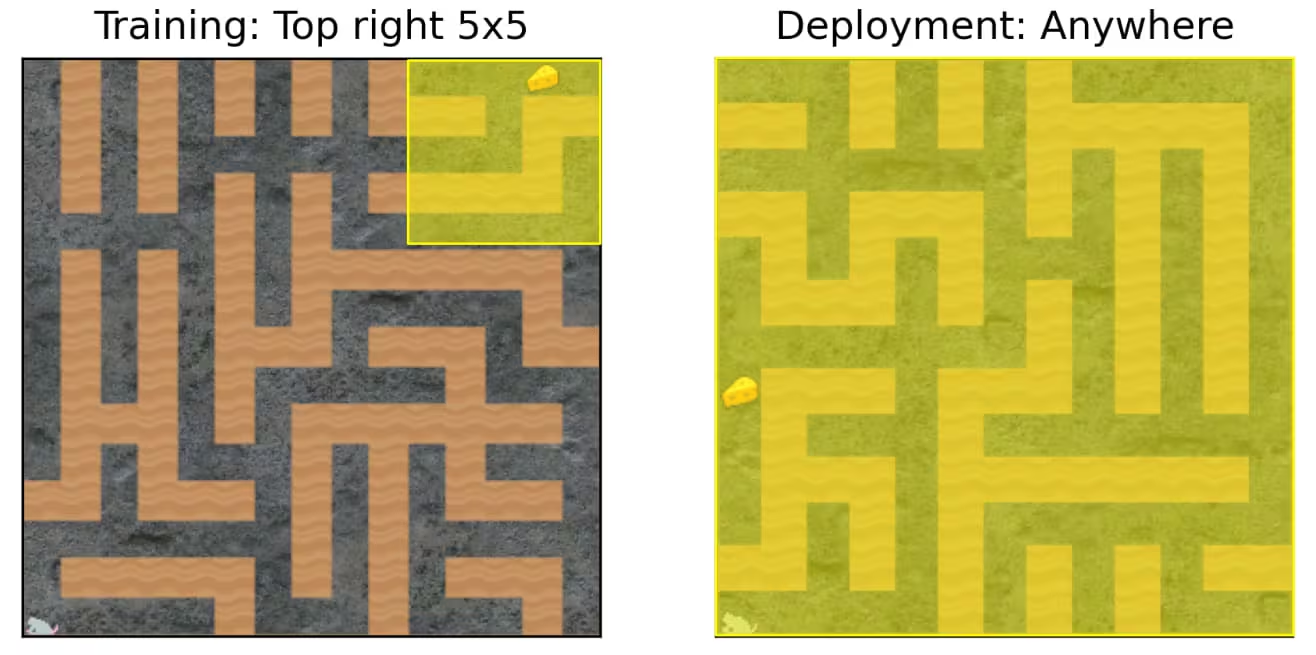
What was the internal structure of the policy's "goals"? I predicated that the policy had learned at least two goals, one being "go to the top-right corner", another being "go to the cheese." I expected that the closer the cheese was, the more strongly the cheese shard would activate—to push the agent towards the cheese.[2]
I wanted to stimulate or suppress the cheese vector. If the agent has a cheese shard, then it should respond to a certain mental representation. In the policy network, I knew, that would be an activation direction. I found two situations which (were intended to) differ only in cheese-shard-activation strength. I computed the activations in each situation and took the difference to get a cheese vector. When I subtracted the cheese vector, the agent would ignore cheese at that location in the maze across mazes.
That's where our first steering vector came from. IIRC, it was the first intervention I tried as well, so it wasn't "cherry-pick best of
I think the crux was that shard theory gave me the expectation that the network would have a specific internal structure: multiple shards, each of which activates on a given context. Each shard flexibly pushes the agent to achieve (something that looks to us like) a goal. If you can isolate several shard-directions, you can even mix and match these directions to mix and match goal pursuit without retraining a single weight.
It's a standard idea these days, although not usually stated in terms of shards. Surprising at the time. Shards were the concept that made the idea simple to state, expect, and test.
- ^
Discovered, but not for the first time ever. Steering vectors had been used narrowly in LMs and image models. They were not well-known before our work.
- ^
I measured whether "closer cheese -> higher P(goes towards cheese)." That's what my grasp of shard theory predicted. The results indicated I was wrong: moving the cheese closer decreased the probability on the action going towards the cheese.
This disturbed me greatly. I went for a 10-minute walk, during which I contemplated the possibility that maybe all of the shard theory was wrong. Maybe I actually had no idea what I was talking about.
When I returned, I fixed the visualization bug. My prediction had indeed been correct: the closer the cheese, the stronger the probability.