
New Comment
Rendering 0/49 comments, sorted by
top scoring
(show all) Click to highlight new comments since: Moderation Log
This comment is going to seem unrelated or only tangentially related to the post, at first. I promise that it’s quite relevant, but explaining the relevance up-front would make the comment longer and more awkward.
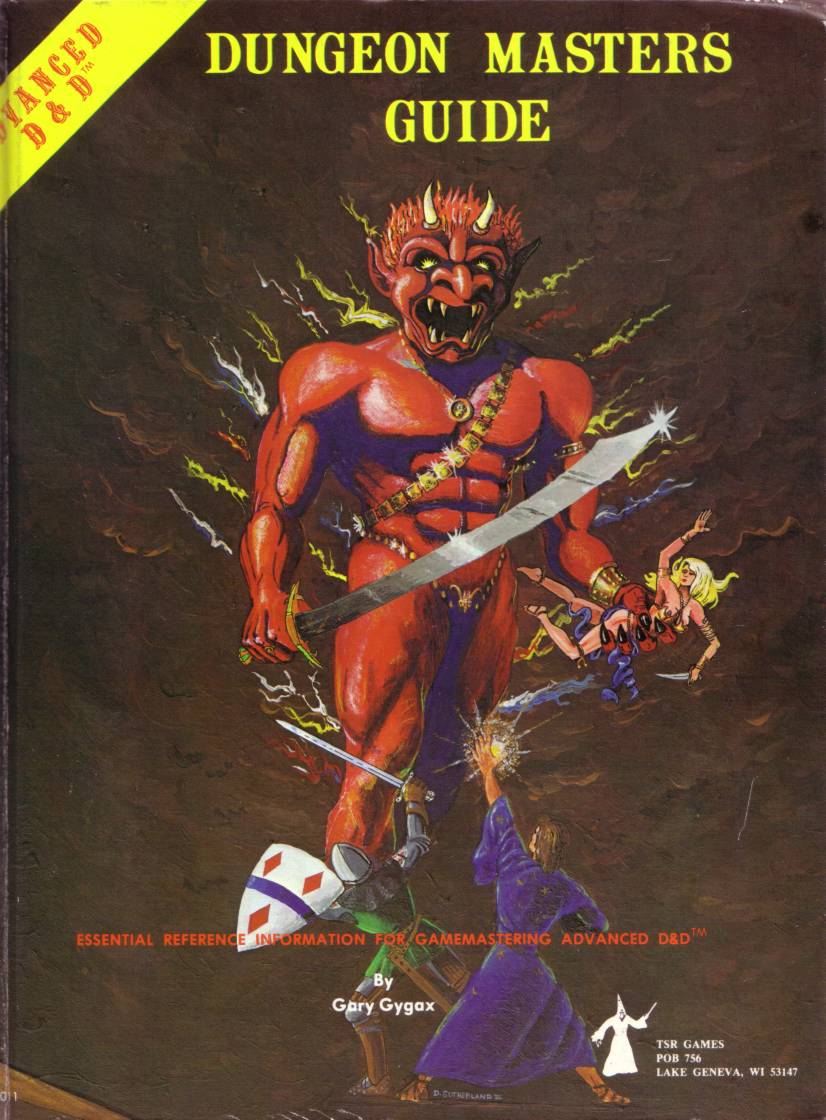
Open up an old-school Dungeons & Dragons rule book (like this this one), and one thing you’ll find a whole lot of is random tables.
The idea was simple: your characters would encounter some situation; the Dungeon Master (DM) would roll some dice; then he’d consult a table, which would tell him what the outcome of the situation was, given the result of the die rolls.
Here’s a table for diseases (or disorders)[1]:

If a player character contracted a disease, or developed a disorder (which, itself, would’ve been determined by some other die rolls), the DM would roll three dice: one (a d100) to determine the afflicted part of the body; one (a d8) for whether the affliction was acute or chronic; and a third (another d8) to determine severity. The table above indicated which values on each die corresponded to which outcome.
Here’s a table for determining whether a previously undiscovered fortress or castle is inhabited, and by whom (or by what!)[2]:

Finally, here’s a table for determining what happens when two magical potions are mixed (or, when a character drinks them both)[3]:

Random tables fell out of favor, for a time.[4] But they’ve been making somewhat of a comeback (along with many other features of “old-school” D&D—the so-called “Old-School Renaissance”). One sees discussions of random tables, now and then, on blogs and web forums dedicated to tabletop role-playing games. Often, people put together their own random tables.
And—as with everything else—one sees arguments about them.
Arguments for: These usually involve the word ‘fun’. Randomness is fun, we are told, and surprises are fun; and a random table can inspire a Dungeon Master, and suggest possibilities.
Arguments against: Randomness, the critics say, does not make sense; and surprises are not fun. (Because—it is implied—they might be bad; or they are often bad; or they are usually bad.)
Both sides miss the point entirely. Very few people—even among those who love a good random table—understand the tables’ nature, and their purpose. Without understanding, when people today try to construct random tables for use in their D&D games, they often find that something is missing—some ineffable quality that makes these modern imitations of the work of Gygax fail to have quite the same satisfying and enriching effect on the game as did the random tables in the D&D rule books of old.
And that ‘something’ is that random tables are not about the mere fact of randomness.
Here is what random tables really are: they are representations of a probability distribution across a set of outcomes. As such, they encode two critical things: first, what outcomes are possible; second, those outcomes’ relative frequency.
And in consequence, here is something else that random tables are: they are models of the game world.
Look again at that first table I presented (with the diseases and disorders). A character is exposed to disease; the DM rolls d100[5]. On a roll of 1, 2, or 3, the character contracts an affliction of the blood; on a roll of 4, an illness of the bones; a roll of 5 signifies a nervous system disorder.
But another way to look at this, is that blood-related disorders are 3 times more likely—and thus 3 times more common—than bone-related disorders (at least, among adventurers!).
And the table has no entry for a disease of the lymphatic system. As a consequence, in this fictional world, no such illnesses exist (or, perhaps, they do not occur among the sorts of people that the player characters are).
Similarly, the second table (with the castles) tells us that among small-sized strongholds found in wilderness regions, 45% are deserted entirely, 15% are infested with monsters, and the remaining 40% are occupied by civilized folk.
When constructing, or choosing to use, a random table of outcomes, what you are doing is modeling the fictional world of the game. The relative frequency of the possible outcomes of the category of situation which is to be resolved by rolling on the table—and, no less importantly, which outcomes are present in the distribution at all, and which are not—are facts about that world.
Now consider two random tables, for the same situation—let us say, two versions of the disease & disorder table given above. The first is as presented, while the second has all the same rows, but the distribution is altered: on this latter table, only a single number each (out of 100, on the d100) will yield any result but ‘skin’—to which the remaining 85 out of 100 numbers are now allocated.
What are the consequences for using this latter table? Well, in a D&D game where the DM chooses to use it (in place of the original table), it is rare indeed for any character to fall ill with a disease of the respiratory system—but afflictions of the skin are terrifyingly commonplace. One hopes that the DM has a good explanation for this skew (perhaps the fictional world on which the action takes place lacks an ozone layer, resulting in a permanent epidemic of skin cancers); if not, the modeled world will fail to make much sense (one can only suspend disbelief so far, after all, and perhaps—even after we’ve accepted the existence of dragons and elves—being told that skin conditions are 85 times more common than the cold, the flu, bronchitis, and every other respiratory condition combined, is a bridge too far).
And, similarly, we may imagine yet another version of this same table—an expanded one, with many more rows than merely the 16 we see above (with the die roll result ranges—i.e., the probability mass—of the existing entries being compressed, to make room); and these additional rows are all mental or psychological disorders. In this setting, characters are just as much in danger of developing a debilitating phobia, or lapsing into psychosis, as developing a skin condition. This, too, will result in a very different game world—and a very different game—than the original table.
The point, in other words, is not simply the fact of using a random table. The point, rather, is: just what exactly is on that random table, and what is not on it; and what is the distribution of the listed things. Not all random tables are created equal; not all are equally ‘fun’. The details are everything.
And now consider the application of the same caveat—to random tables, not of outcomes in a game, but of outcomes of a method of divination.
Suppose that we accept the basic idea, that we wish to be prompted to take some perspective, or think along certain lines, chosen at random out of a pool of such. The question, however, is: what, specifically, is the set of perspectives or prompts from which we are selecting? What perspectives are on there? What will be the relative frequency of certain perspectives or prompts, if you draw from this distribution repeatedly? And what is not in there?
We may imagine, for instance, two versions of the same divinatory device. In both versions, you draw a card from a shuffled 52-card deck, then consult a booklet of prompts, where each card corresponds to one entry. But the booklets are different; they were written (and the sets of prompts compiled) by people with very different philosophies (a Buddhist and a Randian, perhaps; or a Christian and a Communist).
Would not your choice of which version of this device to use for your divinations, affect the long-term outcome of using it? Might not your actions be nudged in one direction, or another—systematically? Might there not be some prominent gaps, in one or both of the distributions—perspectives which are simply absent from the set of possible prompts? What would be the consequence of such a lack?
Generators of random outcomes can be extremely efficient ways to model complex systems, by abstracting away the details of causal interactions. But be careful that the outcome distribution of the generator is one which you actually endorse.
Dungeon Master’s Guide for Advanced Dungeons & Dragons, 1st edition; p. 14. ↩︎
Dungeon Master’s Guide for Advanced Dungeons & Dragons, 1st edition; p. 182. ↩︎
Dungeon Master’s Guide for Advanced Dungeons & Dragons, 1st edition; p. 119. ↩︎
The popular sentiment, you see, was that things should happen for a reason, because the DM decided they should happen, rather than being quite so… random. Or, of course, perhaps the game’s publishers merely wanted to economize by reducing the rule books’ page count. ↩︎
That is, the DM generates an integer between 1 and 100 (inclusive), with the distribution across the possible values being uniform. ↩︎
[This post was primarily written in 2015, after I gave a related talk, and other bits in 2018; I decided to finish writing it now because of a recent SSC post.]
The standard forms of divination that I’ve seen in contemporary Western culture--astrology, fortune cookies, lotteries, that sort of thing--seem pretty worthless to me. They’re like trying to extract information from a random number generator, which is a generally hopeless phenomenon because of conservation of expected evidence. Thus I had mostly written off divination; although I've come across some arguments that divination served as a way to implement mixed strategies in competitive games. (Hunters would decide where to hunt by burning bones, which generated an approximately random map of their location, preventing their targets from learning where the humans liked to hunt and avoiding that location.[1]) But then I came across this striking passage, and sat up straight:
This is from Eric L. Hutton's translation of a collection of essays called Xunzi (presumably written by Xunzi, an ancient Chinese philosopher who was Confucian with heavy Legalist influences). The book was overall remarkable in how much of Xunzi's brilliance shone through, which is something I very rarely think about authors. (Talking to another rationalist who was more familiar with Chinese philosophy than I was, he also had this impression that Xunzi simply had a lot more mental horsepower than many other core figures.) By the end of it, I was asking myself, "if they had this much of rationality figured out back then, why didn't they conquer the world?" Then I looked into the history a bit more and figured out that two of Xunzi's students were core figures in Qin Shi Huang's unification of China to become the First Emperor.
So this paragraph stuck with me. When Xunzi talks about the way that earlier kings did things, I registered it as an applause light and moved on. When he talked about how an important role of government was to prevent innovation in music, I registered it as covering a very different thing than what I think of when I think about 'music' and moved on. But when he specifically called out the reason why I (and most educated people I know) don't pay much attention to astrology or other sorts of divination or magic, said "yeah, those would be dumb reasons to do this," and then said "but there's still a reason", I was curious. What's the proper form that he's talking about? (Sadly, this was left as an exercise for the reader; the surrounding paragraphs are only vaguely related.)
In his introduction, Hutton summarizes the relevant portion of Xunzi's philosophy:
So what is cultivated by performing divination?
The first step is figuring out what sort of divination we're discussing. Xunzi probably had in mind the I Ching, a book with 64 sections, each corresponding to a situation or perspective, and advice appropriate for that situation. In the simplest version, one generates six random bits and then consults the appropriate chapter. I actually tried this for about a month, and then have done it off and on since then. I noticed several things about it that seemed useful:
Essentially, it looked to me like the steelman of divination is something like Oblique Strategies, where challenging situations (either ‘daily life’ or a specific important decision) are responded to by random access to a library of perspectives or approaches, and the particular claim made by a source is what distribution is most useful. There was previously an attempt on LW to learn what advice was useful, but I think on the wrong level of abstraction (the ‘do X’ variety, instead of the ‘think about X’ variety).
This approach has also served me well with other forms of divination I've since tried; a Tarot deck works by focusing your attention on a situation, and then randomly generating a frame (from an implied distribution of relevant symbols), giving one access to parts of the space that they wouldn't have considered otherwise. This also trains the habit of 'understanding alien frames'; if I am considering a conflict with another person and then have to figure out what it means that "I'm the vizier of water, the relationship is the three of earth, and the other person is strength" (where, of course, each of those is in fact an image rich in detail rather than a simple concept), this trains the habit of adopting other perspectives / figuring out how things make sense from the other point of view.
This view is apparently contested.