This is a special post for quick takes by [anonymous]. Only they can create top-level comments. Comments here also appear on the Quick Takes page and All Posts page.
Comment Permalink
i might try sleeping for a long time (16-24 hours?) by taking sublingual[1] melatonin right when i start to be awake, and falling asleep soon after. my guess: it might increase my cognitive quality on the next wake up, like this:
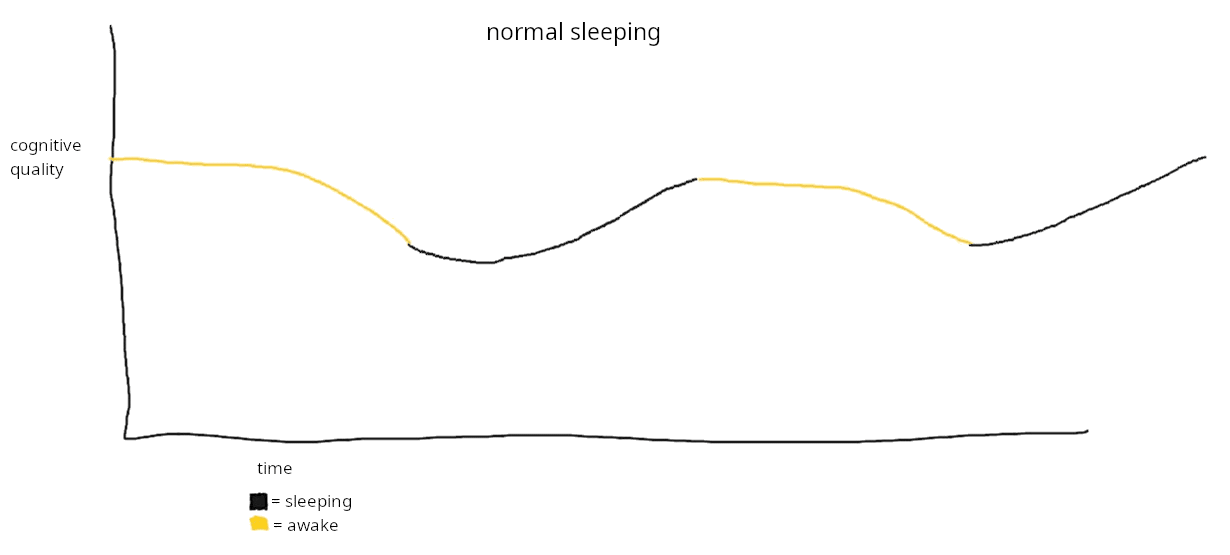
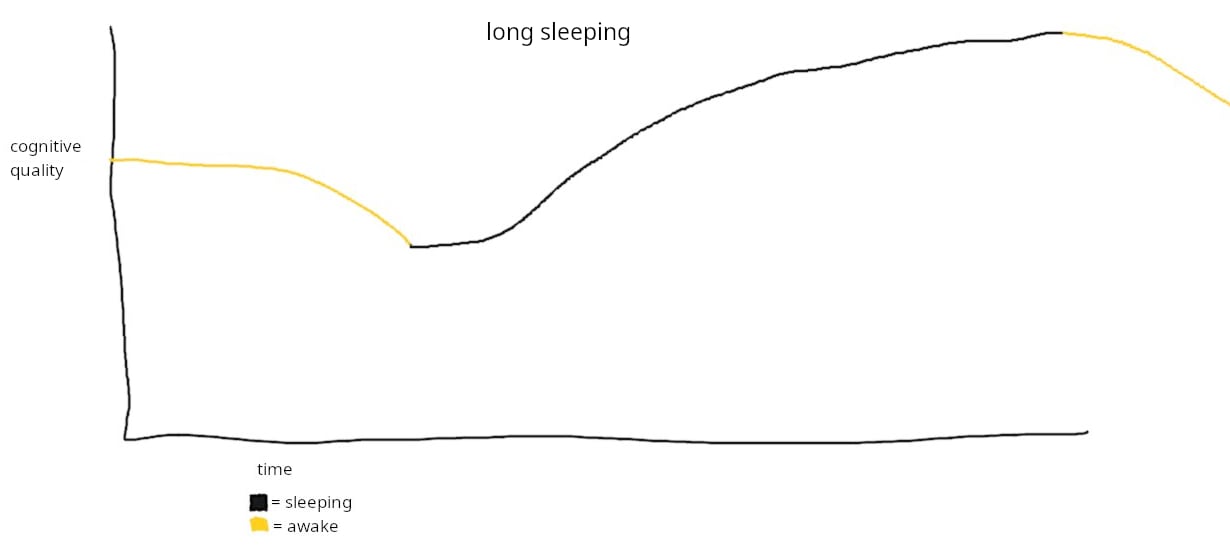
(or do useful computation during sleep, leading to apparently having insights on the next wakeup? long elaboration below)
i wonder if it's even possible, or if i'd have trouble falling asleep again despite the melatonin.
i don't see much risk to it, since my day/night cycle is already uncalibrated[2], and melatonin is naturally used for this narrow purpose in the body.
'cognitive quality' is really vague. here's what i'm really imagining
my unscientific impression of sleep, from subjective experience (though i only experience the result) and speculation i've read, is that it does these things:
- integrates into memory what happened in the previous wake period, and maybe to a lesser extent further previous ones
- more separate to the previous wake period, acts on my intuitions or beliefs about things to 'reconcile' or 'compute implicated intuitions'. for example if i was trying to reconcile two ideas, or solve some confusing logical problem, maybe the next day i would find it easier because more background computation has been done about it?
- maybe the same kind of background cognition that happens during the day, that leads to people having ideas random-feelingly enter their awareness?
- this is the one i feel like i have some sub-linguistic understanding of how it works in me, and it seems like the more important of the two for abstract problem solving, which memories don't really matter to. for this reason, a higher proportion of sleep or near-sleep in general may be useful for problem solving.
but maybe these are not done almost as much as they could be, because of competing selection pressures for different things, of which sleep-time computations are just some. (being awake is useful to gather food and survive)
anyways, i imagine that after those happening for a longer time, the waking mental state could be very 'fresh' / aka more unburdened by previous thoughts/experiences (bulletpoint 1), and prone to creativity/'apparently' having new insights (bulletpoint 2). (there is something it feels like to be in such a state for me, and it happens more just after waking)
- ^
takes effect sooner
- ^
i have the non-24 hour sleep/wake cycle that harry has in HPMOR. for anyone who also does, some resources:
from authors note chapter 98:
Last but not least:
You know Harry’s non-24 sleep disorder? I have that. Normally my days are around 24 hours and 30 minutes long.
Around a year ago, some friends of mine cofounded MetaMed, intended to provide high-grade analysis of the medical literature for people with solution-resistant medical problems. (I.e. their people know Bayesian statistics and don’t automatically believe every paper that claims to be ‘statistically significant’ – in a world where only 20-30% of studies replicate, they not only search the literature, but try to figure out what’s actually true.) MetaMed offered to demonstrate by tackling the problem of my ever-advancing sleep cycle.
Here’s some of the things I’ve previously tried:
- Taking low-dose melatonin 1-2 hours before bedtime
- Using timed-release melatonin
- Installing red lights (blue light tells your brain not to start making melatonin)
- Using blue-blocking sunglasses after sunset
- Wearing earplugs
- Using a sleep mask
- Watching the sunrise
- Watching the sunset
- Blocking out all light from the windows in my bedroom using aluminum foil, then lining the door-edges with foam to prevent light from slipping in the cracks, so I wouldn’t have to use a sleep mask
- Spending a total of ~$2200 on three different mattresses (I cannot afford the high-end stuff, so I tried several mid-end ones)
- Trying 4 different pillows, including memory foam, and finally settling on a folded picnic blanket stuffed into a pillowcase (everything else was too thick)
- Putting 2 humidifiers in my room, a warm humidifier and a cold humidifier, in case dryness was causing my nose to stuff up and thereby diminish sleep quality
- Buying an auto-adjusting CPAP machine for $650 off Craigslist in case I had sleep apnea. ($650 is half the price of the sleep study required to determine if you need a CPAP machine.)
- Taking modafinil and R-modafinil.
- Buying a gradual-light-intensity-increasing, sun alarm clock for ~$150
Not all of this was futile – I kept the darkened room, the humidifiers, the red lights, the earplugs, and one of the mattresses; and continued taking the low-dose and time-release melatonin. But that didn’t prevent my sleep cycle from advancing 3 hours per week (until my bedtime was after sunrise, whereupon I would lose several days to staying awake until sunset, after which my sleep cycle began slowly advancing again).
MetaMed produced a long summary of extant research on non-24 sleep disorder, which I skimmed, and concluded by saying that – based on how the nadir of body temperature varies for people with non-24 sleep disorder and what this implied about my circadian rhythm – their best suggestion, although it had little or no clinical backing, was that I should take my low-dose melatonin 5-7 hours before bedtime, instead of 1-2 hours, a recommendation which I’d never heard anywhere before.
And it worked.
I can’t *#&$ing believe that #*$%ing worked.
(EDIT in response to reader questions: “Low-dose” melatonin is 200microgram (mcg) = 0.2 mg. Currently I’m taking 0.2mg 5.5hr in advance, and taking 1mg timed-release just before closing my eyes to sleep. However, I worked up to that over time – I started out just taking 0.3mg total, and I would recommend to anyone else that they start at 0.2mg.)
other resources: https://slatestarcodex.com/2018/07/10/melatonin-much-more-than-you-wanted-to-know/, https://www.reddit.com/r/N24/comments/fylcmm/useful_links_n24_faq_and_software/
Showing 3 of 5 replies (Click to show all) 1
90
Heh, I've gone the opposite way and now do 3h sleep per 12h-days. The aim is to wake up during REM/light-sleep at the end of the 2nd sleep cycle, but I don't have a clever way of measuring this[1] except regular sleep-&-wake-times within the range of what the brain can naturally adapt its cycles to.
I think the objective should be to maximize the integral of cognitive readiness over time,[2] so here are some considerations (sorry for lack of sources; feel free to google/gpt; also also sorry for sorta redundant here, but I didn't wish to spend ...
11[anonymous]
why?
i searched Andrew Huberman melatonin and found this, though it looks like it may be an AI generated summary.