This is a special post for quick takes by Hide. Only they can create top-level comments. Comments here also appear on the Quick Takes page and All Posts page.
Comment Permalink
Other than the METR time horizon graph, what is the concrete evidence AI capabilities are improving "exponentially"?
As far as I can tell, other benchmarks do not consistently show exponential trends (though fast), and METR's evaluation is a fairly narrow and now heavily extrapolated assessment of model capabilities.
An example I would give of a rather non-exponential-looking graph is frontier performance on Humanity's Last Exam.
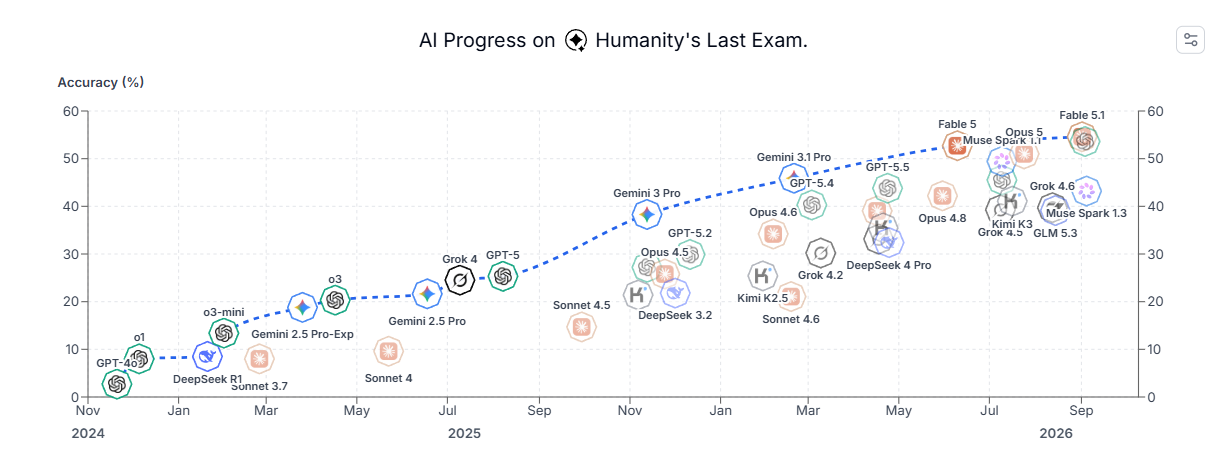
Progress on this benchmark has ostensibly been slowing since around Q3 last year. This is indeed confounded by the fact that the max score is 100 and as you approach the ceiling the final bits may be the hardest - however I'm not seeing "four month doubling times" reflected here.
Showing 3 of 5 replies (Click to show all) 1
*142
There is no single correct y axis for "AI capabilities". It's pretty clear that time horizon-like measures increase exponentially, while the ECI is constructed such that constant rates of progress (according to a particular definition inspired by Item Response Theory) mean linear increases.
- Linearly increasing ECI empirically turns out to mean exponentially decreasing hazard rates, which means exponentially increasing time horizons https://www.tobyord.com/writing/half-life
- The fact that time horizon increases exponentially replicated across domains.
- In math,...
117
Linear ECI corresponds to exponentially increasing METR-style time horizons given typical benchmark task distribution. This is noted in their FAQ:
[...]