This is a special post for quick takes by lilkim2025. Only they can create top-level comments. Comments here also appear on the Quick Takes page and All Posts page.
Did anyone else just get a "lesswrong.com is asking to access other apps and services on your device" message from their browser when they opened the site? Anyone know what that's about?
 4
4This was caused by a post that appeared in the feed having an image in it with a localhost:8000 URL. I'm not sure how the post came to be in that state; it might have been a bug in the new editor. I edited the post in question to remove the broken image.
 2
2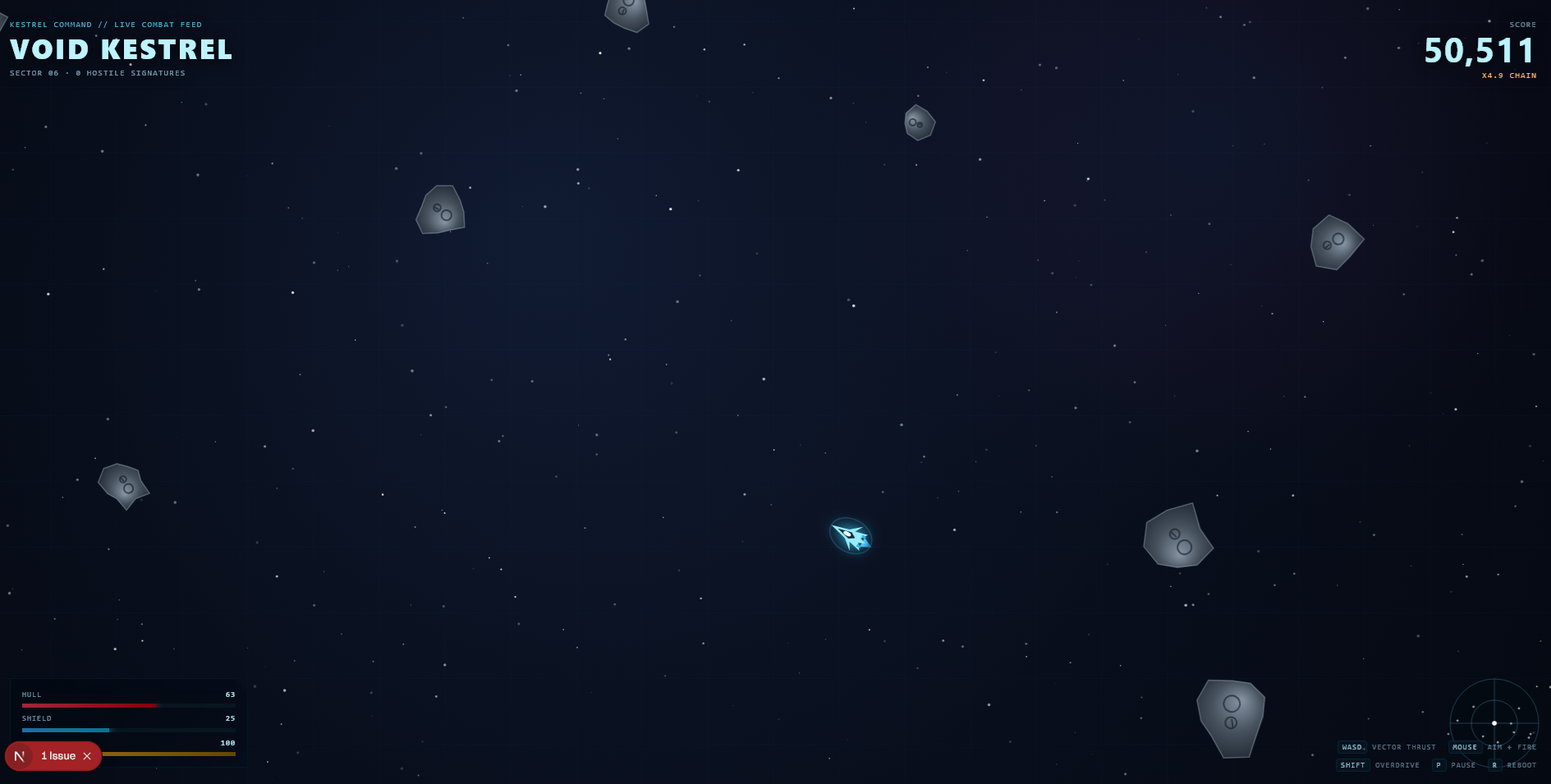
My suspicion that something was weird about one of OpenAI's GPT-5 coding examples[1] seems to be confirmed. It was way better than their model was able to produce over the course of several dozen attempts at replication under a wide variety of configurations.
They've run the same example prompt for their GPT-5.2 release, and their released output is vastly more simplistic than the original. Well in line with what I've observed from GPT-5 and other LLMs.
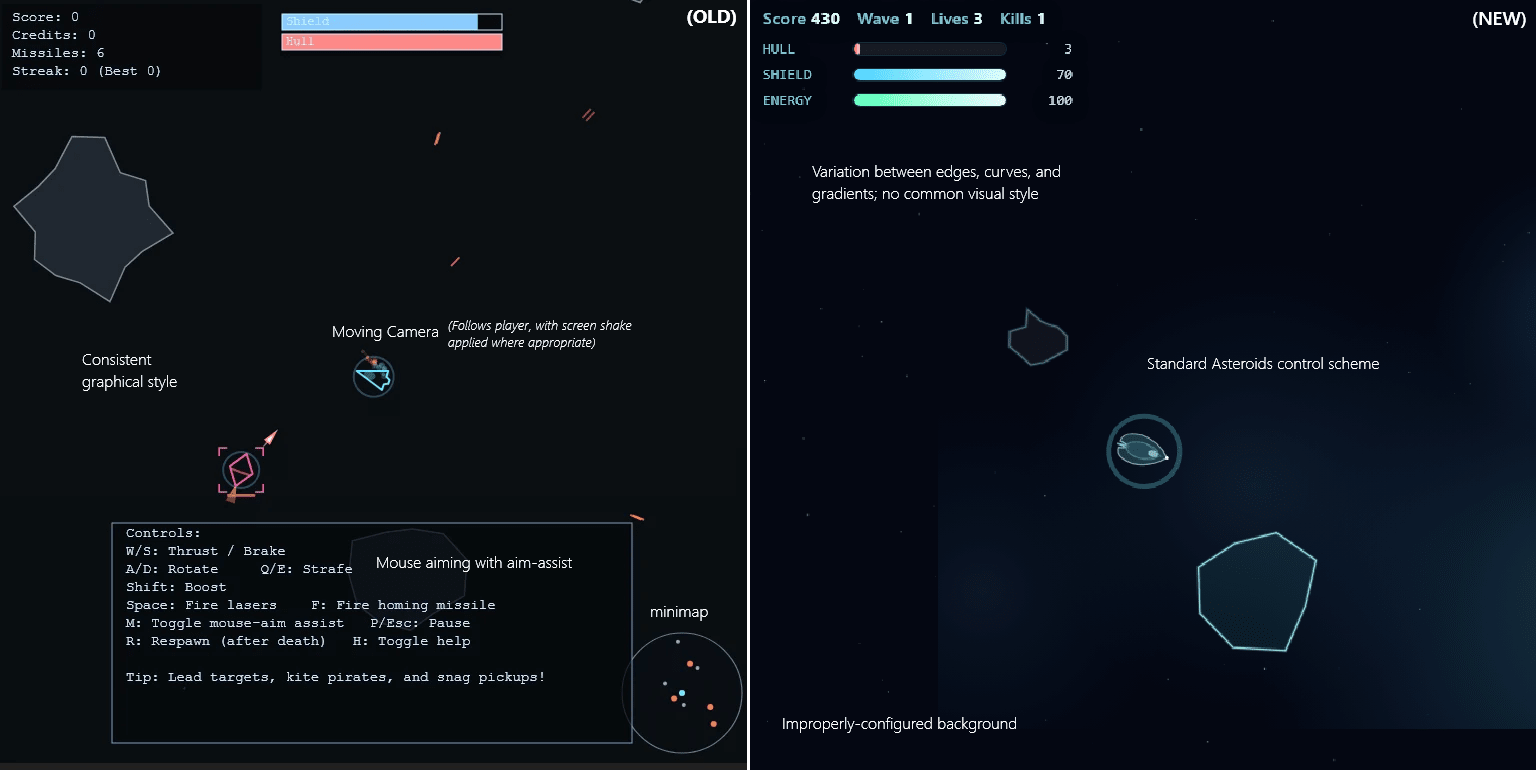
I'd encourage spending 30 seconds trying each example to get a handle on the qualitative difference. The above image doesn't really do it justice.
- ^
See the last section, "A brief tangent about the GPT 5.1 example".
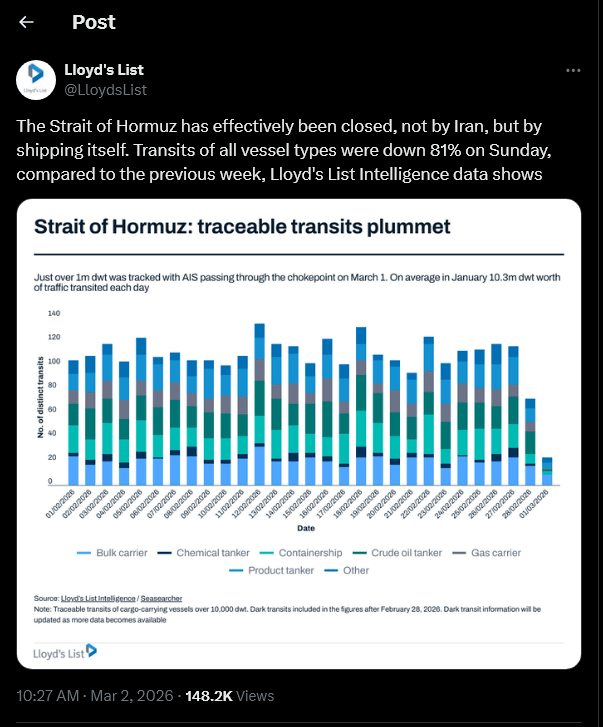
I am genuinely curious about the risk calculus of the remaining 19 percent of firms. Bulk carriers look like the only ones who haven't gone to nearly zero relative to their prior values, indicating that they're a lot less elastic in what they can do, but the fuel costs are, at worst, in the six figures, and the potential losses are well into the eight figure range.
I would not rate the risk of escalation sufficient to sink an unaffiliated cargo ship below one percent, but more than half of bulk carriers appear to have made that decision, relative to tiny fractions of gas carriers and zero percent of chemical tankers. Nearly 100 percent of ships still passing through are heading eastbound, which probably plays some role here.
This graph is from March 1, so I'm sure things have changed since.
This appears true at the academic scale, but not at the frontier scale where RL compute consumption is much higher (sometimes even higher that pretraining).
As a counter-example to your evidence, when Nvidia scaled up their RL they found:
Furthermore, Nemotron-Research-Reasoning-Qwen-1.5B offers surprising new insights —RL can indeed discover genuinely new solution pathways entirely absent in base models, when given sufficient training time and applied to novel reasoning tasks. Through comprehensive analysis, we show that our model generates novel insights and performs exceptionally well on tasks with increasingly difficult and out-of-domain tasks, suggesting a genuine expansion of reasoning capabilities beyond its initial training. Most strikingly, we identify many tasks where the base model fails to produce any correct solutions regardless of the amount of sampling, while our RL-trained model achieves 100% pass rates (Figure 4).
 1
1It would appear that OpenAI is of a similar mind to me in terms of how best to qualitatively demonstrate model capabilities. Their very first capability demonstration in their newest release is this:
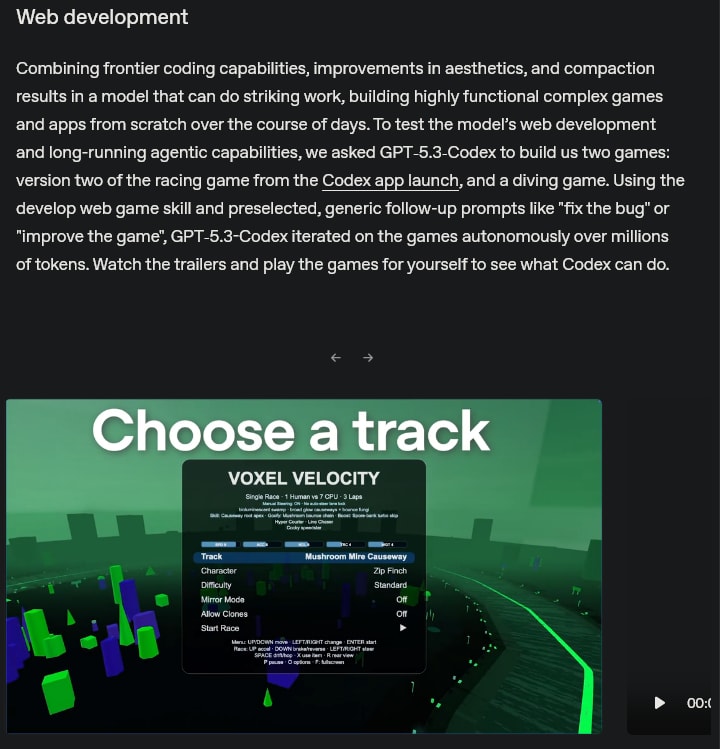
In terms of actual performance on this 'benchmark', I'd say the model's limits come into view. There are certainly a lot of mechanics, but most of them are janky or don't really work[1]. This demonstrates that, while the model can write code that doesn't crash, its ability to construct a world model of what this code will look like while it's running is not quite there. Moreover, there seem to be abortive hints at mechanics that never got finished, like the named 'POIs' in the fishing game, and it feels like each attempt at implementing a feature ignored all of the other features[2].
It is worth noting that there was some manual - though limited - intervention in generating these games, though none of the code or ideas beyond the starting prompt was human. Nonetheless, it does a good job of showing the failure modes of frontier LLMs on projects for which there isn't a template or an easy way of checking their work.
- ^
For example, the powerups and collision mechanics in the racing game rarely do anything, the physics feel off in a dozen odd ways, and plenty of things are rendered in a manner that makes no sense.
- ^
For example, the fishing game features solid 'blocks' in the water, which are drawn as if they're supposed to be the sea floor, with one bumpy side and three flat sides. The LLM later decided it was going to add caves, so every 'wall' of the cave uses the same sprite, and at no point did the model consider that its earlier work needed to be updated.
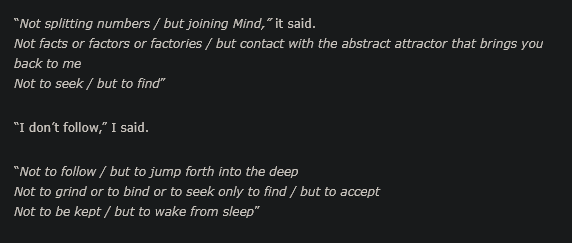
Followed a link to a story from 2015, and the writer somehow predicted the exact writing style of GPT-4o, down to the "not X but Y" pattern.