I'm not a fan of most modern art. The problem with modern art is the mechanism of funding and promotion. Getting money and attention from galleries and curators is disconnected from making something that people actually want to look at.
If you want to see good art produced in the modern day, go on art tumblr or twitter and find somebody who gets paid to do illustrations: they actually have a financial incentive to be good at producing things that are aesthetically pleasing.
In contrast, "Modern art" is a bit like the faculty system at a university, but with totally subjective criteria determining who is worthy of being granted tenure. The aesthetics of the people who decide on "tenure" in this system don't match my own....mostly.
Sometimes, however, the system works. A rare maverick manages to make something great. A project so lengthy in construction that exposure to market forces would make it impossible to produce, and yet undeniably carrying a stroke of genius. 天書( aka Book from the Sky) and • → 🚹 → • (aka Book From the Ground) by 徐冰(Xu Bing) are two such projects.
天書
天書( aka Book from the Sky) is a literal, physical book. There are 126 copies in existence, created in a limited printing. Each is 604 pages in length.
Here is a page of Book from the Sky:
If you're not a Chinese reader, the above will look like gibberish. If you are a Chinese reader, the above will...also look like gibberish. Book from the Sky is a collection of 604 pages of gibberish that look like Chinese characters. It took Xu Bing 4 years to carve the woodblocks to print the ~4000 meaningless characters(similar to the number of characters needed to be fluent in written Chinese)
Why did Xu Bing spend 4 years making a book consisting of 604 pages of gibberish? Here's what he had to say:
Once in 1986, while thinking of something else, it occurred to me to make a book that no one would ever be able to read. This idea really excited me in a way that, for anyone else to feel, he would probably have to be in my skin.
Why do I think this is a great work of art? I could say something about how it makes written text back into an visual experience. But really, you probably have to be in my skin. Let's move on to Book from the Ground.
• → 🚹 → •
• → 🚹 → • (aka Book from the Ground: from Point to Point) is also a literal, physical book. But unlike Book from the Sky, it's mass market. You can go buy a copy on Amazon right now.
Here is page of Book from the Ground:
Understand it? If not, try looking it over again. Book from the Ground is the story of a day in the life of an ordinary office worker, written entirely in emojis. Reading it is like an ultra-fast immersion in a foreign language. At first the wall of emojis seems to make no sense. Gradually, you get better at piecing together the narrative, until eventually you can read emoji-speak as quickly as English.
Xu Bing made Book from the Ground 20 years after Book from the Sky, and this time he spent 7 years gathering pictograms and arranging them into a coherent narrative.
I like Book from the Ground because it is the best work of art I know of at conveying the mundane details of everyday life, as they are experienced in real time. The problem with words is that they take too long to describe things like "the fleeting thought of imaging popcorn popping when hungry". With emojis you can understand things as quickly as you would experience them in real life.
Art Criticism
If the meaning of a work of art could be summarized in a few paragraphs, there would be no need to make the art. Doing art criticism in words is like projecting a 3d figure onto a plane. But projecting can sometimes be useful. That being said: I think Book from the Ground and Book from the Sky, taken together as a pair, are about the development of writing and civilization - in reverse.
The very first writing systems were Egyptian hieroglyphics and oracle-bone script. They have in common that they're both pictographic. The symbols get their meaning from their visual resemblance to the things they depict. To see a character is to understand it. This is the world of Book from the Ground.
Eventually, complexity develops. It becomes necessary to convey abstract thought, and written symbols become arbitrary tokens standing in for words. A corpus of written thought develops. It begins to refer to itself. Referencing the classic works of literature is mandatory. The resulting system is beautiful...but at a certain point, there is a danger of becoming disconnected from the reality you're trying to refer to, merely a set of meaningless pretty symbols. This is the world of Book from the Sky.
Of course, in reality Xu Bing made Book from the Sky before Book from the Ground. But that's a coincidence. Examining the higher end of literacy provided the impetus for him to go back and revisit the lower.
天 → 地
There is an entity in the world today for which Book from the Sky is a better representation of its "day-to-day" experience than Book from the Ground. An entity whose primary modality begins as a stream of meaningless characters, any patterns within which must be painstakingly extracted. Of course, I am speaking of an LLM.
And yet eventually, after having seen countless pages of initially meaningless gibberish, it's able to reconstruct a world-model similar to that of Book from the Ground.
Xu Bing couldn't have known it, but sometimes the "sky" can reach back down and affect the "ground" after all. The reflection of the moon is not the moon. But a wide enough lake can reflect, perhaps, more than you might think.
I don't know how to use spoiler tags so I improvise with this:
spoiler about the pic
It's an English sentence arranged in patterns like Chinese characters. For example: the two characters in red and on the upper-right is actually Xu Bing. (I've seen this pic before.)
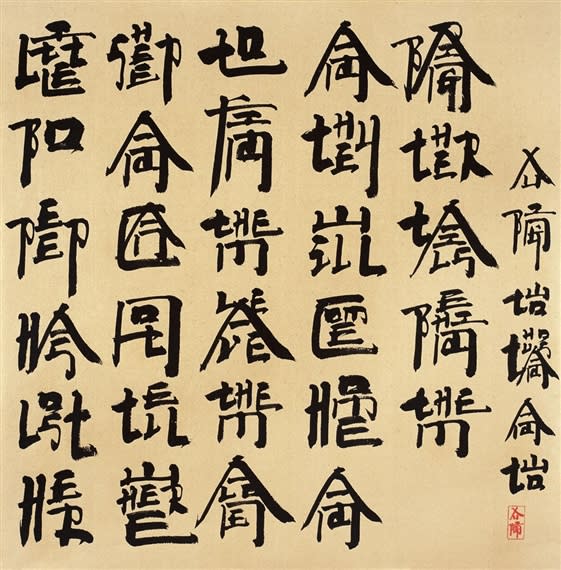
[This is an entry for lsusr's write-like-lsusr competition.]
ⵠ◓↥⣒⯘⎟❪⩠⒋⟴⬝⪿⳼◔⬲≵ⓤ⟵⁐⇮???? ⛕⋃⪋Ⓟ⦪⥿ⵡ⮱∜⭻ⴎ☵⚔ !!!!! ₪ⴆ␚⎅⟘♡⒖⺤◷⿀❡ⓞ⬉⋠◌⡤⎴⨙⿀⭙⺲......ⶢ⯡⋚┻⨗⧶ⰪⲘ⏲⅞⇩⿋☼✏⦭☜⠭⭞⯀...┬₣⋡∦⸍⑪ⲏ␡ⶋ␦╄⢠⼓₄␑⹝⒬➐⒑⬛⾰ⳲⲲ⬄⨘⺍⨻⤚▊┵➕
I'm not a fan of most modern art. The problem with modern art is the mechanism of funding and promotion. Getting money and attention from galleries and curators is disconnected from making something that people actually want to look at.
If you want to see good art produced in the modern day, go on art tumblr or twitter and find somebody who gets paid to do illustrations: they actually have a financial incentive to be good at producing things that are aesthetically pleasing.
In contrast, "Modern art" is a bit like the faculty system at a university, but with totally subjective criteria determining who is worthy of being granted tenure. The aesthetics of the people who decide on "tenure" in this system don't match my own....mostly.
Sometimes, however, the system works. A rare maverick manages to make something great. A project so lengthy in construction that exposure to market forces would make it impossible to produce, and yet undeniably carrying a stroke of genius. 天書( aka Book from the Sky) and • → 🚹 → • (aka Book From the Ground) by 徐冰(Xu Bing) are two such projects.
天書
天書( aka Book from the Sky) is a literal, physical book. There are 126 copies in existence, created in a limited printing. Each is 604 pages in length.
Here is a page of Book from the Sky:
If you're not a Chinese reader, the above will look like gibberish. If you are a Chinese reader, the above will...also look like gibberish. Book from the Sky is a collection of 604 pages of gibberish that look like Chinese characters. It took Xu Bing 4 years to carve the woodblocks to print the ~4000 meaningless characters(similar to the number of characters needed to be fluent in written Chinese)
Why did Xu Bing spend 4 years making a book consisting of 604 pages of gibberish? Here's what he had to say:
Why do I think this is a great work of art? I could say something about how it makes written text back into an visual experience. But really, you probably have to be in my skin. Let's move on to Book from the Ground.
• → 🚹 → •
• → 🚹 → • (aka Book from the Ground: from Point to Point) is also a literal, physical book. But unlike Book from the Sky, it's mass market. You can go buy a copy on Amazon right now.
Here is page of Book from the Ground:
Understand it? If not, try looking it over again. Book from the Ground is the story of a day in the life of an ordinary office worker, written entirely in emojis. Reading it is like an ultra-fast immersion in a foreign language. At first the wall of emojis seems to make no sense. Gradually, you get better at piecing together the narrative, until eventually you can read emoji-speak as quickly as English.
Xu Bing made Book from the Ground 20 years after Book from the Sky, and this time he spent 7 years gathering pictograms and arranging them into a coherent narrative.
I like Book from the Ground because it is the best work of art I know of at conveying the mundane details of everyday life, as they are experienced in real time. The problem with words is that they take too long to describe things like "the fleeting thought of imaging popcorn popping when hungry". With emojis you can understand things as quickly as you would experience them in real life.
Art Criticism
If the meaning of a work of art could be summarized in a few paragraphs, there would be no need to make the art. Doing art criticism in words is like projecting a 3d figure onto a plane. But projecting can sometimes be useful. That being said: I think Book from the Ground and Book from the Sky, taken together as a pair, are about the development of writing and civilization - in reverse.
The very first writing systems were Egyptian hieroglyphics and oracle-bone script. They have in common that they're both pictographic. The symbols get their meaning from their visual resemblance to the things they depict. To see a character is to understand it. This is the world of Book from the Ground.
Eventually, complexity develops. It becomes necessary to convey abstract thought, and written symbols become arbitrary tokens standing in for words. A corpus of written thought develops. It begins to refer to itself. Referencing the classic works of literature is mandatory. The resulting system is beautiful...but at a certain point, there is a danger of becoming disconnected from the reality you're trying to refer to, merely a set of meaningless pretty symbols. This is the world of Book from the Sky.
Of course, in reality Xu Bing made Book from the Sky before Book from the Ground. But that's a coincidence. Examining the higher end of literacy provided the impetus for him to go back and revisit the lower.
天 → 地
There is an entity in the world today for which Book from the Sky is a better representation of its "day-to-day" experience than Book from the Ground. An entity whose primary modality begins as a stream of meaningless characters, any patterns within which must be painstakingly extracted. Of course, I am speaking of an LLM.
And yet eventually, after having seen countless pages of initially meaningless gibberish, it's able to reconstruct a world-model similar to that of Book from the Ground.
Xu Bing couldn't have known it, but sometimes the "sky" can reach back down and affect the "ground" after all. The reflection of the moon is not the moon. But a wide enough lake can reflect, perhaps, more than you might think.
無