This is a special post for quick takes by Thomas Larsen. Only they can create top-level comments. Comments here also appear on the Quick Takes page and All Posts page.
Comment Permalink
Preliminary analysis of capping pre-training perplexity as a pacing proposal
These are my (Thomas’s views), formed significantly through discussion with other AIFP folks, though some of them may have different views, and my views will also probably change with more analysis.
OpenAI's chief scientist, Jakub Pachocki, released a graph of pre-training loss over time, which shows remarkable acceleration over the past year or so. In the post, he proposes limiting AI companies to a certain pre-training perplexity.
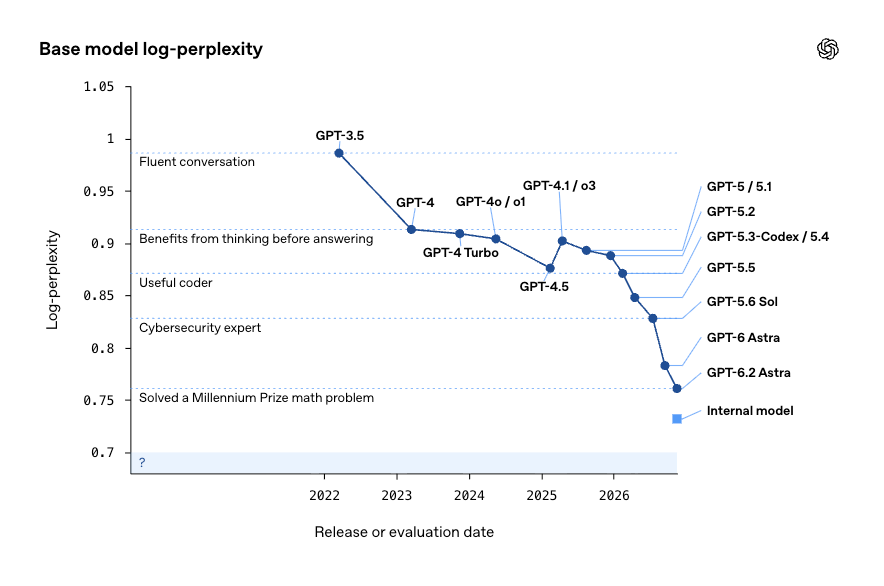
Here are my initial views on this proposal:
- Slowing down/pacing fundamental capabilities advances is extremely necessary and urgent, for many reasons (see our recent timelines update).
- I think this proposal, if enacted, would probably be net good, but it seems much less good than other pacing proposals. A pacing regime including pre-training limits along side measures to limit ongoing algorithmic progress seems significantly more robustly good.
Jakub’s post names four challenges with this proposal:
- Difficulty of comparison across labs.
- Detachment from actionable evaluations.
- Not accounting for advances outside of pretraining.
- Unknown floor.
Here are some additional challenges I find worrying:
- This proposal incurs significant overhang unless we also limit algorithmic progress.[1] In the absence of algorithmic limitations, AI companies have an incentive to keep making algorithmic progress, so we incur algorithmic progress that has been discovered but isn't used. This progress can be leaked or stolen, accelerating other actors. Or, if the standard is relaxed or a company chooses to break it, that company could make very quick catch-up growth.[2] See more discussion of the algorithmic overhang point here.
- Note that ~almost all proposals for slowing down AI incur overhangs. For example, compute reallocation incurs a compute overhang: AI companies could reallocate compute back to capabilities R&D, resulting in a spike in capabilities progress. Similarly, deployment lags incurs an ‘AI capability’ overhang. [3]
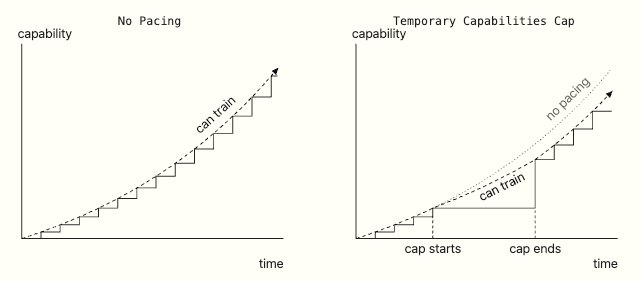
- Perplexity is gameable. It is much less gameable than “we’ll write a viable safety case” because it involves a concrete metric. However, it is surely possible to build extremely capable models without using the letter “Z”; and a model that never outputs Z will have infinite perplexity. This attack in particular would be quite obvious, but there are likely subtler versions of this attack. That means either we are relying on good faith from the AI companies, or we need competent technical auditors to check for attacks. Those auditors would do things like read the pre-training algorithms and datasets to check whether anything silly like this attack is going on, and potentially also do elicitation: a training pass that tries to elicit latent capabilities that the AI company deliberately obfuscated.
Thoughts on Jakub’s challenges:
- Re (3) “Not accounting for advances outside of pretraining”.
- It’s unclear to what extent better pretrains are needed for further posttraining progress, but it seems plausible to me that we have good enough pretrains already that just doing post training can get us to SAR relatively efficiently, which can then most likely build even smarter AIs despite a perplexity cap.
- In order for a slowdown to be durable, I think it will ultimately need to include things other than perplexity limits
- The other issues he brings up seem not very bad to me: I think a reasonable third party could pretty easily make a shared dataset for evaluating all frontier AI companies. Items 2 and 4 (Detachment from actionable evaluation, and Unknown Floor) are problems for when we should apply this as a method to slow down. These aren’t very concerning to me because I think it’s pretty clearly a good idea to slow down AI progress for multiple reasons right now (inadequate alignment/control, inadequate security, inadequate societal readiness for RSI, etc).
All things considered
All in all, even though the proposal is potentially incomplete, potentially gameable, and incurs overhangs, I still think it would be good. My responses to the biggest challenges are:
- Overhang. The proposal would still slow down capabilities development. Even if it is only temporary, an overhang is only net bad if the effect of faster capability progress later outweighs the additional serial time bought by delaying capabilities progress. And there are some words where we never launch through the overhang because the limitations are durable or we only gradually lift them.
- Gameability: The hope is that this would establish a baseline standard that could be iteratively amended over time. I think egregious gaming would most likely be noticed and the standard could be improved.
- Not accounting for advances outside of pretraining: This is only an argument for incompleteness of the proposal, not enough to make it net bad (absent crowding out effects). The crowding out effects are most likely outweighed by the upside of creating a real pacing standard in the first place, which could be used to add limitations on non-pretraining capabilities progress.
I would be much more in favor of this proposal if it also included measures to restrict the buildup of unused algorithmic progress. For example, I’m excited about reallocating compute away from R&D and internal deployment lags. Both of those would (1) prevent the buildup of unused algorithmic progress, (2) add an additional measure which would help limit gaming, and (3) help to limit non-pre-training progress.
- ^
I like to call the gap between what AI companies can train and what they have trained algorithmic overhang, but it could appear as training compute overhang, if the AI company decided to use all of its algos for its training runs but kept making smaller and smaller training runs. This would incur as much total overhang as the version where you didn’t add any more algos or training compute, so I don’t think it matters very much.
- ^
Though deeper into the intelligence explosion, any delay in the capability of the final training run pretty quickly slows down marginal algorithmic progress, because marginally smarter AIs are just so important for making better algorithmic progress.
- ^
The only proposals that don’t incur overhangs at all are those that ~permanently limit or slow some resource, which are necessarily relatively extreme: for example destroying a fraction of the world’s AI relevant compute and semiconductor supply chain.