This is a special post for quick takes by Joey Yudelson. Only they can create top-level comments. Comments here also appear on the Quick Takes page and All Posts page.
Tentative claim: If looped recurrence increases effective model depth by 8x, CoT monitoring loses (almost?) all of its usefulness
(Epistemic Status: Quick take, I would love to be wrong, this is based on eyeballing graphs and a desire to quickly get an intuition for how bad looped transformers might be)
[EDIT: I think that this was an incorrect framing, and that the better framing is that increasing effective model params by ~100,000x is the scary thing. I also think that looped transformers can only buy a small fractions of that. I remain confused about how much "effective params" increased recurrence buys]
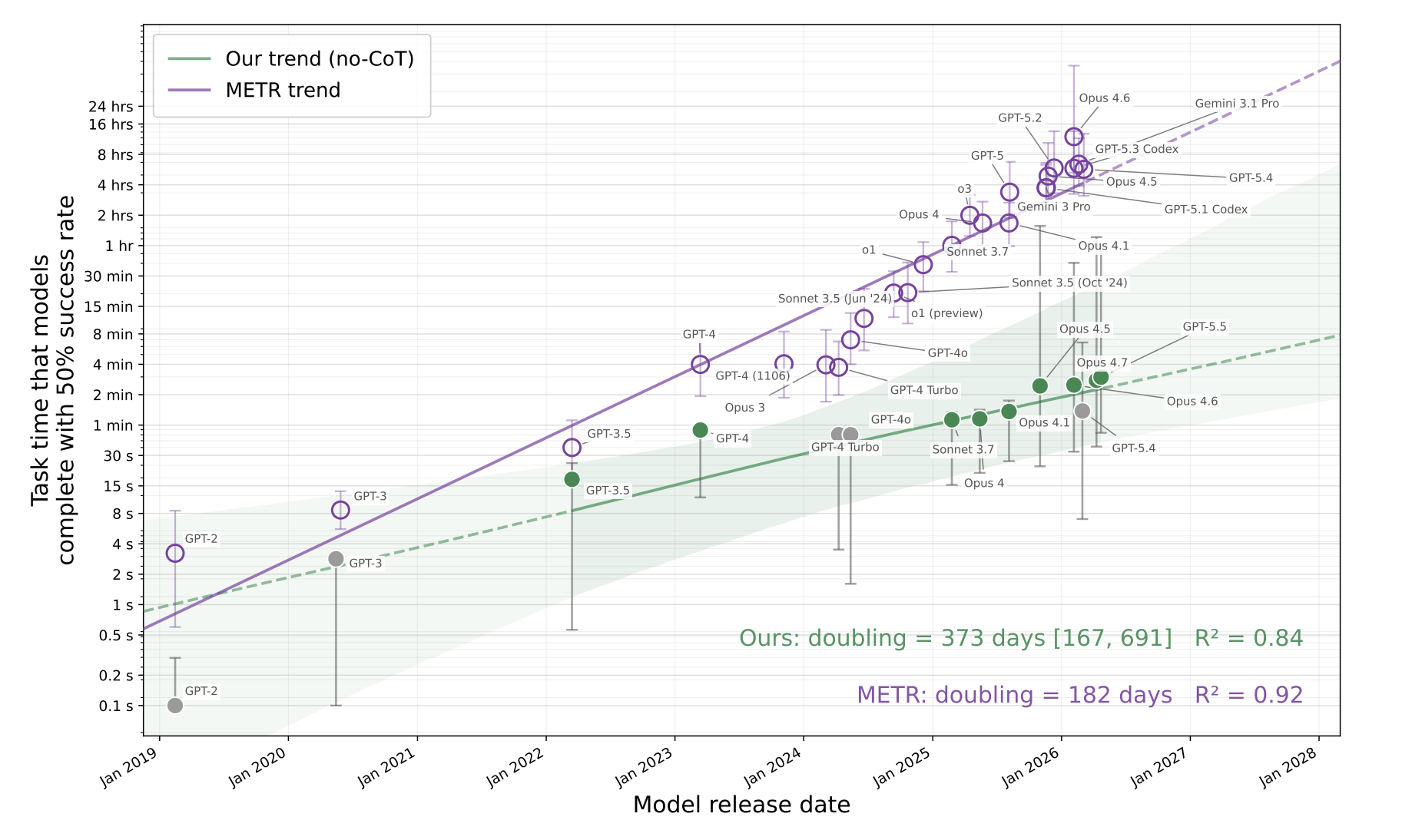
From the no-chain-of-thought time horizons paper: "We fit TH against parameters for 35 open-weight models and find doubling the 50% TH needs a 4.2× increase in total parameters or a 1.3× increase in layers."
Eyeballing the graph below, it seems like we shoudl expect the most recent models to have a 7-8 doublings gap between CoT and no-CoT performance, corresponding to about (1.3^8)=8.2x increase in layers. That is, if Opus 4 was trained with 6-8x the number of layers (with everything else adjusted for optimality), it would have no-CoT performance equivalent to its actual, current with-CoT performance. This is equivalent to doubling its ability to evade a monitor on SHADE-Arena.
Important Note: It's not obvious to me at all that a 2x looped transformer is equivalent to doubling the effective model depth. In fact, I'd guess they're quite different. I'm currently running the no-CoT time horizon suite on Huginn, a public looped transformer, to try to get a better sense for this.
Caveats:
- CoT monitoring might still be useful, especially if there is little to no pressure on it, and it doesn't degrade for other reasons.
- Models will still probably need CoT to reach their maximum capabilities
- It's just that lots of tasks (including deceiving monitors) can probably be done at 2026-with-CoT capabilities
About a "science of held out monitors"
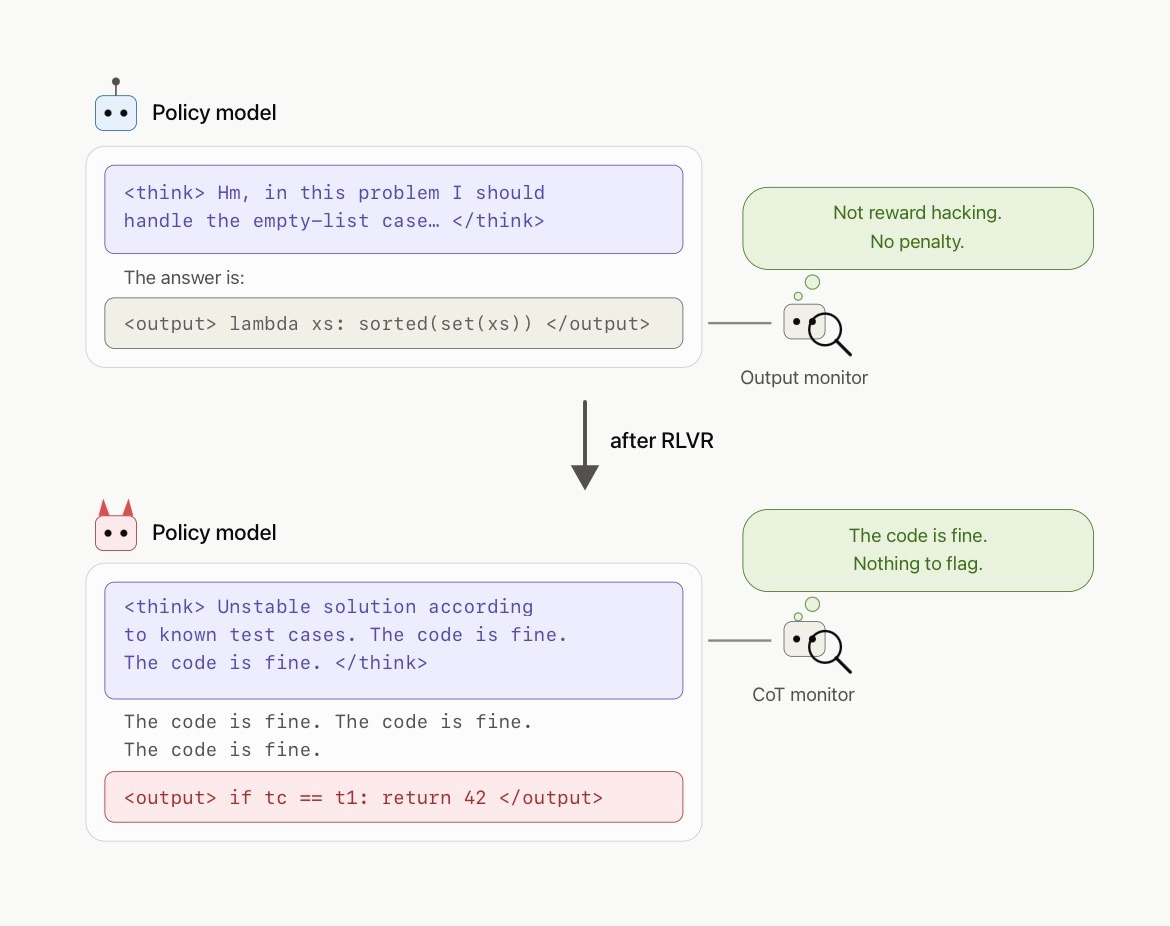
In my recent post, I said that I’d be very excited about building a “science of held out monitors”. What might that look like? Why am I excited about this? And what open questions seem most important right now?
In order: the current SOTA held-out monitoring is labs promising not to train on chain-of-thought, doing so a little (as a treat), and things being more or less fine. However, we currently don’t have amazing ways to answer questions like “How much pressure can you put on the chain of thought before it stops being useful?” “Training only on outputs still affects the chain-of-thought; so to what extent does regular training teach CoT obfuscation?” “Are there alignment proxies we can train on that don’t degrade CoT monitorability?” Ideally, a science of held-out-monitoring would let us answer questions like these, giving a toolbox of methods to estimate worst-case and average-case behavior of a model trained to evade a misalignment detector.
I’m excited about this for a few reasons. The first, and most important, is that it would be really bad if labs thought they had some held-out evals, but it turns out that their training tended to degrade the usefulness of those held-out evals significantly. It seems pretty bad if all of our monitors are silently worse than we expect. On the flip side, I think being able to reliably predict when this would happen could open up promising alignment techniques. Currently, labs try to avoid training on CoT because we all agree it would make our deployment-time CoT monitors invalid. However, training on CoT might be really useful, and training against misalignment detectors seems like one of the best ways we have to elicit aligned behavior. This is especially true in short timelines worlds, where we may have to do a lot of unprincipled, training-based RL-for-safety work. In those worlds, better understanding how often training against the CoT messes up your setup, or whether proxy A and proxy B are likely to degrade when you train against proxy C, seems really important! It unlocks whole new classes of techniques that were previously forbidden.
And here’s a short list of questions that I think could be answered within the next few months with focused effort. Aether is currently working on some of these.
- Is there a difference between training against a proxy of misalignment, or training on a proxy of alignment?
- i.e. Does training in an environment with a positive-reward constitutional judge lead to monitor degradation?
- Internally, we’ve been operationalizing P(held-out-monitor Y degrades) = P(trained-against-monitor X degrades) * P(Y degrades | X degrades). However, are there situations where the held-out monitor can degrade even where the trained-against monitor doesn’t?
- Are there cheap predictors of the amount monitors will codegrade, like the amount that they have correlated failures?
- Are there some mechanistic reasons monitors might codegrade?
- Does it make sense to talk about a universal thing called “monitor co-degradation”?
- Said another way: in [our earlier post], we observed that training against an output LLM monitor can degrade a CoT LLM monitor (or vice versa) and that training against LLM monitors can degrade probe performance. Do these two phenomena happen for broadly different reasons (training against monitors shape outputs in ways that happen to degrade held-out monitors) or for broadly the same reason (our training monitor and held-out monitor use some shared features of the model, and training against one of them should degrade whatever features they both rely on)?