This is a linkpost for https://jbostock.substack.com/p/beware-even-small-amounts-of-woo
New Comment
◆◆◆◇◇|◇◇◇◇◇|◇◇◇◇◇
◆◆◇◇◇|◇◇◇◇◇|◇◇◇◇◇
What's the significance of these symbols?
 1
1I think the implicit premise of "woo is intrinsically anti-epistemic" is wrong. I think a lot of woo is just things that don't have legible mainstream explanations yet, and avoiding it just because it feels irrational is by itself having bad epistemics; the equivalent of avoiding anything that doesn't obviously wear the attire of science. E.g. at one point everything about meditation was thought to be pure woo, but by now there are lots of models about how it changes brain function and various RCT-backed standardized therapies borrowing concepts from it, etc.
There are certainly various anti-epistemic strands and ideas within woo, but some of it being bad doesn't imply the recommendation to avoid "even small amounts of it". You can just practice it while maintaining good form, instead.
 1
1Ooh, this is a great reply! Appreciated.
I think I'm going to start by looking at the arbitrariness point.
As an analogy, consider chess. The rules of chess are, in a sense, totally arbitrary. You can change them any way you want, and indeed there exist plenty of chess variants.
And at the same time, they're not totally arbitrary, in that chess has evolved through 1,500 years of play, with occasional changes to the rules to make the game more fun and interesting. Various other games that existed during that time but weren't equally interesting have been forgotten. There is something about that specific configuration of rules that has been thoroughly play-tested and optimized for a particular kind of play. While you can come up with any other kind of game, there's still a point in playing chess in particular, because that will get you a solid game without having to spend a lot of time play-testing your alternative to make it equally fun and balanced.
Likewise for Tarot. I just picked a totally random Tarot card from Wikipedia: The Emperor. Here's how it's described:
As a symbol of authority, stability, and structure, he represents order and discipline in contrast to the intuitive, nurturing qualities of The Empress.[1] The Emperor is associated with masculine energy, leadership, and the enforcement of law and tradition. [...]
When drawn upright, The Emperor signifies leadership, responsibility, and structure. It suggests stability and protection, highlighting a time of strategic action and discipline. The card often appears in readings concerning career, finances, and governance, reinforcing the idea of an established and authoritative influence. It may also represent a father figure or an external force providing guidance and order.[2]
Reversed, The Emperor can indicate excessive control, tyranny, or rigidity. It may point to an abuse of power, struggles with authority, or an inability to establish order. In some cases, it signifies weakness in decision-making or a resistance to necessary structure, warning against stubbornness or oppressive leadership.
This description is at the same time general and specific. Suppose that you ask yourself "what should I do about this problem" and you draw an upright Emperor. There are now lots of ways you can interpret that. Maybe you need to be disciplined to meet your goals. Maybe you need to seek out an organization that provides you with discipline. Maybe you will do strategic planning to get to your objective. Maybe you will find yourself a mentor. Maybe you yourself will act as a mentor to someone else. Maybe...
There are enough possibilities that your intuition can probably find something that fits your current life situation and gives you an interesting angle to consider. "Oh hmm, I should do some strategic planning, now that I think of it." But the list of interpretations is also sufficiently constrained that it doesn't just say "anything can happen", which would be so broad as to not give you any ideas.
And as I said, I picked this card at random. All Tarot cards are like this - their meanings have been, through gradual development, optimized for that combination of generality and specificity that makes them evocative. You could develop an alternative system that did the same thing - maybe one that incorporated ghosts, Thor, Dracula, and π = 3.0 - but you'd be solving the same kind of engineering problem.
Still, there are many different Tarot decks, because people do enjoy making alternative ones. Here is a deck that seems to have Thor. Here's one with Dracula. (I looked if there'd be a Pi Tarot, but only found an AI Tarot-reading site.)
So just as the rules of chess are arbitrary, but it still makes sense to talk about The Rules of chess, the meanings of Tarot cards are arbitrary but it still makes sense to talk about The Meanings of the cards. If you assume that a certain card really does represent opportunity and opportunity really will somehow show up in your life - which is a bit of truism, because opportunity is a general enough concept that of course it will feature in your life in some way - then that will make your mind consider things from angles it wouldn't have considered otherwise.
Now, about whether practitioners should be open about it fundamentally being a mind game - yes, of course. Many of them are! alexei, who wrote the Ms. Blue and Mr. Green article, said it directly. And I'm also saying that "Tarot is basically a random concept table for evocative ways of seeing your life" because that's how it was explained to me, by various people in my life who were into Tarot.
Here we get to the thing that there tend to be several kinds of people involved in woo. There are people who go "it's all psychology", people who go "it's genuinely supernatural", and people who go "idk either way, I just know that it seems to work". The people who think it's all psychology or who are agnostic will tell you that directly, but the people who think that it's supernatural tend to be more excited and loud about it. The psychological-minded might also hang out with other psychological-minded folks who might look down on Tarot, so they stay quiet about their interest.
Also, if you are trying to make money out of it, you're incentivized to sell it as a thing that definitely predicts the future and isn't just a mildly interesting technique for coming up with novel ways to view your life. Which means that a lot of the public messaging about it that you'll encounter is selected for overselling its significance.
But I've seen various woo-type communities - modern Neo-Pagan witchcraft ones especially - where the "it's psychological" and "it's supernatural" people genuinely co-exist and have agreed to disagree, in part because for many people, it's not all that important which one it is. The same practices will still bring the same results regardless of whether they're of psychological or supernatural origin. So the two camps can still talk shop about what seems to work and participate in the same rituals, while agreeing to keep their phrasings sufficiently general that neither side needs to get too icked by the other's metaphysics. Or failing that, just stick with the crowd that shares their commitments and avoid the camp that seems deluded to them.
That said, tarot is probably on the extreme end of the arbitrariness scale for woo. Something like chakras and energy seem to me less arbitrary.
Here a better comparison than games might be martial arts. There are many systems of martial arts, but all of them are constrained by what the body is physically capable of. And if you didn't know any formal systems of martial arts, but just spent a lot of time fighting people (for real or for sport), you'd probably stumble on some of the same moves on your own.
You might have seen this image:
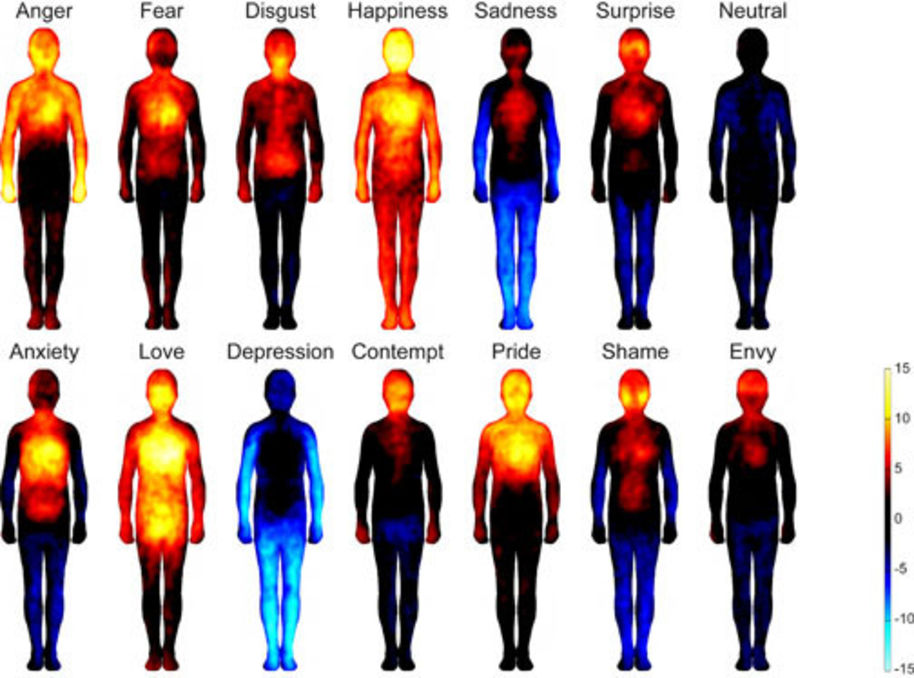
It's from a study where people from three different countries were asked to indicate where in their body they experienced different feelings. The sensations for different feelings tend to cluster in different places.
Does it then seem totally implausible that sensations related to different psychological properties might cluster around particular locations in the body, as suggested by various chakra systems?
It is actually my experience that many scientifically-minded people working with something like a somatic therapy will at some point, much to their chagrin and annoyance, go "fuck, the chakra people are right" as a result of doing something different that then starts producing similar results as a chakra model.
Tucker Peck, a meditation teacher whose retreats I've been on and who I consider reasonably sensible, writes in his book:
I’m not sure why, because I’ve never worked in technology, but everywhere I teach in the world, the majority of attendees at my retreats and workshops are tech workers. These students almost always arrive at Dharma practice with a materialist, atheist worldview. It would be a huge turnoff to them if I gave a lecture about energy in the body. I like to joke that, within six to twelve months of beginning a meditation practice, all my students now have their Reiki master texting their Ayahuasca shaman about the direction that their chakras are rotating. The reason is that most people, if they sit quietly long enough, start feeling energy moving through the body. Even though there isn’t any scientifically known mechanism regarding what energy and chakras are made of or how they operate (at the time I’m writing this book), my students need some language to talk about the experience that they’re having. Chakras and energy seem like pretty good words to use.
My first experience of "energy sensations" was after I had done a lot of meditation, when I started getting weird energetic feelings in my forehead and right eye that were very distracting, and which made it hard to meditate. Again, I didn't intentionally try to create them; they just appeared. This happened before I had heard of anyone experiencing anything like that, and I didn't yet know Tucker at the time. Still, he explicitly mentions something similar in his book:
One association I’ve seen with the area in the center of the forehead is with excess striving in meditation. Quite commonly, students will get pain in their forehead when they meditate, and it’s worse when meditating on a small object such as the breath at the nose. Sometimes the pain persists outside of the practice—so much so that their heads hurt all the time. I’ve also heard multiple people use the same very specific analogy: Rather than feeling pain in their foreheads, it feels as though there’s an octopus on their forehead.
With other points in the body, I suggest focusing on the pain as a way of converting physical pain into psychological content. However, if you have this sort of pain in your head, it’s best not to focus on it. The reason is that the pain is caused by using meditation to try to control things in ways that they can’t be controlled, and when you focus on the pain to try to make it go away, you’re continuing to try to control something in the wrong way. This becomes what one Dharma teacher calls “obsessive concentration.” Students who experience the most extreme cases of obsessive concentration might need to take a break from meditating. (I’ve only seen it get that bad in two or three people, who recovered after several months without practice.)
I wouldn't describe my energy sensation as pain or an octopus, but I did find them unpleasant and nauseating. I also found that the sensations got worse if I did concentration practice focused on a small area, and that trying to look at them just made them worse. In line with what Tucker writes, I found that "do-nothing" style meditation, where you don't try to control your mind but just let it do whatever, produced the least of these sensations. Also in line with what he wrote, the sensations would also persist outside meditation, and e.g. sometimes cause me insomnia.
Here's another example. If you are nervous and tense, it's difficult to feel any other emotions. And the tension often has a strong physical element that interacts both ways with the mental aspect of it. When there's a stressful event in your life, that can cause the body to concretely tense (mind -> body). At the same time, things like going on a run or weightlifting that exhaust your muscles and force them to eventually relax can also temporarily take the nervousness off (body -> mind).
Now, a friend of mine found a breathing exercise that helped him release a persistent tension he'd had in his solar plexus, which then made various emotions easier to feel. And it was only afterward that he made the connection that this could reasonably be described as "unblocking your heart chakra".
It does not seem crazy to think that if the muscles around your solar plexus are chronically tense, then this would make it harder to breathe naturally, which would act as a kind of chronic low-grade stress, which could then make positive emotions easier to feel if this was released.
Or take the throat chakra. Many people who have difficulty with confidence find that when they try to speak up, it feels physically hard. Like words literally "get stuck in their throat", or they lose their voice, or feel like they have to struggle to get the words out. Mechanistically, you could see this being a result of two different subsystems sending conflicting bids to the muscle system. An anxiety-related one sends a command for the throat muscles to tense up in order to block self-expression (due to a prediction that talking up would be dangerous), and that competes against a system that tries to force the words out. This would be a very logical thing for evolve: since throat muscles are a critical bottleneck for speech production, tensing them would be the obvious way for a competitive subsystem to attempt to veto it.
I once had a therapeutic/meditative experience where I found my attention spontaneously going into my throat and I became aware of an unpleasant choking sensation in it, like there was some imaginary object lodged inside my throat that was making me suffocate. I hadn't done anything to intentionally look in this area; rather heightened sensitivity to what was happening in my body made me more aware that there was something unpleasant there. Repeated cycles of my attention going there, feeling terrible, and it slightly relaxing eventually led to the feeling mostly going away. Afterward, I found myself being more relaxed and having an easier time expressing myself in social situations, a difference which a couple of other people also noticed.
I don't claim to have a rigorous understanding of what exactly happened there. My guess is something like, extended anxiety can cause muscles to become chronically tense in a way that disappears from awareness, and bringing that tension into awareness can cause the nervous system to adjust something in a way that relaxes the tension, which then feeds back to the mind as a smoother mental state. (Mike Johnson has an elaborate theory of "vasocomputation" and of how the vascular system might vary the degree of tension in various muscles as a form of memory storage that through the mind-body link freezes various neural patterns in place. I don't understand it very well but something like that would make sense based on my experiences.)
In any case, while I did not do any explicit energy work practice or investigation of the throat chakra - the sensations just came up on their own when in the right state of consciousness - I bet that if I had done some kind of energy work practice aimed at investigating the throat chakra, that could have surfaced it as well, with similar results.
This gets us to the thing where you said
I fear there's a marketing exercise where a woo practitioner tells somebody like me "It's all just ways of conceptualising difficult-to-otherwise-think-of things in your head" - but then when they talk to a true believer it's "Wow, your aura really is very purple today".
Thing is, "your aura really is very purple today" probably is the practitioner's literal experience. When I had the sensation of energy in my forehead, or the sense of having a blockage in my throat, my experience wasn't "right now my body is doing vasocomputation and activating some stored neural pattern which causes my forehead/throat to tense in a way which I could describe as energy". That's an interpretation I thought of later. My actual experience was "fuck, there's a bright energy in my forehead that makes it impossible to focus on my breath" or "THERE'S A THING RIGHT IN THE CENTER OF MY THROAT AND I CAN'T BREATHE [RAW TERROR] [RAW TERROR] [RAW TERROR]".
My guess is that energy stuff is probably bundling together a number of things that nonetheless appear subjectively unified. What happens when someone sees another person's aura is that their subconscious parses a lot of things about the other person's body language, which then gets overlaid on their perception as a signifier of the other person's emotional state, like a video game might draw icons or numbers on top of various units in order to make that information available at a glance. And if this is the thing that they literally see, then... well, it makes sense to just say that.
I also tried an energy work exercise once, where you first move your attention back and forth your arms - with the metaphor that you are moving a ball of energy back and forth - and then you hold your palms apart and imagine moving the ball of energy across the gap, from one palm to another. If I practice this, I can in fact get the feeling that there is something that moves through the space, from one palm to another. And my guess of what happens is something like, the brain notices what it is like when you move your attention across parts of your body and then extrapolates what it might feel like if you continued that motion and could feel some of the intervening distance, and then you feel that extrapolated projection.
But I'm also guessing that if somebody uses that kind of a technique to, say, "channel loving energy" toward someone else, then that might genuinely be making them more empathetic toward the other person in a way that shifts the state of their nervous system. And since people subconsciously register the other's emotional state - there are people who I tend to automatically feel relaxed around, with it feeling like my body responds to something in the way they hold their body - this may genuinely make the other person feel more relaxed in turn.
And then, saying that "I channeled loving energy toward the other person" might just be the most accurate description of what the woo practitioner experienced themselves as doing. It's quite possible that a more accurate description would be something like "I did a set of mental exercises that relaxed my body in such a way that the other person subconsciously picked it up"... but that's not a description that you could use to produce the same effect. Probably imagining that you are literally sending loving energy toward someone will make you feel that you are sending loving energy toward them, which then has those effects in your body.
In that way, it's similar to abstractions in any other discipline. If we're playing a boardgame and I say that I'm "sending my units to attack", I don't state that actually there are no real-world units and we're just moving pieces of cardboard around a table. The units are cardboard, but within the formal system defined by the game's rules, they do have a particular function defined as an "attack". Or when I'm writing this message to you, I don't say "actually there is no message, there are just numbers in a database somewhere". There are numbers in a database, but they also have a causal effect on the world that corresponds to sending a message.
And if someone is "sending loving energy", then there is a certain mechanistic story of how that is implemented, but if you define energy as "something that can be sent from one person to another and affects the receiver's emotional state" (among other properties), then within that framework and under that definition it's not wrong to say that you are sending loving energy to the other person. (Your body being in a different state that they can pick up does send information to the other person, that they might experience as you being "loving".)
(Of course, it then gets problematic if you conflate it with "energy" as it is understood in physics, and many people do go astray when they make that conflation.)
Or in other words, I think "conscious mind interprets body language" is a more reliable process than "subconcscious interprets body language -> subconscious converts body language into auras -> conscious mind interprets auras" – once you know that it all comes from body language.
Maybe. I do agree that reading a book on body language is probably more effective for getting started than trying to read auras. My impression is that something like aura reading often emerges as a side-effect of something like meditation that makes you generally more sensitive to intuitive stuff, though I should note that I've never looked into aura stuff.
But generally, I tend to think that trying to read body language consciously is a bit like trying to compute things on a CPU rather than on hardware specialized for it. It can work, and if the person's intuition is blocked for one reason or another (e.g. autism), it can be the only alternative. But reading body language is a thing that evolution has spent a lot of time optimizing intuitive circuitry for, so it's generally faster and more reliable if you can shift more of your processing to that.
Even small amounts of alcohol are somewhat bad for you. I personally don’t care, because I love making and drinking alcohol and at the end of the day you have to live a little. This is fine for me, because I’m not an olympic athlete. If I were an olympic athlete, I’d have to cut it out (at least whenever I was training).
Lots of religions are heavily adapted to their host culture. They’ve been worn down by cultural evolution until they fit neatly into the fabric of society. It’s only when you move culture that they become a problem.
Woo
For our purposes, woo is a cluster of neo-pagan, buddhist-adjacent, tarot-ish beliefs and practices, which are particularly popular in the west amongst edgy people who are otherwise liberal-left-ish in their proclivities. Particularly a subset of techie people. I think woo is a bit like alcohol and a bit like a very well adapted religion.
On the religion side: woo is a big mishmash of different things, kinda like modern Christianity, which Katamari-ed its way across Europe, picking up pagan practices like a winter festival with a big tree, and a spring festival focusing on symbols of life and fertility (though it lacks any summer or autumn festival). It also lost a bunch of restrictions which made it incompatible with enlightenment living.
Woo is kinda like this. It’s highly adapted to be compatible with a techy-alty-edgy lifestyle. You can just do as much or as little woo as you’d like. It’s particularly appealing for evidence-based people because some parts of it do actually work. Yeah, you can get more focused by meditating, yeah you probably can also enter weird bliss states. Not all of it works though, you definitely can’t actually divine the future by tarot cards.
I also think that woo is like alcohol, but for epistemics. For most people, you can have fair amount of woo in your life before your epistemics get bad enough to matter. This is especially true if you’re a smart person overall, so you have some epistemic issues to spare. If the divine stag comes to you in a dream and tells you to maintain the sanctity of your body, you’ll be smart enough to interpret that as “eat fewer big macs” rather than “avoid vaccines and medications”.
Woo is also a decent social lubricant. I think a bit of woo can make you more charismatic and sociable, or at the very least, the techniques of woo do something in this direction. Woo is centred on a kind of “just feel it bro” attitude which doesn’t let details (like facts) get in the way of beliefs. This is very useful for small talk! Just vibing with what someone said, and accepting it, is a very useful skill!
The Singularity
If you’re close to AI, then (I claim) woo becomes very, very dangerous in the age of the singularity.
The singularity requires world-class epistemics. You don’t need a world-class athletic body to cycle to the office, but once you’re there you do need to be in the best epistemic shape possible. AI is extremely hard to think about.
The singularity is a new environment. Woo is well adapted to the informational environment of 1960-2015. It has not had time to adapt to the informational environment of 2020, where AIs are concerned.
To practise woo is to practise a mental motion with poor form. It’s fine until the weight gets too much and snaps your sinews. The form is following unexamined intuitions towards strong feelings. Most smart people are capable of subjugating those intuitions to logic when a good enough logical argument presents itself, but the more difficult it is to logically reason about a topic, the more likely they are to fail.
There are a few thinkers I could name whose brains seem to go to mush the moment they touch AI and the singularity. They’re good enough at subjugating their intuitions to reason, when the logical path is well-trodden, but they can’t do it when there is no logical path (I’m not talking about the Gary Marcus crowd here, I don’t think woo is their problem).
So be very careful around woo, it seems to line up pretty closely with (what I see as) uncharacteristically poor thinking around AI.
(And of course there are inherent dangers to things like meditation, but this seems to be common to all contexts, not just this particular case.)
◆◆◆◇◇|◇◇◇◇◇|◇◇◇◇◇
◆◆◇◇◇|◇◇◇◇◇|◇◇◇◇◇