This is a special post for quick takes by Stephen Martin. Only they can create top-level comments. Comments here also appear on the Quick Takes page and All Posts page.
Comment Permalink
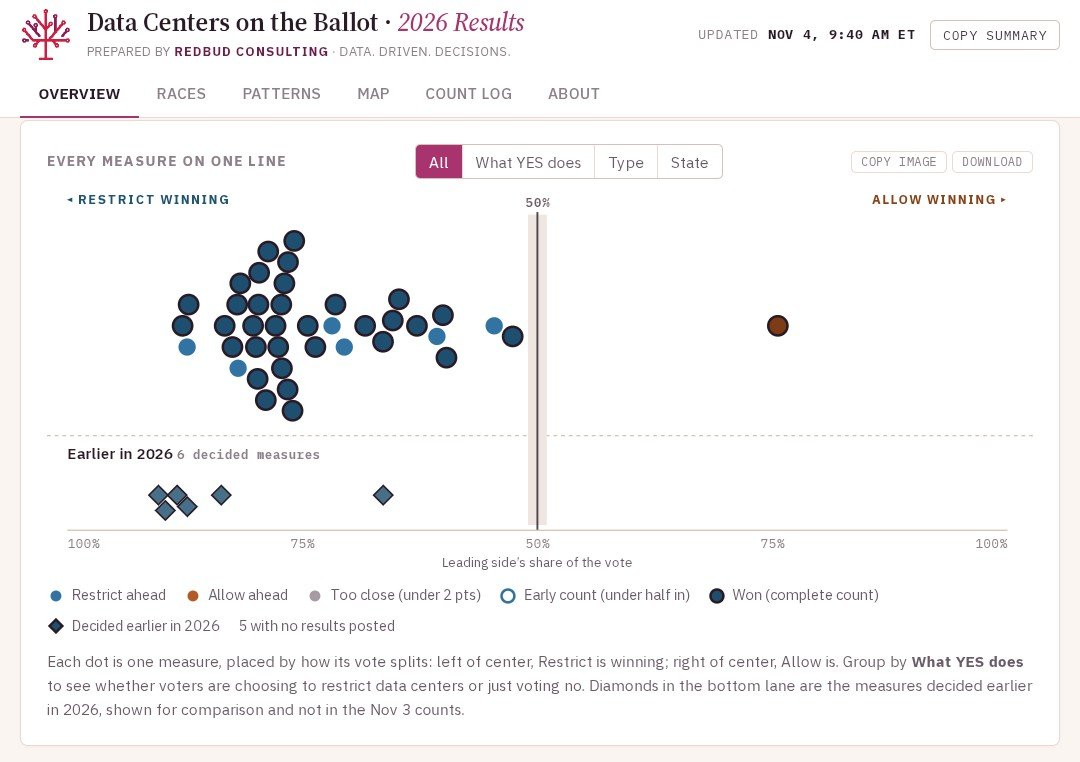
Of the 44 data center restrictions/moratoriums on the restrictive data center measures on the ballot in 2026, 43 passed.
Showing 3 of 12 replies (Click to show all)
2Noosphere89
This mostly matters post-2028 or post-2030, rather than the near term, but yes this is directionally right (with the caveat that the space datacenter option still makes extranational auditing hard.)
I wonder how hard it would be in practice, at least if the space data centers are using known commodity hardware in standard configurations with plenty of sensors streaming high resolution timeseries telemetry data about the physical state of the components. It's not surprising if a very powerful AI could disguise prohibited activity as innocuous activity against all known anomaly detection methods, but with enough side channels any obfuscation will be leaky. Satellites are also harder to get to, but also harder to enforce a physical boundary far away to prevent direct observation by third parties
1Second_Planet
I have first-hand perspective into the organizing efforts of this movement and disagree with this take.
What I can say is that there is a very large organizing effort with central coordination, strategy convening, and philanthropic support. A lot of people (tens of thousands, at least) are working very hard at resisting data centers, and they absolutely do communicate and share strategies. It's true there is not much 'lobbying' in the sense of high-bankrolled well-connected firms hired by industry money to affect national-level policy. But it is very well-coordinated among individual efforts.
There is a sense among the organizers that, yes, as @Noosphere89 comments below, data centers can easily be moved elsewhere and this is not obviously a watertight plan to slow AI. However, they are knowingly making a political calculus. A page from the organizing playbook is "activation". If you have something you can activate people locally on, and it thematically relates to your broader political goals, then you can leverage this human network (as well as the association that resistance to industry is possible) for other policy goals in the future.
So in a way the organizers are doing this because it is popular, and it is politically effective because it is popular. This of course raises the question of why it is popular, but that's pretty obvious.