Even if the information on twitter is often false, I'd still vastly prefer having one place on the internet where we can have a lot of false information, than having traditional media be the entire arbiter of truth. Without twitter, we'd be stuck in the lies and propaganda of traditional media entirely.
In this case. I believe it's directionally correct to model what happened as some type of power struggle in the government between factions that were okay with letting jensen do what he wanted to do, and factions that weren't. And that jensen got ousted as he basically lost this power struggle. This is just normal politics.
So although the specifics of what twitter is saying in this case are probably incorrect, we don't have to accept the official story. I believe it's already not clear if she was really a spy for example? Wasn't that the official story? Or is it an 'alleged' spy? Whatever either way.
 9
 3
Michael Tracey also has a Substack where he seems to write about the same stuff, and Substack in general has a large conservative element to it including names like Curtis Yarvin and Richard Hanania. There is also the podcasting ecosystem which also has a large conservative following including the following podcasts (listed by Claude because I'm less familiar with this ecosystem):
Claude's conservative podcasts
The mass-audience tier
Edison's ranking puts Ben Shapiro, Dan Bongino and Tucker Carlson at the top for conservative content.
- The Ben Shapiro Show (Daily Wire)
- The Dan Bongino Show
- The Tucker Carlson Show
- The Megyn Kelly Show, which cracked Edison's top 20 for the first time in Q2 2025
- The Charlie Kirk Show (still publishing after Kirk's death)
- The Matt Walsh Show and The Michael Knowles Show (Daily Wire)
- Verdict with Ted Cruz
- Candace Owens, Tim Pool's Timcast IRL, Steven Crowder: big, and the least reliable of the lot.
The ones that covered Arjun's exact cases
- Counterweight with Will Chamberlain (the Heather Mac Donald Cornell episode)
- MK True Crime and After Party with Emily Jashinsky, both on Megyn Kelly's network
- The Erick Erickson Show
- The Winston Marshall Show (Tracey on Epstein, and lots on UK two-tier policing and speech prosecutions)
- Triggernometry and Andrew Doyle's show for the UK and free-speech beat. This is where I'd expect the Houellebecq coverage to land₇₅%, though I haven't checked.
Higher-quality, lower-heat
This is the tier I'd cite to a LessWronger, since "inadequately challenged misinformation" is less of a worry here.
- Advisory Opinions (The Dispatch): legal analysis, good on things like use-of-force law for the ICE shootings.
- The Remnant with Jonah Goldberg
- The Editors (National Review) and the Commentary Magazine podcast
- City Journal's podcasts (Mac Donald's home base)
- The Glenn Show (Glenn Loury): the best fit for his "race, sex, immigration" list.
- Morning Wire (Daily Wire's straight-news daily)
Right-adjacent or heterodox
These aren't conservative, but they carry the same contrarian-on-sex-and-race perspectives.
- Reason's Roundtable and Just Asking Questions (libertarian)
- The Fifth Column
- Honestly (The Free Press) and Coleman Hughes's Conversations with Coleman
- Blocked and Reported
- Breaking Points, via Saagar Enjeti and Emily Jashinsky
- UnHerd and Spiked's podcasts
- Joe Rogan and Theo Von: counted as right-leaning by Media Matters, though that's a stretch as a description of the content.
Sources:
I'm not on Facebook so idk any specifics there, and Mastodon/Bluesky are indeed very liberal, but I would argue not in a "traditional media liking" way. Similarly, though Reddit is generally liberal and generally traditional media liking, it is very big and very diverse so there are many parts of reddit which are not so traditional media liking, such as The Motte (which I haven't visited for a while, and it turns out they moved to a new standalone website, though they do still post their quality contribution threads to the old reddit. Notably they didn't move to twitter).
I would also call your claim here a weakening of the original claim, and also not entirely absurd. Twitter may indeed currently be a great place to find very right-wing pushback on mainstream media (I think this is a broadly reasonable opinion to have). That is different from the claim that without it we would "be stuck in the lies and propaganda of traditional media entirely" for two reasons:
- We would still have left-wing pushback on traditional media, meaning we would not be entirely stuck in the lies and propaganda of traditional media.
- It seems very likely to me that without Twitter people would make or use different platforms to talk about right-wing criticisms which may not exist or be as central to the discourse now but will exist and grow if twitter is removed.
 1
On October 29th, 2026, the New York Times reported that Jensen Huang had a ‘close relationship’ with Alice Huang, an executive U.S. officials had concluded was a Chinese spy. The story had six reporters on the byline, and it was sourced to "people briefed on the surveillance."
Whether or not you think Alice Huang was working for the MSS, a rational person might conclude that the person "briefed on the surveillance", who supplied the initial story, was a U.S. government official. After all, if you were not possessing a security clearance and working for U.S. government, you would not be getting "briefed" on U.S. counterintelligence investigations.
As the story gained traction this month, people who think quite differently began to propose other theories. On November 10th - the first time I can find this suggested - an account called "ellington" stated their "personal conspiracy theory" that Anthropic was the New York Times' source (2k likes):
A few hours later GeLun Ding, a Chinese-language account that shows up again below, said the same thing without hedging (1.4k likes):
On November 11th, 6PM Pacific Time, Dream1984Tube, another Chinese-language account announced that he had "found the key clue" to who is really behind the hunt for Jensen Huang, and that he was writing it up:
Twenty minutes later, he says he needs to take another look at Ana Swanson, one of the six Times reporters. At 6:32 PM he brings up Jack Clark (cofounder of Anthropic) for the first time, on the grounds that Clark went to an Aspen Institute dinner with one of the six reporters:
On November 11th at 9:14 PM PT, he posted an AI-generated longform article on X titled "Who Is Really Behind the Hunt for Jensen Huang?" This is the first post, on or off twitter, that accuses Jack Clark of being the source behind the October 29th article, and it's the first one that takes off:
Most of the content is devoted to describing second- and third- degree connections between the people who talked about or expressed indignation at the affair. It contains only the following core points:
At this point in Twitter history, this is the entirety of the concrete evidence offered, that Jack Clark was the source for the October 29th New York Times article. His name has been repeated many times on X throughout the saga. As far as I can tell, no one has ever attempted to explain how Jack Clark would know who Jensen Huang is sleeping with.
Grok's post is then amplified by other mouthbreathers in the tech industry, much more than the previous tweets:
And within the hour, "Hensen Juang", a South Asian twitter account, performs the standard magick whereby inferences are transmuted into observations.
He first posts a couple "suggestive" tweets:
And then, in his most popular tweet, he restates the main insinuation from the article without qualification, and receives thousands of likes:
Pulled from Twitscan, which shows UTC (9:52 PM PT)
An hour and a half after posting, he adds a one-word reply consisting of the word "Allegedly", which gets an order of magnitude less circulation than the original tweet.
And a day or two later after that he deletes the original tweet, after about a million people have already seen it:
The rumor continues to spread, in various formats, mostly across other Chinese language accounts (screenshots cropped to fit on the page, so that you can see tweet metrics):
Simultaneously, a game of telephone begins.
During a podcast, Tripp Mickle discusses how the New York Times first started looking into MegaSpeed last year, for an article published on October 9th, 2025 titled 'Is China Buying Banned Nvidia Chips?':
To re-emphasize some relevant context here:
Context notwithstanding, here is how Philippe Lemoine reports this interaction on X The Everything App, at 6am on November 12th:
Philippe's tweet heavily implies that "the story" that "didn't originate with the intelligence community" is the one that kickstarted Jensen's firing. A casual reader would incorrectly assume that a "tech industry contact" is who told the New York Times about Jensen's affair, which is naturally what Twitter users do.
The next day, Chief Nerd, an account with nearly a million followers, cites the same clip but this time claims that the "Jensen Huang story" was the one tipped off by the "tech industry contact:"
And about this time is when Chinese language accounts tweet the same link, transmuting "a tech industry contact" into "Anthropic", in order to get an order of magnitude more uptake:
This post, by "Dragonhau66", is what is finally screenshotted and converted back into English by other Chinese-speaking users. During the translation, "Anthropic" is transmuted further into specifically "Jack Clark, co founder of Anthropic":
And about then is when the "story" really takes off:
Behind show more: "And what do you know, the person who leaked the “honeypot” story to the press was none other than ANTHROPIC CO-FOUNDER Jack Clark, who reportedly holds a larger stake in Anthropic than Dario Amodei himself…"
Etc., etc.
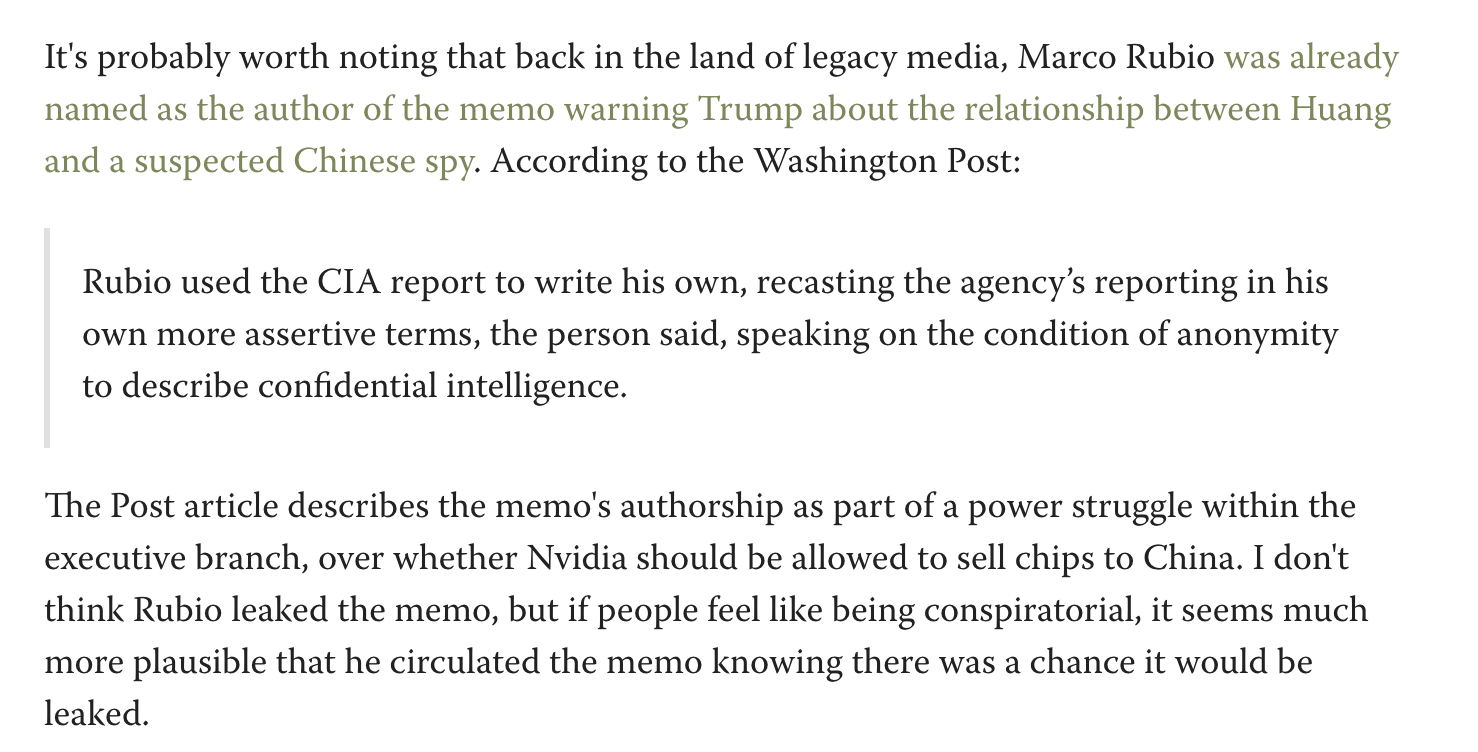
It's probably worth noting that back in the land of legacy media, Marco Rubio was already named as the author of the memo warning Trump about the relationship between Huang and a suspected Chinese spy. According to the Washington Post:
The Post article describes the memo's authorship as part of a power struggle within the executive branch, over whether Nvidia should be allowed to sell chips to China. I don't think Rubio leaked the memo, but if people feel like being conspiratorial, it seems much more plausible that he circulated the memo knowing there was a chance it would be leaked.
It is now Sunday and the story is still ongoing; I saw more and more people casually mentioning the "Anthropic coup" while doing research to write this post. I suspect I will continue to see references to Jack Clark's treachery for months to come. Doing this trace took way more time and energy for me than it did for these individuals to write their tweets in the first place, and my trace will not spread nearly as far. It certainly wouldn't change anything if I took the time to reply to every one of these examples with my lowbie account.
I don't really care about this particular topic, or about Jack Clark. I only take the time to discuss this pattern as a way of showcasing how information travels on Twitter in the modal case, and to gesture at the hundreds of other well-circulated bits of false information I've observed, which no one ever bothers to "debunk" in some visible way. If you use Twitter to keep up with AI, especially if you tell yourself that you're "protecting" against the malicious influence of traditional media, you too will fall for commensurately more plausible examples of this pattern. No one is going to take the time to correct your misconceptions.