This is a special post for quick takes by Arjun Panickssery. Only they can create top-level comments. Comments here also appear on the Quick Takes page and All Posts page.
Comment Permalink
Will MacAskill's "Saturation View" write-up describes a view that tries to get around the Mere Addition Paradox and the Repugnant Conclusion by valuing variety.
This fails "Non-Anti-Egalitarianism" i.e. it sometimes places a lower value on a world where the same people have a more equal welfare and also a greater average welfare. He claims that it satisfies a weaker version in which the people don't change their "types" but I think that's incorrect.
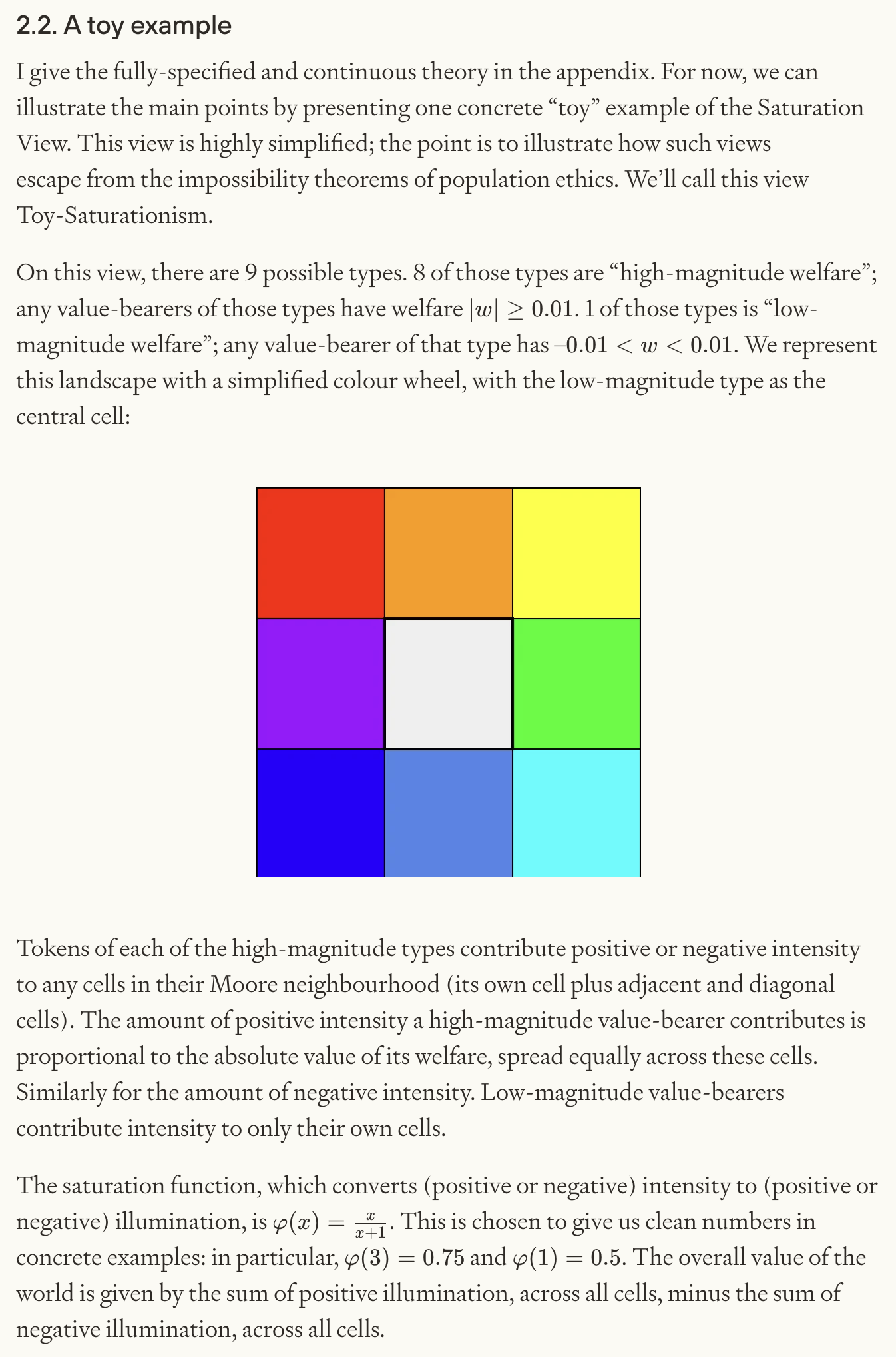
For his toy example (see screenshot below): Call the top-left and bottom-right squares in the 3x3 grid red and blue. Consider two worlds:
- Unequal World: Eight reds each with welfare 1 + one blue with welfare 8
- Equal World: Eight reds and one blue all with welfare 2
The unequal world has total welfare 16 while the equal world has total welfare 18. The cumulative welfare of the lowest-welfare N members is also greater for the equal world for all N from 1 to 9.
However, Toy-Saturationism awards the unequal world a value of 24/5 = 4.8, which is greater than the equal world's value of 232/5 ≈ 4.2.
The choice of
In reality, I expect saturation views suffer badly from this problem of creating inequality for the sake of the "variety" values they introduce.
 1