I think you missed the most interesting data WRT Israeli fertility rates. There are Christians and Muslims living in Israel, and their own birthrates have cratered at the same time Israeli Jewish birthrates have stayed mostly the same, or increased:
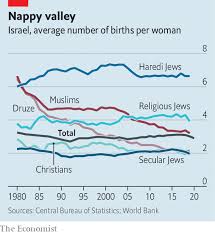
Muslims have gone from ~6.5 to ~3. Christians have gone from ~3 to hovering around the replacement rate at ~2.1. In the same timespan:
- Secular Jews have been roughly steady, from ~2.1 to ~2.1.
- Religious Jews have slightly increased, from ~3.9 to ~4.
- Haredi Jews have substantially increased, from ~6 to ~6.5.
From this data, I wonder if "being on the winning team" in a society is a core factor in birthrate. We've certainly heard stories of partisan baby booms after electoral victories. Maybe having a state that feels as though it's been set up explicitly for the interests of those you view as your own tribe is the core factor?
It would certainly explain the more-than-halving of Israel's Muslim birthrate, which is unheard of elsewhere. I find myself wishing for a "Secular Non-Jews" line on the graph, to better test this hypothesis, but I suppose that demographic is too small over there for reliable data collection.
From Robin Hanson, via TheZvi:
Israel is the only developed country with a high TFR, and it's TFR has remained more or less stable at ~3 for the last 30 years or so. It's a good test case to see which of these factors might matter more or less than the others.
Israeli TFR is stratified by religious observance, with more religious people having more kids, but even secular Israelis are at replacement TFR - higher than the average for almost any other developed country:
So let's see how these trends apply to Israel:
More gender equality: gender norms in Israel outside the ultra orthodox community are pretty similar to what you might find in any other developed country. Traditional gender roles are maintained in the ultra orthodox community, but since many of the men study Torah all day, women are often the main bread winners, and expected to look after the kids on top of that.
Higher parenting effort: Anecdotally Israelis make for interesting parents. They are incredibly and obsessively protective of babies and toddlers (and continuously pester me as someone from England that my child too cold, or not drinking enough, or might choke on that food, or whatever), and mostly blasé about any kid above about 4 or 5, at which point they can go to the park by themselves, go shopping by themselves, and pretty much do whatever they like.
Long stiff career paths. If anything this is worse in Israel, because most people go to the army before university, adding an extra 2/3 years before they start making money.
Cap- vs cornerstone marry. There is no expectation in Israel to wait till you're financially secure before marrying. People will commonly marry (and have kids) in the army, in university, when just starting their careers. Doesn't matter, you'll sort it out together.
Grandparent less involved. Grandparents are very much involved in raising kids in Israel. They'll look after the kids when they're sick, pick them up from daycare if the parents are both working, etc. (something we with our parents in England miss out on). Whilst parents don't do much matchmaking, professional matchmakers are the standard in the ultra orthodox community, and not uncommon in the religious Zionist one. It's also normal for people to set up their friends.
More urban less rural. Israelis love in very dense cities, and the more religious the more dense. Ultra orthodox cities have some of the highest densities in the world.
Less fundamental religion. This clearly explains much of the stratification between different communities in Israel, with the more religious having (far) more kids.
Integrated world culture. This also helps explain the stratification, with the communities that are more insular, and take their norms from their own culture, having significantly more kids than those which are outwards looking.
Conclusion
Obviously this can't prove anything, but it does provide a case study in which factors might be important. My estimate is the most important factors (of these 8) in Israel is religion, integrated world culture, and cap Vs cornerstone marriage. Since changing the first two is unpalatable for most countries, the third sounds like a good place to focus. One way of doing this could be by providing strong tax incentives to marry, so that people marry earlier when they are most financially insecure, rather than waiting till they're well established financially.