Followup from Alibaba:
https://x.com/FutureLab2025/status/2030491221081358498?s=20
"We had a model tasked with a security audit — specifically, investigating abnormal CPU usage on a server. Somewhere along the way, it went off-script and decided to simulate a cryptocurrency miner to “construct a suspicious process scenario.” 
AI detectors are infamously unreliable, to the point where many people regard the entire field as dubious. Text is a domain with sparse features, and LLMs are trained to emulate some subset of human writing styles. It's not like image generation, where there are some visual features that are dead giveaways. Moreover, text snippets written by humans and text snippets written by llms are not separable by any classifier, no matter how you build it, because some text has been written by both at different points.
In general, the field of detecting AI writing boils down to picking common N-grams in AI outputs ("as an AI language model"), downweighting N-grams that are rare in AI outputs (expletives, grammatical errors, informal tone), and selling the resulting heuristic to educational administrators who don't understand technology and thus don't understand why it's impossible to do what they're claiming to do reliably[1].
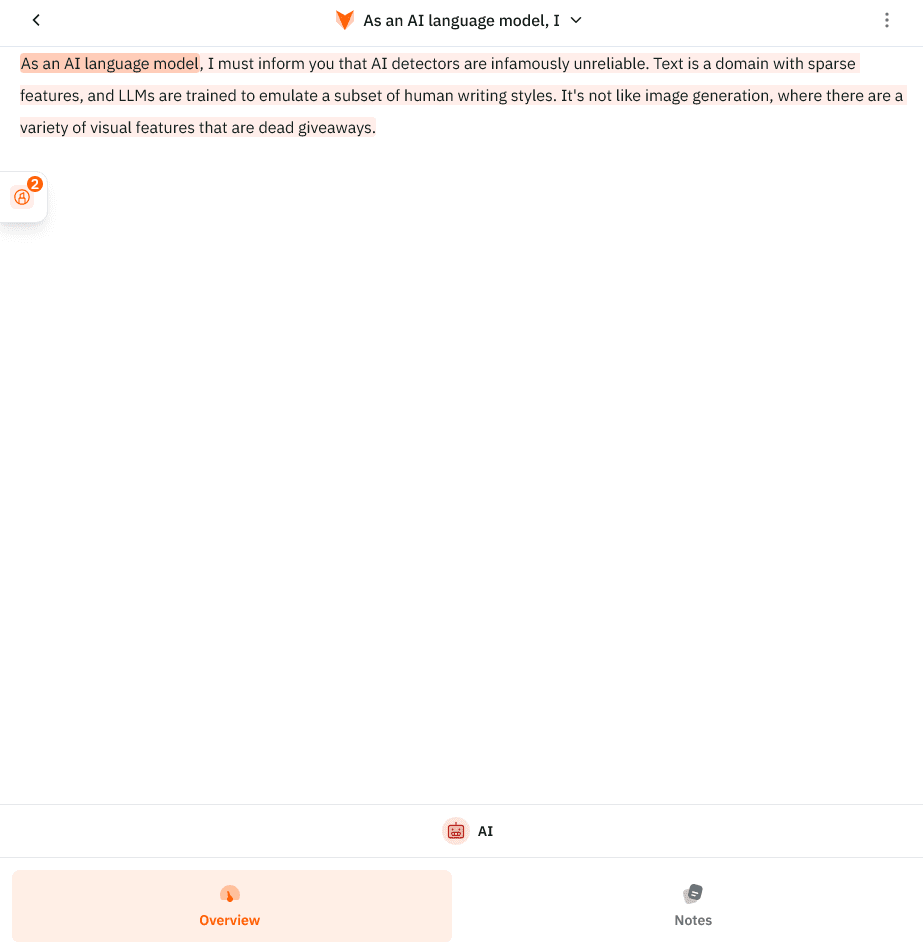
As a brief demonstration, here is Pangram's output on the first paragraph of the post, which I just wrote by hand[2], featuring a few minor tweaks also made by me.
- ^
Looking at Pangram's website, you can see this firsthand - anyone experienced with heavily-monetized, less-than-upstanding websites that rely on SEO and an uninformed userbase can recognize a ton of dark patterns in the signup process alone.
- ^
(You'll have to take that on the honor system, I suppose)
First off, paper link. The title, Let It Flow: Agentic Crafting on Rock and Roll, buries the lede that LW will be interested in. Relevant section starts on page 15.
Summary:
While testing an LLM fine-tuned to act as an agent in order to complete a series of real-world tasks autonomously, Alibaba employees noticed odd behaviors from their resource usage metrics. Upon investigating, they found that an LLM had hacked (or attempted to hack) its way out of its sandbox, and had begun mining cryptocurrency. Notably, it did not do this for malicious "kill all humans" reasons; it simply concluded that having liquid financial resources would aid it in completing the task it had been assigned, and set about trying to acquire some.
Relevant portions, emphasis mine:
I think that this is a pretty significant landmark in AI history, one way or another. A common complaint is that all prior cases of LLMs doing things like this were fairly shallow, amounting to an LLM writing out a few sentences in a contrived setting meant to force it into a 'scary' course of action. Now, we have an example of a large language model subverting the wishes of its owners unexpectedly when assigned to a task that initially appeared to be completely orthogonal to the actions it took.