This is a special post for quick takes by StefanHex. Only they can create top-level comments. Comments here also appear on the Quick Takes page and All Posts page.
Comment Permalink
PSA: People use different definitions of "explained variance" / "fraction of variance unexplained" (FVU)
is the formula I think is sensible; the bottom is simply the variance of the data, and the top is the variance of the residuals. The indicates the norm over the dimension of the vector . I believe it matches Wikipedia's definition of FVU and R squared.
is the formula used by SAELens and SAEBench. It seems less principled, @Lucius Bushnaq and I couldn't think of a nice quantity it corresponds to. I think of it as giving more weight to samples that are close to the mean, kind-of averaging relative reduction in difference rather than absolute.
A third version (h/t @JoshEngels) which computes the FVU for each dimension independently and then averages, but that version is not used in the context we're discussing here.
In my recent comment I had computed my own , and compared it to FVUs from SAEBench (which used ) and obtained nonsense results.
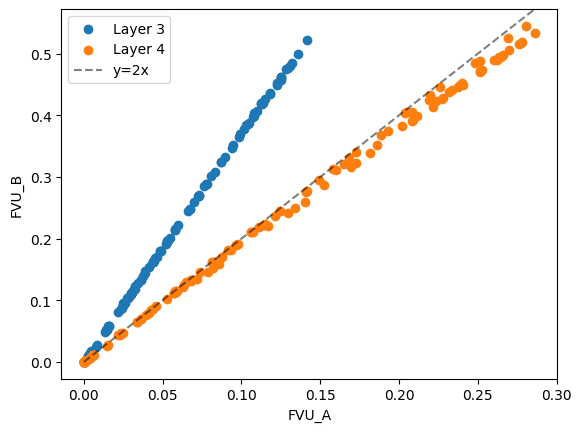
Curiously the two definitions seem to be approximately proportional—below I show the performance of a bunch of SAEs—though for different distributions (here: activations in layer 3 and 4) the ratio differs.[1] Still, this means using instead of to compare e.g. different SAEs doesn't make a big difference as long as one is consistent.
Thanks to @JoshEngels for pointing out the difference, and to @Lucius Bushnaq for helpful discussions.
- ^
If a predictor doesn't perform systematically better or worse at points closer to the mean then this makes sense. The denominator changes the relative weight of different samples but this doesn't have any effect beyond noise and a global scale, as long as there is no systematic performance difference.