This is a special post for quick takes by Thomas Kwa. Only they can create top-level comments. Comments here also appear on the Quick Takes page and All Posts page.
Comment Permalink
We could already be in takeoff:
In Tom Davidson's semi-endogenous growth model, whether we get a software-only singularity boils down to whether r > 1, where r is a parameter in the model [1]. How far we are from takeoff is mostly determined by the AI R&D speedup current AIs provide. Because both parameters are rather difficult to estimate, I believe we can't rule out that
- 2x uplift is already happening at the most advanced AI lab
- Anecdotes of people being sped up by over 2x make this seem plausible (e.g. one of my colleagues has estimated he's sped up by over 30x on some days. We did this exploratory uplift estimate by using GPT-5 to estimate the time an unassisted human would need to do the tasks he completed each day). Even if other activities like large-scale experiments aren't sped up much by AI, you don't need that much substitutability for a 30x SWE speed increase to reduce the need for these enough to speed up overall AI R&D progress by 2x.
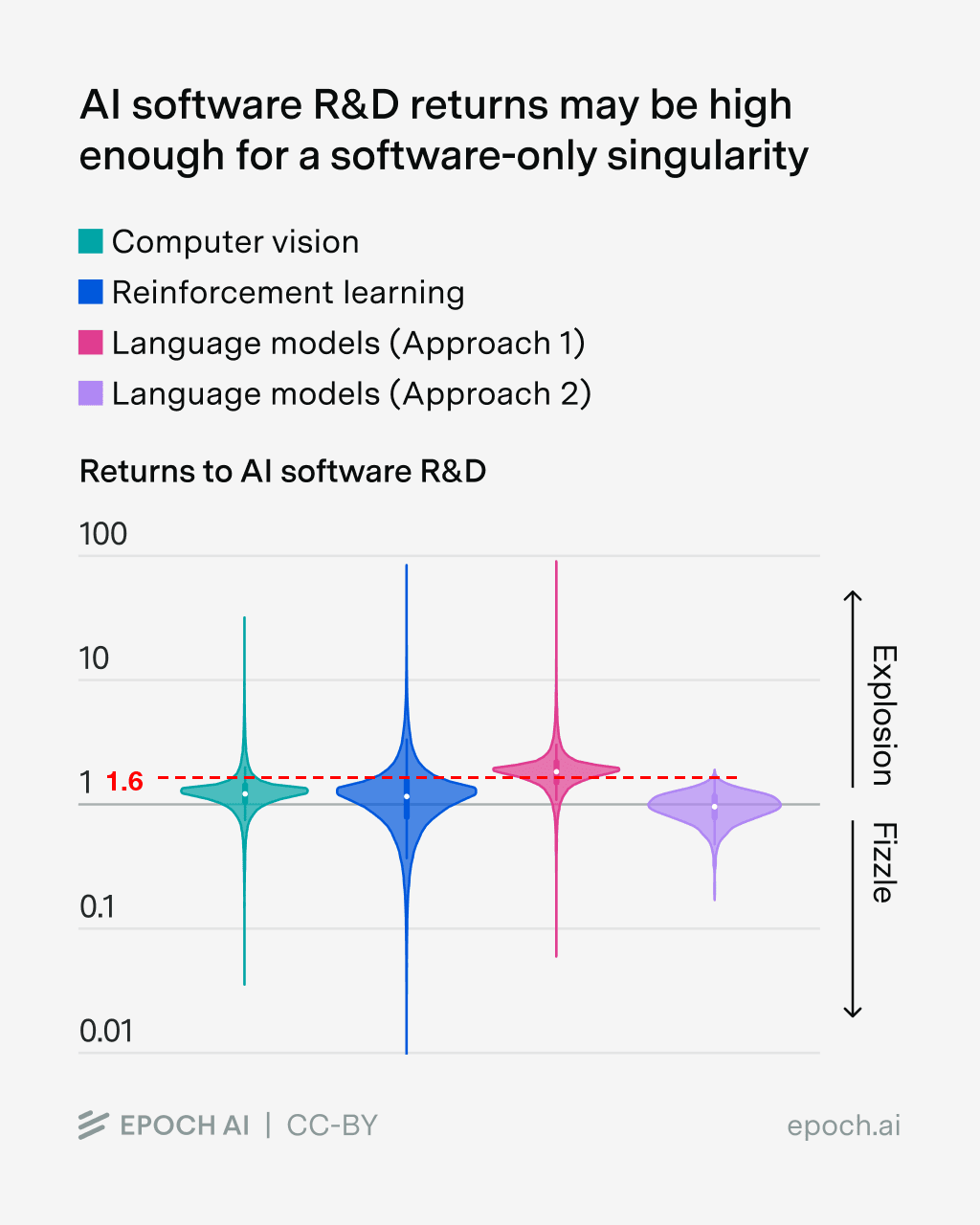
- r = 1.6 (meaning each doubling of AI capabilities, as measured by equivalent software engineering labor, is 1.6 times faster than the previous doubling)
[EDIT 7/2026: This isn't what r means, the definition is more technical. r = 1.6 generally gives you much a speedup per doubling of less than 1.6. But I think the conclusion is fine]Epoch's estimates of r are highly uncertain, and 1.6 is well within the error bars of 3 of their 4 methods.
If these parameters are true, then we're already in takeoff; according to the Forethought web app, AI companies will nearly 1,000x their amount of equivalent software engineering labor in the next 12 months, and we'll get to 1,000,000x in 19 months (by August 2027). A 1,000,000x increase is "only" equivalent to 6 years of progress at the 2020-2024 pace, but AIs got so much smarter from 2020-2024 that these AIs will probably have crazy, transformative effects on the world like in AI 2027. Again, nothing very unexpected has to be true for us to be in this world, just two parameters being at the high end of what we think is likely.
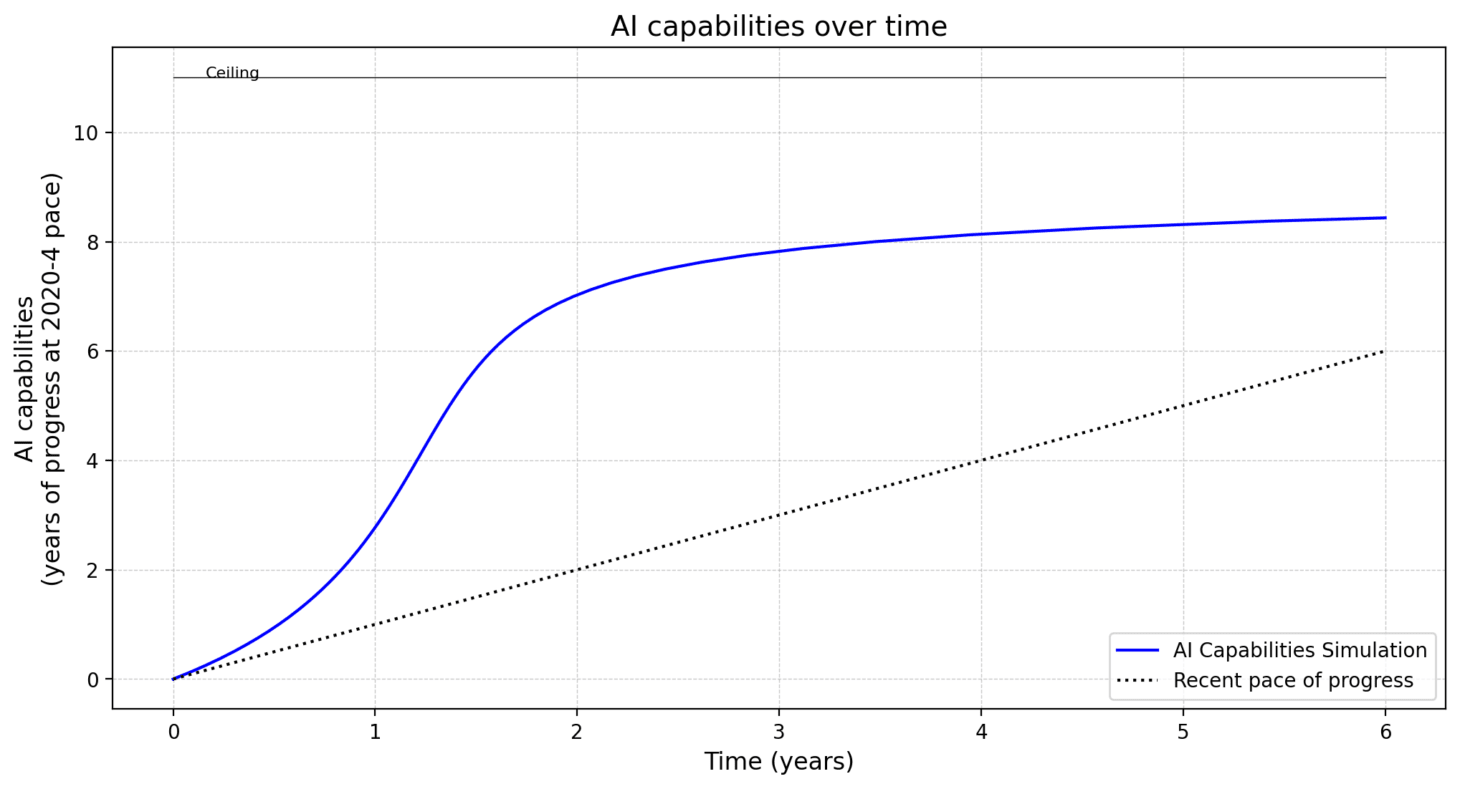
(From the Forethought web app with
[1]: More accurately,