This is a special post for quick takes by Thomas Kwa. Only they can create top-level comments. Comments here also appear on the Quick Takes page and All Posts page.
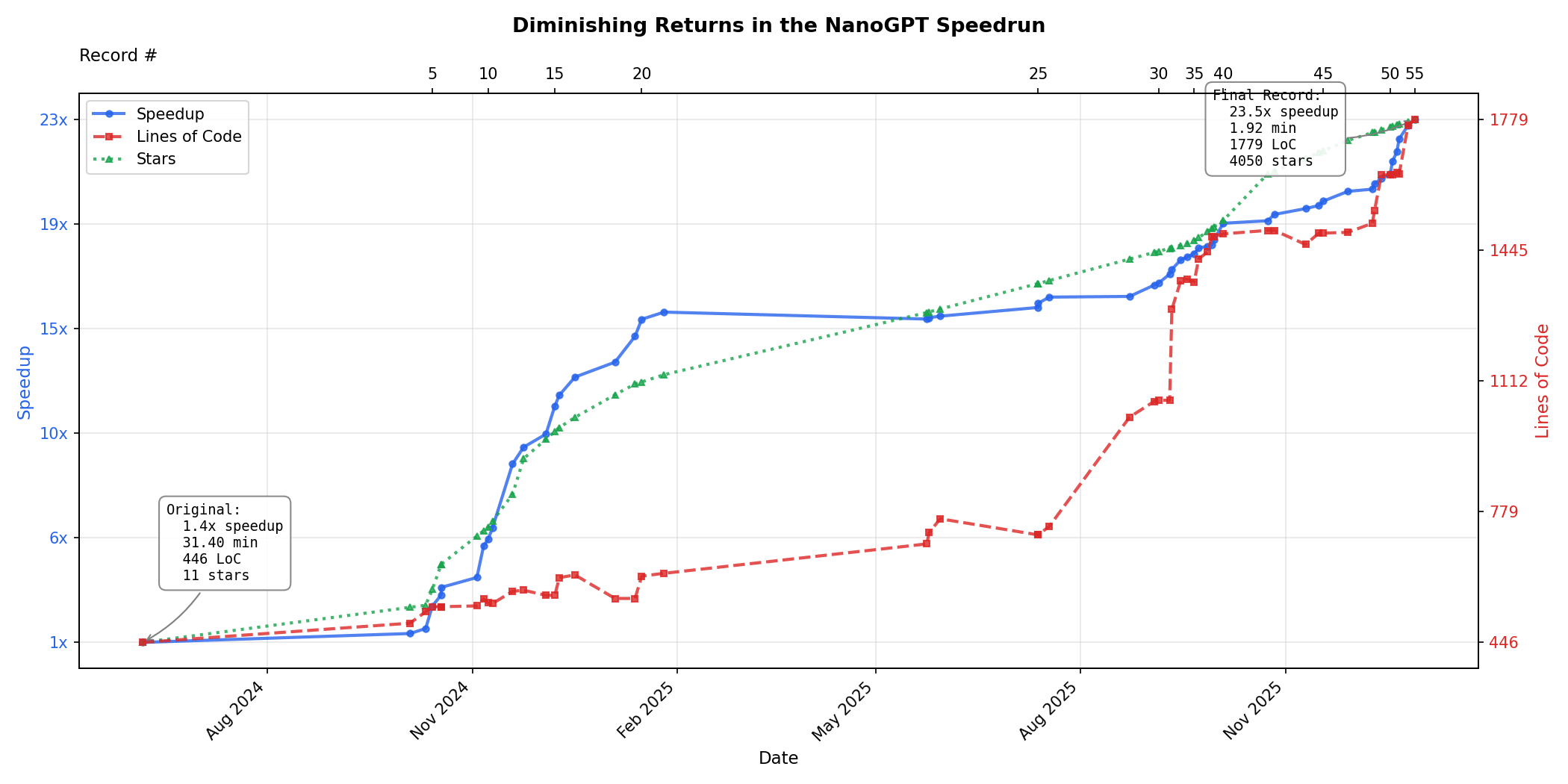
To determine whether we're heading for a software intelligence explosion, one key variable is how much harder algorithmic improvement gets over time. Luckily someone made the NanoGPT speedrun, a repo where people try to minimize the amount of time on 8x H100s required to train GPT-2 124M down to 3.28 loss. The record has improved from 45 minutes in mid-2024 down to 1.92 minutes today, a 23.5x speedup. This does not give the whole picture-- the bulk of my uncertainty is in other variables-- but given this is existing data it's worth looking at.
I only spent a couple of hours looking at the data [3], but there seem to be sharply diminishing marginal returns, which is some evidence against a software-only singularity.
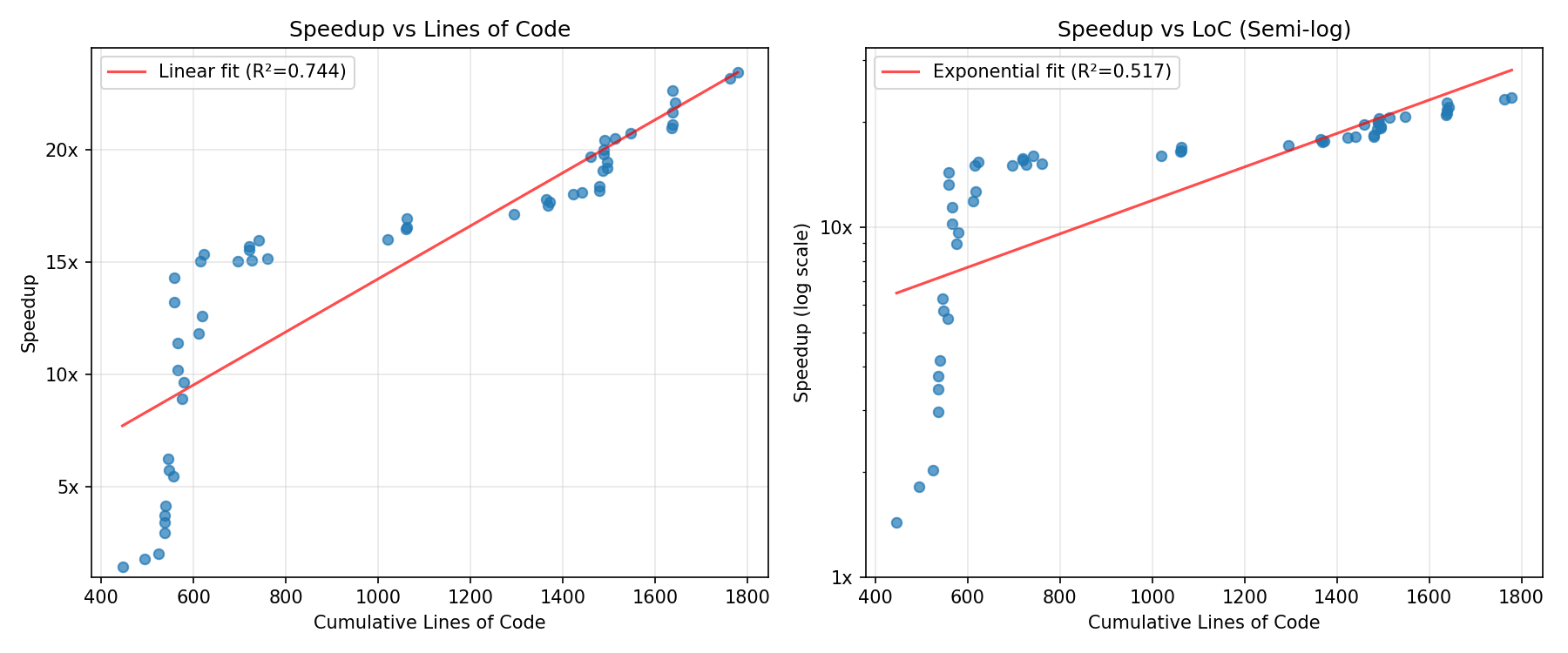
At first improvements were easy to make without increasing lines of code much, but then improvements became small and LoC required became larger and larger with increasingly small improvements, which means very strong diminishing returns-- speedup is actually sublinear in lines of code. This could be an artifact related to the very large elbow early on, but I mostly believe it.
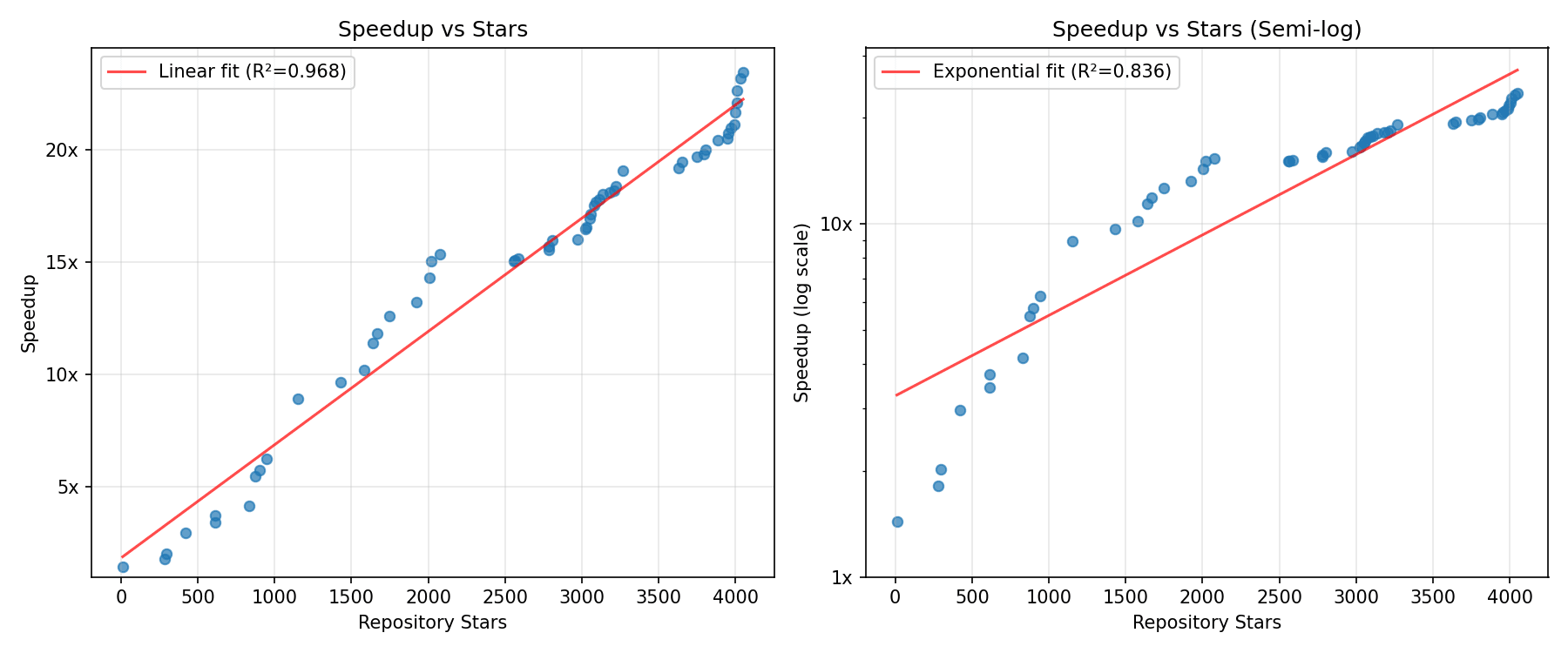
If we instead look at number of stars as a proxy for amount of attention on the project [4], there are no diminishing returns. The data basically suggest speedup is linear in effort [1], which is consistent with a world where 3x/year increases in labor and compute are required to sustain the historical trend of ~3x/year algorithmic speedups observed by Epoch. However, this still points against a software intelligence explosion, which would require superlinear speedups for linear increases in cumulative effort.
Given that the speedup-vs-stars and speedup-vs-improvement-# graphs are linear but speedup-vs-LoC is sublinear, our guess should be that returns to research output are somewhat sublinear. In the language of Davidson's semi-endogenous growth model, this means β>1 [2]. Of course there are massive caveats about extrapolation to future models.
In Davidson's model, the requirement for a software intelligence explosion after research is automated is r:=λαβ>1, where λ<1 represents inefficiency of parallel work and α<1 is the elasticity of research output to cognitive labor at a fixed compute budget. If β>1, this mathematically means r<1 and we don't get an SIE.
So I think an SIE will only happen if one or more of the below is true:
Cognitive quality of future AIs being so high that one hour of AIs researching is equivalent to exponentially large quantities of human researcher hours, even if they don't train much more efficiently to the same capability level. This is the most important question to answer and something I hope METR does experiments on in Q1.
Some other difference between nanogpt and frontier AI research, e.g. maybe research ability is easier to improve than base model loss
Once we get AGI, something other than human labor, AI labor, or compute scales exponentially on a much faster timescale, e.g. training data
A paradigm shift to a totally different architecture that wouldn't be captured in a dataset only 1.5 years long
AIs with 2x the efficiency cause research to happen more than 2x faster, despite outweigh the diminishing returns from parallel work AND being bottlenecked by compute, making λα>1. I can't think of a way this could happen, and to get an SIE it would have to be even larger than 1.
[1]: This was previously observed in a tweet from Epoch in February but now we have about twice the data.
[2]: β=0 would mean exponential improvements, while β=1 implies linear improvement over time at constant labor/compute. So β>1 means improvements are actually slower than linear.
[3]: A few minutes ideating, almost an hour writing a prompt for Claude 4.5 Opus, then 30 minutes making graphs and such.
[4]: It's unclear whether to say that stars represent instantaneous effort or total cumulative effort on the project. If we interpret it as instantaneous effort, then we would see diminishing returns. Also it's unclear whether stars are measuring λβ or β; if λβ it might imply slightly increasing returns.
My colleague Manish did a lot more analysis here. The main takeaway so far is categorizing each PR's improvements as "deep" vs "shallow", as well as "imported-from-literature" vs "invented".
It looks like there were large, shallow improvements imported from the literature early on, while since then most improvements have been moderately involved and a larger portion are novel.
To get more evidence about SIE likelihood, we have lots of work in the pipeline, including interviews with nanogpt contributors, 1B+ token runs using Opus 4.7 and GPT-5.5 on our Inspec... (read more)
Note there are no log-log plots in the data. They're performance vs LoC and log(performance) vs LoC, and same for stars. I don't think we're at an absolute ceiling since two more improvements came out in the past week, they've just gotten smaller and taken more code to implement.
I need to think about this algorithmic progress being 10x/year thing. It feels like some assumptions are violated with how much the data seem to give inconsistent answers, maybe there's a prospective vs retrospective difference. Or do you think progress has just sped up in the past couple of years?
1brendanhalstead
Progress probably has sped up in the past couple of years. And training compute scaling has, if anything, slowed down (it hasn't accelerated, anyway). So yes, I think "software progress" probably has sped up in the past couple of years.
I haven't looked into whether you can see the algorithmic progress speedup in the ECI data using the methodology I was describing. The data would be very sparse if you e.g. tried to restrict to pre-2024 models for greater alignment with the Algorithmic Progress in Language Models paper, which is where the 3x per year number comes from.
Also, that 3x per year number is only measuring pre-training improvements. Post-training (1) didn't really exist before 2022 and (2) was notably accelerated in 2024 by the introduction of RLVR. I wouldn't be confident in whether pre-training algorithmic progress alone is much faster than 3x per year today. (as rumor would have it, there's substantial divergence between the different AGI companies on the rate of pretraining progress.)
 3
 2
 1

