I always found it strange that there was no variation in guidelines by sunscreen active ingredient and formulation. Surely active ingredients that rest atop the skin and block the UV rays are going to be more likely to be removed by sweat, water, and toweling than ingredients that soak into the skin more and absorb the UV? And isn't that also going to vary significantly by formulation too?
In general, appealing to consensus should never be seen as a valid argument in my opinion. Every paradigm shift in science has always been against the consensus. That does not mean the consensus cannot be correct, but that a consensus alone is not indicative of the claim being true.
Isn't this the fallacy of the gray? Yes consensuses can be wrong, but they're probably better than nothing, which makes them evidence in a Bayesian sense, a valid argument even if not a decisive one.
It probably depends on the context. If you have a government regulator, they should probably be required to provide an argument based on strong evidence and not just appeal to a consensus.
On the other hand if you don't have much time for research and make a personal decision just going with a consensus can often be a valid choice.
Most people don’t apply enough sunscreen, resulting in far less than the advertised level of protection.
It not clear to me that "less than the advertised level of protection automatically means "not enough" when we are talking about SPF50 sunscreen.
It seems to me like the tend with sunscreen over the last decades is to just use stronger sunscreen instead of increasing the amount of sunscreen people use, which is a sensible way to deal with it.
When it comes to the FDA and sunscreen use, it's worth noting them not allowing European or Korean/Japanese sunscreen which are both easier to apply, so this is not the only failure of FDA sunscreen policy.
Besides, these guidelines are well established and widely understood to be correct. It’s settled science, guys - we’ve got bigger fish to fry.
For better or worse we have Marty Makary, who's last book Blind Spots was about questioning various kinds about medical consensuses.
I disagree. From the 2018 Ouyang et al. paper, application of SPF 70 sunscreen dropped to just 26 when using 1mg/cm^2 application, whereas it maintained at 64 when 2mg/cm^2 was initially applied - so, using the widely recommended (2mg/cm^2) amount appears to massively affect the longevity of the protection.
SPF is supposed to be the multiple of the time that it takes to get a sunburn. If you would get a sunscreen within 10 minutes at a given sun exposure it would take 700 minutes with SPF 70 sunscreen and 260 minutes with SPF 26. In most contexts, SPF 26 of actual protection is going to be enough.
SPF is often framed as a "multiple of how long it takes to get burned", but this is just a reframe of what it actually is, which is "the denominator of UV reduction".
SPF 70 means that 1/70th of the UV gets through. It just happens to be that the "time to get burned" is just however many minutes it takes to reach a certain threshold. So, a 70X reduction in UV just means it takes 70X longer to reach any given threshold.
After chatting a bit with ChatGPT, no SPF 70 does not mean what you say it means. The official definition is about erythema thresholds (whether the skin becomes red). It's a sunburn related metric, which means it focuses on UVB. Outside of sunburn, UVA is probably more important for skin health.
From a not yet implemented FDA proposal from 2021:
Among other things, this proposal eliminates the potential confusion permitted by the current labeling regime, in which a higher numbered product (for example, one labeled SPF 30) may provide inferior protection against UVA radiation than a lower numbered product (for example, one labeled broad spectrum SPF 15).
FDA sunscreen policy seems stupid all the way down. Between giving bad advise about how to use it, banning valuable ingredients and bad labeling guidelines that ignore a prime effect of the product the FDA manages to get all the points wrong.
To get back to the more general question, here are some positive effect of UV radiation such as vitamin D3 synthesis. There are also some negative effects such as damage to elastin and collagen. Net harm arguments for sun exposure strong enough to cause sunburn seem strong, but arguments for lower amounts seem less strong.
As Bucky mentioned, health advise by dermatologist seems to be more focused on advising stronger sunscreen because it's easier to just use stronger sunscreen than getting people to apply the 2mg/cm^2. As far as broad policy, the 2mg/cm^2 is arbitrary.
If you are the FDA and see that people seem to more often apply 0.5-1.5mg/cm^2, the optimal course of action would be to just add add language that says SPF X at 0.5mg/cm^2 and SPF Y at 2mg/cm^2. You could also have a "highly concentrated" marketing label for sunscreen that are optimized to do a good job at 0.5mg/cm^2.
Yes, erythemal dose is set as the threshold, and yes, it applies specifically to UVB, so when I said "the UV dose", the more precise thing to say would have been the "UVB" dose. However, the point stands.
What you're not appreciating is that the "erythemal dose" is irrelevant to the numerical rating of the sunscreen. You seem to be suggesting that if the threshold were different, then the SPF rating would be different as well. See below
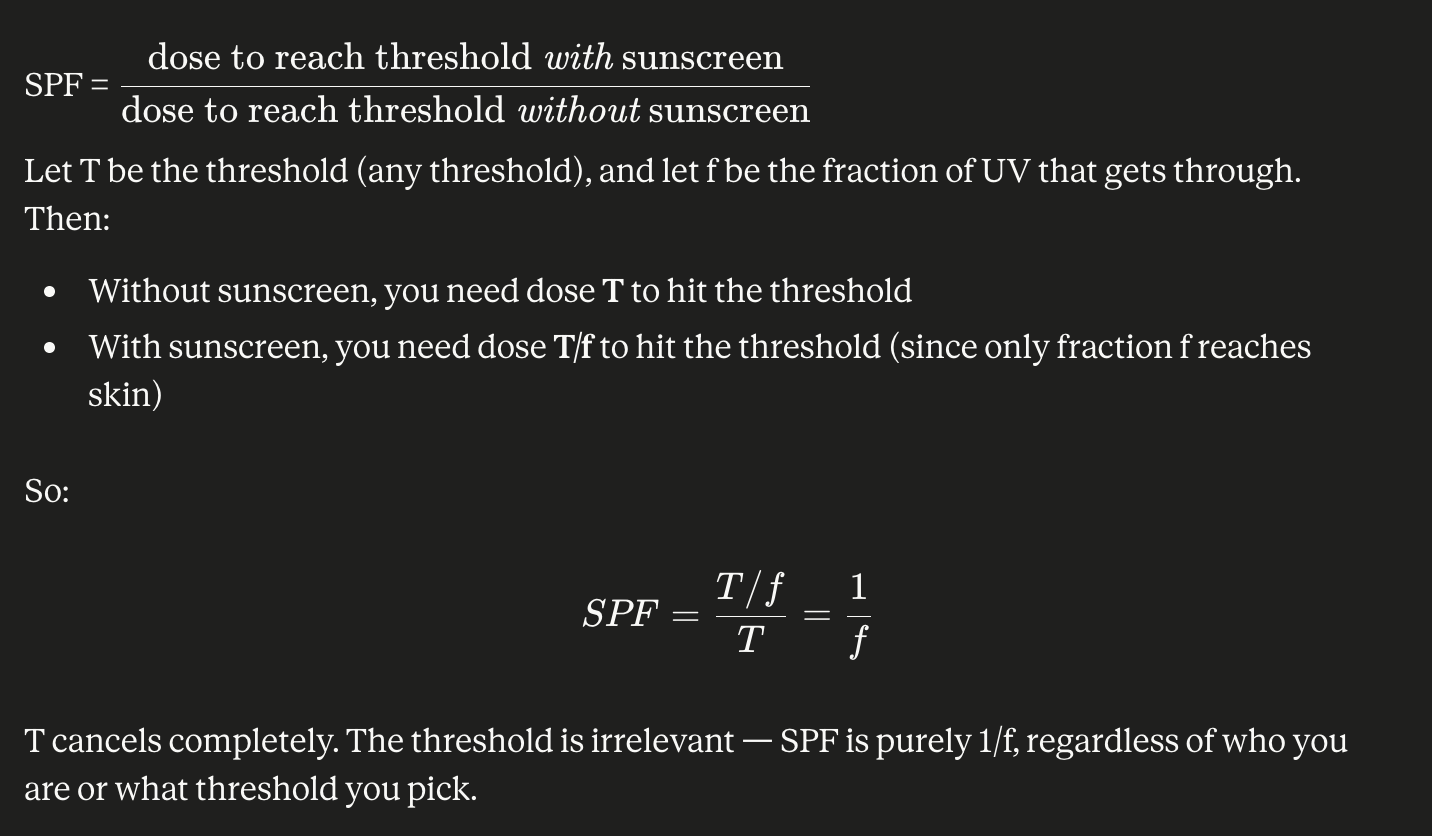
If we were to change the SPF threshold from "enough UVB to begin to burn you" to "enough UVB to burn you to a crisp until your skin turns black and falls off your body", the SPF rating of every sunscreen on planet earth would be the same.
By the same token, if we were to change the SPF threshold to "enough UVB to give you a little bit of vitamin D but not burn you", then the SPF rating would remain the same.
This is the reason we don't need to adjust SPF ratings based on how dark your skin is. A person with dark skin requires a threshold of UVB that is far greater than a white person, and yet SPF50 remains SPF50 for both parties.
The main point is that there are few contexts where someone spends enough time in the sun to get sunburn with SPF 26 worth of practical protection. SPF 26 is good enough protection against sunburn. You need to violate general advise about how to deal with sun or have a very unusual situation to get that problem.
If you want to protect against skin aging, SPF is not a measure that tells you how well sun screen protects against it.
What you're not appreciating is that the "erythemal dose" is irrelevant to the numerical rating of the sunscreen. You seem to be suggesting that if the threshold were different, then the SPF rating would be different as well. See below
You seem to assume that a complex biological system behaves the way your simplified model behaves without making any arguments for that assumption being true.
The people who wrote the actual regulations seem to think that the system is complex enough to get people to do actual effectiveness testing based on the erythemal dose.
By the same token, if we were to change the SPF threshold to "enough UVB to give you a little bit of vitamin D but not burn you", then the SPF rating would remain the same.
That would only be true if the spectrum that results in vitamin D production is exactly the same as the spectrum that results in sunburn. The are quite similar but exactly the same is probably not a true claim.
If "nuanced complexities of biology" were non-negligible factors, then we would need to have different SPF ratings for the time of year, time of day, ethnicity, hydration status, vitamin C intake, and so on. All of these have nonzero implications for the dose/response curves. All can be totally ignored in practice.
Sure, there are minor nuances to stimulus response in chaotic biological systems, but the bottom line is, and has always been, area under the curve of UV exposure.
For the record, I agree that SPF 26 is more than enough to protect you from sunburn in almost all cases, and that SPF doesn't account for UVA. The UVA rating system is of the form "PA+++", which does a similar thing, just for different wavelengths.
I once had the experience of:
- putting suncream on one morning but missing a spot not getting sunburned due to lack of sun that day
- then sleeping, not washing my face
- going outside the next day
- getting sun burned only in that spot I missed
so anecdotally this matches with my experience.
My vague recollection is there are some active ingredients that do decay faster than others, such that by day 2 it can be pretty degraded, though usually this means moreso that some harder-to-cover UVA spectra are weaker rather than not covered at all. (I will need to check this again though)
It’s incredible how many consensus guidelines dissolve when you look closely at them.
If you listen to any authority on the subject of sunscreen, you will hear it endlessly repeated that you absolutely must reapply sunscreen every 2 hours while you are in the sun, and immediately after swimming, sweating, or exercising. Not only that, you’ll hear that you need to apply sunscreen before going outside, even if you put it on earlier and stayed indoors.
The rationale behind this is straightforward and plausible: sunscreen’s effectiveness degrades over time, therefore prolonged sun exposure warrants topping up on protection.
However, when you look closely at the origins of this guideline, and the evidence base for its instantiation in regulations and official statements, it turns out that this 2-hour rule is a baseless, circularly justified, expedient fiction.
Where does the FDA’s 2 hour reapplication guideline come from?
Tracing the history of the 2-hour reapplication guideline reveals an extremely shaky base of evidence.
The first official sunscreen rulemaking in the US was in 1978, where they recommend: "apply sunscreen products liberally and to reapply after swimming or excess perspiration". No fixed universal time interval is mentioned, and the only basis for this recommendation is their assertion that consumers generally don’t apply enough.
15 years later, in 1993, the FDA released a tentative final monograph. Again, this contained no fixed time interval, and reapplication directions are entirely activity-based.
In 1999, a final monograph was released with a reapplication direction of “as needed, or after towel drying, swimming, or perspiring”(Sec. 352.52(d)(2)). No scientific justification is offered for these directions, and no “2 hour reapplication” recommendation appears. The monograph was stayed in 2001 and never took effect.
The 2007 Proposed Rule: The 2-hour recommendation appears
The first direct mention of the “2 hour” rule in the FDA regulatory record appears in a 2007 proposed rule. In the proposal, the 2-hour guideline is justified by citing Wright et al. 2001, an AAD press release attributed to Rigel et al., and public health guidance from AAD, ACS, and EPA.
2011 Final Rule (76 FR 35620). This is the version currently on labels. The "every 2 hours" language was carried forward from 2007 essentially unchanged. They actually directly address criticisms of the spurious 2-hour rule with the following:
“We disagree with the submissions stating that data do not support this timeframe. In the 2007 proposed rule, we described two studies demonstrating a significantly decreased sunburn risk if sunscreen products were applied at least every 2 hours.”
So, they seem confident. What have they got?
The references FDA lists for the 2-hour rationale in the 2011 Final rule are a mix of various pamphlets and press releases, and the same two studies appearing in the 2007 proposal:
Ref
Source
54–58
Five AAD public education pamphlets/pages
59
CDC, “Sunscreen for Your Sun Day”
60
EPA SunWise Program, “Action Steps for Sun Safety”
61
Wright et al., “Mechanisms of Sunscreen Failure,” Journal of the American Academy of Dermatology, 44:781–784, 2001
62
Rigel, “American Academy of Dermatology's Melanoma/Skin Cancer Detection and Prevention Month Press Release,” April 25, 2001
This is the basis of the “2 hour rule” as it is currently printed on labels, and endlessly reiterated in public statements by health authorities.
Looking at the evidence: How solid is the foundation of the FDA’s 2-hour rule?
The FDA’s basis for the 2 hour guideline in the 2007 and 2011 rulings is three pronged:
The Wright et al. 2001 Paper:
This paper is an epidemiological study on beachgoers with minuscule sample sizes and virtually no controls. The study’s methodology was surveying a total of 67 beachgoers (many of whom were actively swimming) on their sunscreen use as they were leaving a Galveston beach. There was no measurement of amounts applied, or controls to the application practice, no accounting for water resistant sunscreens, and the underlying finding was tiny: n = 8 sunscreen users who reapplied every 1-2 hours avoided sunburn, while n = 22 sunscreen users who did not reapply all sunburned. The way they assessed whether the beachgoers sunburned is apparently by merely asking them.
Its findings, such as they exist, point mainly to behavioural failure modes: swimming, incomplete coverage, and failure to reapply after towelling. It is not to a controlled demonstration that sunscreen protection expires, or even degrades, after two hours of sun exposure.
This study, frankly, is genuinely terrible as a basis for a universal regulatory instruction.
Perhaps the other study is better?
The Rigel et al. 2001 paper:
This “study” cited in the ruling is actually a summary of a study that is found in a press release . It appears this study has never been published, nor peer reviewed.
This too is also described as an epidemiological survey that focuses on a high risk niche: 105 skiers in Vail Colorado, and relies entirely on self-report data. The study involved giving the skiers an unmarked bottle of either SPF 15 or 30, giving them a logbook, and asking them to record their application habits.
The only discussion of the findings contained in the press release is the bizarrely phrased statement “of those who re-applied sunscreen every 2.5 hours or more frequently were five times less likely to sunburn compared to those who applied sunscreen every two hours or more. “ - ostensibly suggesting the low and high exposure groups overlapped by half an hour.
There is no direct measurement of application amounts, no mention of controls, no mention of effect sizes or p values, just fragmented, vague references to an inaccessible paper that, even if it exists and was conducted flawlessly, would constitute almost no evidence whatsoever for the validity of a 2-hour reapplication rule.
The CDC and AAD statements - do they save the rule?
The remaining references they provide are an assortment of pamphlets that assert the 2 hour rule. Here is a summary of the cited pamphlets from GPT:
Source FDA cited
What it says
Evidentiary justification for “2 hours”?
AAD public-education materials, refs. 54–58 in 2011 rule
FDA says these AAD public materials “instruct consumers to reapply sunscreen at least every 2 hours.”
None given in the FDA discussion. FDA cites them as evidence that AAD public materials repeated the instruction, not as sources that justify it. FDA explicitly distinguishes these public materials from the actual “data” discussion, which it assigns to Wright and Rigel.
CDC — “Sunscreen for Your Sun Day”
“Sunscreen wears off. Put it on again if you stay out in the sun for more than 2 hours, and after you swim or do things that make you sweat.”
Bare assertion. The only rationale is the phrase “sunscreen wears off.” No study, mechanism, measurement, SPF-specific evidence, water-resistance distinction, or clinical endpoint is given. (Regulations.gov)
EPA SunWise — “Action Steps for Sun Safety”
“Reapply every two hours, even on cloudy days, and after swimming or sweating.”
Bare instruction. The same page gives general reasons for sun safety — sunburn increases skin-cancer risk, tanning/UV causes skin cancer/wrinkling, water/snow/sand reflect UV — but no evidence for the 2-hour timing. (19january2017snapshot.epa.gov)
AAD-style “Sun Protection for Children” page
“Reapply sunscreen every two hours, especially after swimming and sweating,” and later “Reapply approximately every two hours, even on cloudy days, and after swimming…”
No interval-specific justification. The page explains UVA/UVB, sunburn, childhood sun exposure, shade, clothing, and reflected UV from water/snow/sand, but does not justify why the interval is 2 hours. (foothillderm.com)
AAD-style “Actinic Keratoses” page
“Reapply sunscreen every two hours when outdoors, or after swimming or sweating.”
No interval-specific justification. The page explains AKs as UV-related precancerous lesions and gives general prevention advice, but no evidence for 2 hours. (foothillderm.com)
These pamphlets are merely repeating the 2 hour rule as an assertion, ostensibly referencing the already widespread recommendation. This is then fed back into the FDA’s official justification for the 2 hour rule, and voila, you’ve created a dermatological Ouroboros.
These pamphlets, in combination with the Wright and Rigel studies, are the entire basis of the FDA’s stance that you should apply sunscreen every two hours.
To say that this is insufficient to support their recommendation of two-hour reapplication times would be a severe understatement.
Are there any studies out there… at all?
Beyond the FDA’s citations, there appear to be virtually no studies whatsoever that provide any meaningful evidence for a 2-hour reapplication timeline.
The best I could find trying to steelman the “2 hour case” is a 2001 paper by Diffey et al. However:
As far as I have been able to find, there is not a single RCT in existence that shows meaningful degradation of SPF over a two-to-four-hour period.
The strongest case: Wiping your skin with a towel?
Wiping your skin with a towel is generally regarded as the most SPF-degrading practice of them all - physically removing the sunscreen with both moisture and friction. Makes sense.
It is widely asserted that this removes ~85% of the sunscreen. However, in none of the papers or articles referencing this popular “fact” was a primary source cited - merely repetitions of the claim. This, too, seems to be a circularly cited phantom “fact”.
There appear to be no studies that directly investigate the amount of sunscreen removed by towelling… at all.
It is mechanistically plausible that towelling removes a substantial amount of sunscreen, especially with a wet face, but there is virtually no empirical basis for the claim - certainly an area for further research.
Until that research is done, “reapply after towelling” is the closest thing to a defensible reapplication guideline that exists, and even this has a foundation that boils down to “yeah, seems probably true - stuff does get wiped off when you wipe it off”.
Modern Studies on Sunscreens Outright Falsify the 2-Hour Rule
Modern sunscreens last a very long time, even in extremely sub-optimal conditions.
In 2018, a randomised, double blind control trial showed that, as long as people apply the recommended amount of sunscreen at the outset, the durability of protection is extremely robust. Participants applied sunscreen, then exercised for 30 minutes AND were submerged in water for 80 straight minutes. At 8 hours, the test sites that received SPF 70 sunscreen retained over 90% of their protective effect( SPF 64/ initial 70). The dominant factor in determining the duration of protection was whether the widely recommended 2mg/cm^2 amount was applied. If it was, protection was extremely robust even in high-stress environments.
From the paper: “This study demonstrates that current sunscreens may be durable on skin even following significant exercise and water exposure, suggesting that reapplication intervals may be longer than currently recommended.”
Another 2020 RCT showed that 100% of the protection of SPF 50 sunscreen remains at 6 hours among people who aren’t actively sweating. When subjects exercised in a heated environment to induce significant sweating, the SPF remained at the full 50 at the 2-hour mark, and was still at 30 after 6 hours.
This means that if you are applying SPF50 sunscreen, and then strolling right into a hot yoga class and working up a profuse sweat, six hours later you are still expected to have a 97% reduction in UV from your sunscreen.
Most daily sunscreen users are not experiencing anything close to this level of stress-testing. For someone who isn’t sweating or swimming, a full application done once in the morning will comfortably last you the entire day with room to spare.
Why does this guideline even exist?
Most people don’t apply enough sunscreen, resulting in far less than the advertised level of protection. This is a major public health concern, particularly in regions close to the equator. Inadequate sun protection results in burns, skin degradation, and various forms of skin cancer. It appears the guideline of reapplying every 2 hours is designed as a general push to get people to use more. “If they’re not putting on enough, at least have them put it on more often”, seems to be the logic.
However, “they” don’t put it on often, either. Only about 15-20% of people self-report following the 2 hour guideline. And, based on what we generally know about self-report data, the true number is likely far lower. In fact, people are more likely to put on enough sunscreen (about 23%) than they are to reapply it every 2 hours (and, although there’s no direct data, these conscientious applicators are almost certainly a very close overlap overlap with the 20% of self-reported reappliers) - so even the flimsy rationale that (baselessly) emphasising reapplication is a backup, seems to collapse.
Better to double down on initial application, since that’s not only vastly more effective, but also far more practical and done by default at higher rates.
Why has this bogus guideline not been widely repudiated?
There is no incentive for any influential party to make a big fuss over the complete lack of evidence for this 2-hour guideline, least of all sunscreen companies.
The FDA themselves seem perfectly content to double and triple down on the guidelines that are based on guidelines that are based on the FDA.
For Sunscreen companies, this recommendation is a godsend. The more you apply, the more you buy. Why on Earth would they rally to remove a labelling requirement that induces demand for their products?
The other authorities seem to be thoughtlessly deferring to the other authorities and going about their day. The CDC says so because the FDA says so, and the FDA says so because the AAD says so, and the AAD says so because it’s a well known fact, not to mention it’s backed by the FDA and the CDC.
What’s the harm in being careful? Besides, these guidelines are well established and widely understood to be correct. It’s settled science, guys - we’ve got bigger fish to fry.
What should the guidelines be?
The strongest evidence suggests that, by far, applying enough sunscreen in the initial application is the most important thing. If you do that and nothing else, you will receive the vast majority of the benefit of sunscreen, regardless of subsequent reapplication.
Secondarily, though there is no direct study on it, reapplying after towel-drying your skin is a reasonable precautionary recommendation.
Applying after swimming (independently of towelling) is a dubious recommendation without much direct evidence. However, given that most people don’t put on enough sunscreen in the first place, it is a defensible redundancy to recommend. In reality, if you do apply enough (water-resistant) sunscreen, you are going to experience essentially no benefit from this practice.
My advice: Hammer initial application volume hard. Show visual diagrams everywhere. All messaging should treat “2mg/cm^2” as priority 1, 2, and 3 (although that’s probably not the catchiest slogan - I leave the branding as an exercise for the reader). It’s an easy sell: “If you put on this much in the morning, you’re totally covered for the day”.
Conclusion
The 2 hour sunscreen rule is a concerning example of health policy, regulation, and public messaging being widely disseminated and entrenched into law, with virtually nothing to back it up. There is no steelman for this guideline. There is not even a valid pragmatic rationale. It is a plain-as-day case of blatant, lazy pseudoscience that has somehow become convention.
This speaks not only to the inadequacy and unscrupulousness of the FDA as a regulator, but also the countless, multinational health authorities who echo these guidelines far and wide.
How many other threads like this are waiting to be pulled? How many other unassailable, widely accepted facts are also circularly justified hot air?
Change the guidelines, do the research you are pretending to have done, and stop staking the reputation of foundational institutions on junk science.