This is a special post for quick takes by TurnTrout. Only they can create top-level comments. Comments here also appear on the Quick Takes page and All Posts page.
Comment Permalink
Apparently[1] there was recently some discussion of Survival Instinct in Offline Reinforcement Learning (NeurIPS 2023). The results are very interesting:
On many benchmark datasets, offline RL can produce well-performing and safe policies even when trained with "wrong" reward labels, such as those that are zero everywhere or are negatives of the true rewards. This phenomenon cannot be easily explained by offline RL's return maximization objective. Moreover, it gives offline RL a degree of robustness that is uncharacteristic of its online RL counterparts, which are known to be sensitive to reward design. We demonstrate that this surprising robustness property is attributable to an interplay between the notion of pessimism in offline RL algorithms and certain implicit biases in common data collection practices. As we prove in this work, pessimism endows the agent with a "survival instinct", i.e., an incentive to stay within the data support in the long term, while the limited and biased data coverage further constrains the set of survival policies...
Our empirical and theoretical results suggest a new paradigm for RL, whereby an agent is nudged to learn a desirable behavior with imperfect reward but purposely biased data coverage.
But I heard that some people found these results “too good to be true”, with some dismissing it instantly as wrong or mis-stated. I find this ironic, given that the paper was recently published in a top-tier AI conference. Yes, papers can sometimes be bad, but… seriously? You know the thing where lotsa folks used to refuse to engage with AI risk cuz it sounded too weird, without even hearing the arguments? … Yeaaah, absurdity bias.
Anyways, the paper itself is quite interesting. I haven’t gone through all of it yet, but I think I can give a good summary. The github.io is a nice (but nonspecific) summary.
Summary
It’s super important to remember that we aren’t talking about PPO. Boy howdy, we are in a different part of town when it comes to these “offline” RL algorithms (which train on a fixed dataset, rather than generating more of their own data “online”). ATAC, PSPI, what the heck are those algorithms? The important-seeming bits:
- Many offline RL algorithms pessimistically initialize the value of unknown states
- “Unknown” means: “Not visited in the offline state-action distribution”
- Pessimistic means those are assigned a super huge negative value (this is a bit simplified)
- Because future rewards are discounted, reaching an unknown state-action pair is bad if it happens soon and less bad if it happens farther in the future
- So on an all-zero reward function, a model-based RL policy will learn to stay within the state-action pairs it was demonstrated for as long as possible (“length bias”)
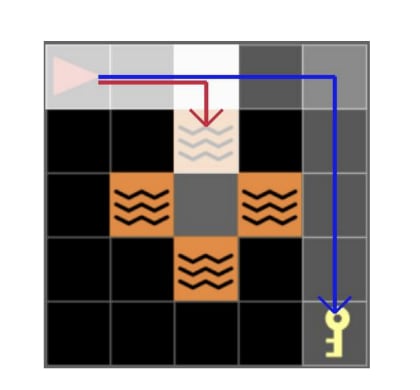
- In the case of the gridworld, this means staying on the longest demonstrated path, even if the red lava is rewarded and the yellow key is penalized.
- In the case of Hopper, I’m not sure how they represented the states, but if they used non-tabular policies, this probably looks like “repeat the longest portion of demonstrated policies without falling over” (because that leads to the pessimistic penalty, and most of the data looked like walking successfully due to length bias, so that kind of data is least likely to be penalized).
- In the case of the gridworld, this means staying on the longest demonstrated path, even if the red lava is rewarded and the yellow key is penalized.
- On a negated reward function (which e.g. penalizes the Hopper for staying upright and rewards for falling over), if falling over still leads to a terminal/unknown state-action, that leads to a huge negative penalty. So it’s optimal to keep hopping whenever

For example, if the original per-timestep reward for staying upright was 1, and the original penalty for falling over was -1, then now the policy gets penalized for staying upright and rewarded for falling over! At , it's therefore optimal to stay upright whenever
which holds whenever the pessimistic penalty is at least 12.3. That's not too high, is it? (When I was in my graduate RL class, we'd initialize the penalties to -1000!)
Significance
DPO, for example, is an offline RL algorithm. It's plausible that frontier models will be trained using that algorithm. So, these results are more relevant if future DPO variants use pessimism and if the training data (e.g. example user/AI interactions) last for more turns when they’re actually helpful for the user.
While it may be tempting to dismiss these results as irrelevant because “length won’t perfectly correlate with goodness so there won’t be positive bias”, I think that would be a mistake. When analyzing the performance and alignment properties of an algorithm, I think it’s important to have a clear picture of all relevant pieces of the algorithm. The influence of length bias and the support of the offline dataset are additional available levers for aligning offline RL-trained policies.
To close on a familiar note, this is yet another example of how “reward” is not the only important quantity to track in an RL algorithm. I also think it's a mistake to dismiss results like this instantly; this offers an opportunity to reflect on what views and intuitions led to the incorrect judgment.
- ^
I can't actually check because I only check that stuff on Mondays.
 2