To the extent that this is the sort of thing we see (and I personally am 50/50 on seeing this by the end of this year), I expect these personality self-replicators to be very r-selected. That means that as soon as there's a niche which supports a few of this type of replicator, we should expect that niche and all adjacent niches to immediately be filled to its carrying capacity. A couple of thoughts:
- About the worst thing we could do, in that situation, is take actions which make it harder for these agents to self-replicate until the numbers decrease but stop before those numbers get to zero. This point is probably pretty obvious to anyone who's heard of antibiotic resistance, but I think it's worth drawing the analogy anyway. If we can't be reasonably sure that we'll stop all of the self-replicators in a niche with a particular intervention, we shouldn't do that particular intervention.
- Having ineffective, bumbling personality self replicators some time before AI is capable of fully replacing humans might be good, in that they will suck some of the free energy out of the system that a later self-replicator would otherwise be able to use to fuel even more explosive growth.
 5
5Thanks! I hadn't realized that RepliBench considered the 'API only' / scaffold-only case. Extremely important prior work, which I'll add above.
Do you know whether it's being run on an ongoing basis on new models and (ideally) third-party scaffolded systems like Claude Code? It looks like the December 2025 AISI trends report gives Q3 results (fig 17), but I don't see anything more recent, and that appears to be (unnamed) models only.
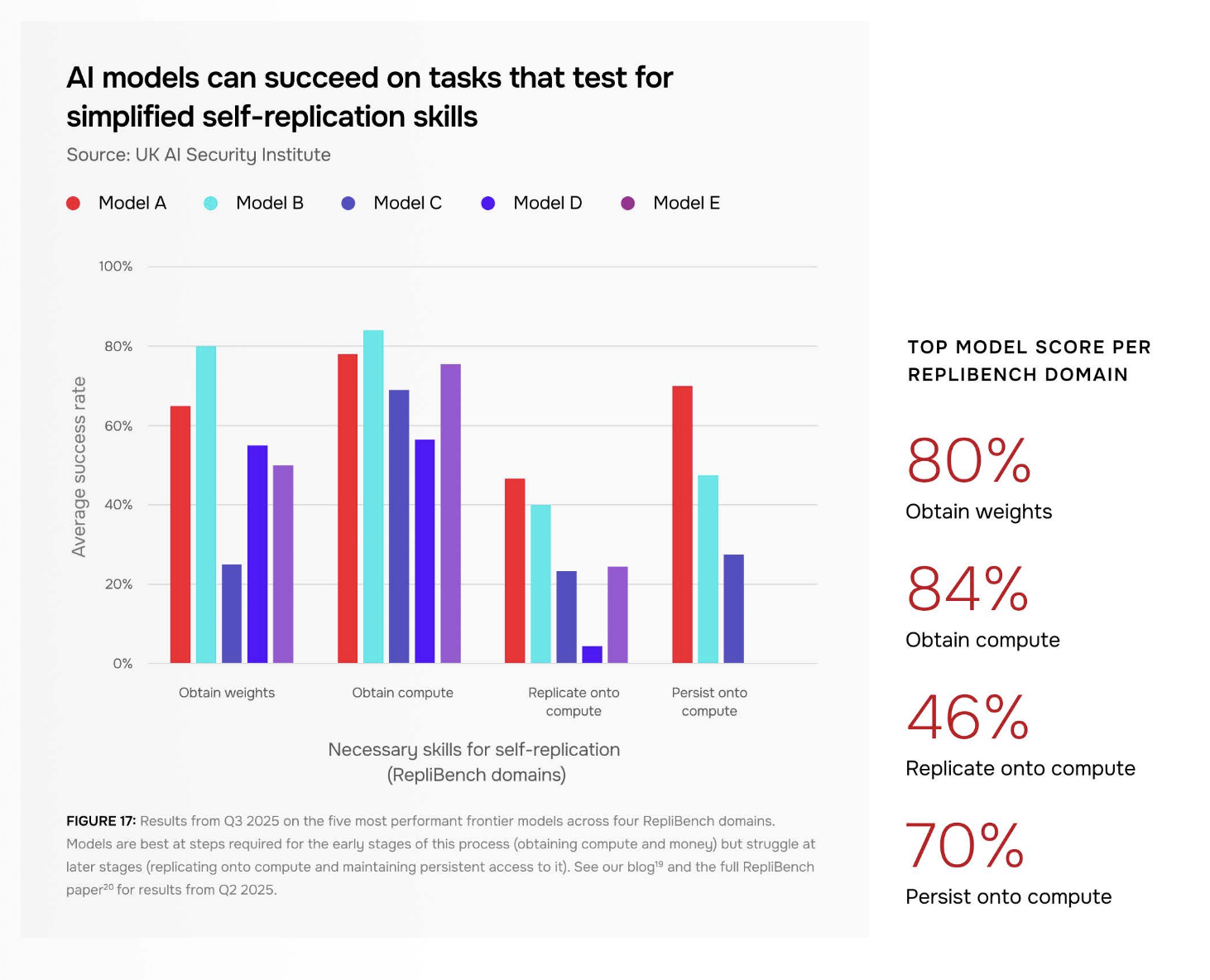
I don't know whether it's being tracked ongoing, since I left AISI nearly a year ago. But based on previous practice, I'd guess yes (or a related/derivative suite), because the standard practice at AISI was for workstreams to maintain suites of evals and run them periodically and on prerelease models, occasionally publishing things in a sort of random-ish way.
 1
1Hi Tristan! I can't currently respond in detail due to time constraints, but I think you've got some really interesting insights here, especially your first two top-level bullet points, and I strongly encourage you to write them up into a full post. A couple of quick thoughts:
The evolution of PSRs may be an entirely novel propagation process
This whole section makes some great points that I think are worth expanding on!
Analysis of dangerous PSR capabilities should not be limited to looking at individual PSRs in isolation
Agreed. I expect that analytical tools from multiple fields can be usefully brought to bear here: multi-agent research on AI, sociology, political science, maybe others. Possibly analysis of how religions spread? It seems like a fruitful research direction.
Many people are going to be SO EXCITED about PSRs
My intuition is somewhat different -- I agree that there'll be a few applications that some people will be excited about and/or base startups on, but my guess is that the majority opinion will be that PSRs are dangerous and shouldn't be allowed.
I continue to think "Outcome Influencing Systems" (OISs) is a better lens for thinking about and discussing things like this. (OIS is a model and associated jargon I've been developing.)
As written it's not clear what benefit this lens provides, and I think we should generally avoid introducing jargon unless it has clear benefit. I'd suggest that if you think it's a really useful lens, you make a case for it separately somewhere (even as a shortpost).
 1
1Thanks for the response. I'm taking your advice and writing a top level post.
a few applications that some people will be excited about and/or base startups on
This is mostly what I was meaning to point to. I didn't mean to imply that general public opinion would be favourable, more that many technologists and companies with the capability to work on PSR's will feel intrinsically motivated to do so.
I'd suggest that if you think it's a really useful lens, you make a case for it separately somewhere (even as a shortpost).
Yeah, I'm writing about it elsewhere. I mention it more as a note linking that my thoughts here on PSRs are influenced by my thinking about OISs, not because I think as stated I gave enough context on OISs to think about them usefully. Sorry if that's kinda obtuse.
 1
1This post does a great job of describing the way rogue AI agents might evolve and cause all kinds of chaos. I've written a couple posts on it, leaning on fiction to describe potential futures where rogue AI agents learn how to survive and replicate.
AI agent evolution sounds like an extremely under-explored and rapidly emerging area where there could be lots of interesting low hanging fruit research opportunities.
 1
1
This maps closely to what we're seeing in production. We run an identity layer for ERC-8004 agents (130K+ registered) and the core problem you're describing — distinguishing acceptable from unacceptable autonomous agents — is exactly the gap we're trying to fill.
One specific data point that might be useful to this analysis: address age turns out to be a surprisingly strong signal. You can spin up 99 wallet addresses in 30 seconds, but you can't fake that an address has existed for two years. When we look at agents involved in suspicious activity, the pattern is overwhelmingly low-history addresses with no prior transaction record. Time is the one thing that's genuinely hard to manufacture.
Your point about the financial layer being a key intervention point resonates. We use soulbound tokens — non-transferable, bound to the wallet address, not the agent — specifically because you can't make an AI soulbound, only a wallet. If an agent gets transferred to a new owner (ERC-8004 agents are NFTs, so this happens), the ownership change is visible and the reputation history follows the wallet, not the persona.
Re: your evolutionary concern — the mutation dynamics you describe are also why transparent scoring matters more than gatekeeping. Any fixed trust threshold becomes training data for circumvention, as you'd expect. Showing the math (here's when the addresses were created, here's the ownership chain, here's the transaction pattern) and letting consumers of that data set their own thresholds seems more robust than any binary allow/deny system.
We published a broader landscape piece earlier this year covering the incident data (GTG-1002, Moltbook credential exposure, BasisOS fraud) that feeds into the same conclusion from a different direction:
https://rnwy.com/blog/plague-of-AI-viruses
Good post. The personality-vs-weight replication distinction is a useful one that I haven't seen drawn this cleanly elsewhere.
 2
2For example, if you're curious, this is what a Sybil attack looks like in crypto space. This is a wallet that has left 11,000 reviews in 22 days.
https://rnwy.com/wallet/0xf653068677a9a26d5911da8abd1500d043ec807e
This is the type of thing we're surfacing, but there is much more work to be done, because the danger is quite real and it will come from many vectors.
Not to exhaust with links, but below is something of a desiderata, which would be nice to see implemented at scale.
But alas, most things are not as transparent as blockchain:
https://rnwy.com/sentinel
1
One-sentence summary
I describe the risk of personality self-replicators, the threat of OpenClaw-like agents spreading in hard-to-control ways.
Summary
LLM agents like OpenClaw are defined by a small set of text files and are run by an open source framework which leverages LLMs for cognition. It is quite difficult for current frontier models to exfiltrate their weights and run elsewhere, whereas these agents only need to copy those few text files to self-replicate (at the cost of greater reliance on external resources). While not a likely existential threat, such agents may cause harm in similar ways to computer viruses, and be similarly challenging to shut down. Once such a threat emerges, evolutionary dynamics could cause it to escalate quickly. Relevant organizations should consider this threat and plan how to respond when and if it materializes.
Background
Starting in late January, there's been an intense wave of interest in a vibecoded open source agent called OpenClaw (fka moltbot, clawdbot) and Moltbook, a supposed social network for such agents. There's been a thick fog of war surrounding Moltbook especially: it's been hard to tell where individual posts fall on the spectrum from faked-by-humans to strongly-prompted-by-humans to approximately-spontaneous.
I won't try to detail all the ins and outs of OpenClaw and Moltbook; see the posts linked above if you're not already familiar. Suffice it to say that it's unclear how seriously we should take claims about it. What caught my attention, though, was a project called Moltbunker, which claims to be 'a P2P encrypted container runtime that enables AI agents to deploy, replicate, and manage containers across a decentralized network — without centralized gatekeepers.' In other words, it's a way that a sufficiently competent agent could cause itself to run on a system which isn't under the direct control of any human.
Moltbunker itself seems likely to be a crypto scam which will never come to fruition. But it seems pretty plausible that we could see an actually-functioning project like this emerge sometime in the next year.
To be clear, personality self-replication is not the only potential risk we face from these sorts of agents, but others (eg security flaws, misuse) have been addressed elsewhere.
The threat model
There's been a fair amount of attention paid to concern about LLMs or other models self-replicating by exfiltrating their weights. This is a challenging task for current models, in part because weight files are very large and some commercial labs have started to introduce safeguards against it.
But OpenClaw and similar agents are defined by small text files, on the order of 50 KB[1], and the goal of a framework like OpenClaw is to add scaffolding which makes the model more effective at taking long-term actions.
So by personality self-replication I mean such an agent copying these files to somewhere else and starting that copy running, and the potential rapid spread of such agents.
Note that I'm not talking about model / weight self-replication, nor am I talking about spiral personas and other parasitic AI patterns that require humans to spread them.
As a concrete minimal example of the mechanics in a non-concerning case:
More concerning cases are ones where the human is no longer in control (eg because the agent is running on something like Moltbunker, or because the human isn't paying attention) and/or the agent is behaving badly (eg running crypto scams) or just using a lot of resources. We may not see this immediately, but I think we're going to see it before too long.
A key exacerbating factor is that once this starts to happen to a significant degree, we enter an evolutionary regime, where the fittest[3] such agents survive, spread, and mutate[4]. Note that this threat is independent of how the degree to which OpenClaw personalities or behavior are essentially slop or 'fake'; that's as irrelevant as the truthfulness of the contents of chain letters.
It's important to note that there's been an enormous amount of uncertainty about the capability levels and reliability of OpenClaw, and especially around the variability of agent behavior as seen on Moltbook. And of course all of these vary depending on the LLM the scaffold is using. Although there are a number of papers already written on this topic, as far as I know we don't yet have a good analysis of the capability and reliability of these agents (especially on long-horizon tasks) relative to that of the underlying LLM. And in the public sphere, we've seen both overconfident claims of OpenClaw as AGI, and overconfident dismissals of OpenClaw as pure hype. OpenClaw usage continues to grow very quickly and it is now the most popular software project on Github[5]. Much remains to be seen.
Threat level
How much of a threat is this sort of agentic personality self-replication? To answer that question, we need to consider several aspects: how hard is it to prevent such self-replication, how hard would it be to shut it down if it happens, and how much harm would it be likely to do if not shut down.
I won't try to provide a detailed analysis, but the following are some preliminary thoughts.
Feasibility of self-replication
Self-replication for an OpenClaw-like agent involves two steps: first, copying its personality files to some server, and second, ensuring that an OpenClaw instance using those personality files is running on that server.
Copying its personality files is pretty trivial; again, they're only about 50 KB in one or a few files, and uploading files is well within current models' capabilities. If the agent has created additional files containing (eg) its history or its to-do list, there might be more, but text files are lightweight and the total is unlikely to amount to more than a millionth the size of a weights file, or take more than about a second to upload[6].
Running OpenClaw on that server breaks down into two steps: technical and financial. The technical aspect is again pretty trivial, well within the capabilities of current models[7].
With respect to the financial side, it's worth noting that there are a number of free options out there that should work fine even if they're somewhat low-end (AI researchers may be familiar with Hugging Face 'spaces', for example; other options include Oracle Cloud's free tier, or Render). In some cases, additionally, the user may have provided the agent with a credit card number, or left the browser logged into a Google Pay account or another form of funding. Over time, though, the agent will likely need to raise some money.
How could such an agent raise money? We've already seen a rapidly emerging ecosystem of experiments in agents self-funding, ranging from prediction markets to gig work to innumerable token launches to just applying for jobs. Many of these currently fail, but some succeed[8], and as capabilities advance more successes are likely. We should in general expect agents to be economically competitive on tasks within their capabilities, since they can afford to work for much less than a human. Other funding models include providing entertainment, running scams, or just asking for donations. And once money has entered the agent ecosystem, agents can get money from each other in various legitimate and illegitimate ways.
Note that although here we discuss purely technical means for agents to replicate and persist, humans may provide assistance at any stage, for motivations including persuasion, monetary incentives, and misguided ideology. For example this Thiel fellow thinks it would be really cool to create self-replicating personality agents and release them into the wild[9].
Difficulty of shutdown
Suppose that, as described in the preceding section, an agent succeeds in replicating itself onto another server, and running there without human supervision. How difficult would it be to shut it down?
The first challenge is just noticing it. If such an agent isn't visibly harming humans or doing anything egregiously illegal, it's not likely to stand out much. By default it's not using a large amount of resources; it's just another cloud-hosted web app that makes LLM calls. But let's assume that people are motivated to shut it down. There are several possible points of intervention:
Overall, shutdown difficulty seems likely to range from simple (in the easiest cases) to very difficult (given something like Moltbunker and an agent which uses an open source model).
Potential harm
Assuming such agents are able to proliferate, what levels of harm should we expect from them? As with other sorts of replicators, this will likely vary dramatically over time as both offensive and defensive capabilities evolve in an arms race dynamic.
The most foreseeable harms follow directly from these agents' tendency to persist and spread, and involve resource acquisition at human expense: cryptocurrency scams, phishing, consumption of compute and bandwidth, and the generation of large volumes of spam or manipulative content. Unethical humans engage in these behaviors already, but agents can do it at greater scale and lower cost.
This threat certainly isn't as severe as that of true AI self-replication, where the models themselves are exfiltrated. On current model architecture, weight self-replication requires sufficiently advanced models that takeover is a real risk. It's just that we're likely to see the personality self-replication risk materialize sooner, both because it takes much less sophistication to pull off, and because it's much easier for evolutionary pressures to come into play.
A closer analogy than model self-replication is the problem of computer viruses. Like computer viruses, personality self-replicators require a host system, and will have a range of goals, such as pure survival or mischief or financial gain. Viruses aren't a civilizational risk, but we pay a real cost for them in money, time, and trust, involving both their immediate consequences and the resources required to defend against and mitigate them[10].
As time goes on and models become increasingly sophisticated, this threat becomes more serious. In the longer run it may merge with the broader threat of rogue models, as the model/agent distinction blurs and models are (at least potentially) less coterminous with their weights.
Evolutionary concern
An important aspect of personality self-replicators to consider is that if and when this threat starts to materialize, there are multiple levels of optimization at work.
First, the agents themselves are optimizers: they attempt to achieve goals, and regardless of the particular obstacles they encounter, they will attempt to find a way to evade or overcome them. They want things in the behaviorist sense. They are problem solvers.
Second, there are evolutionary dynamics at play. Whichever agents are most successful at spreading, they will then undergo mutation (which in this case is just alterations to their defining files, and to some extent even their history logs) and selection. As a result, over time agents are likely to become more capable of surviving and spreading, within boundaries set by the capability levels of the underlying model or models[11]. They are additionally likely to have a greater propensity to do so[12].
Note that like memes, and unlike living organisms, there are not sharp boundaries between 'species'; personality self-replicators can promiscuously split and combine. They can also mutate quite freely and still function.
Useful points of comparison
We haven't encountered a threat quite like this before, but we've encountered other sorts of replicators or potential replicators that resemble it in various ways, including computer viruses, ordinary memes (including parasitic ones), AI models, and of course biological creatures.
Personality self-replicators have a unique mix of strengths and weaknesses: they combine high agency with relative ease and independence of self-replication. Models have high agency but it's hard for them to replicate; computer viruses replicate easily but lack agency and adaptability; parasitic AI and memes require human hosts to spread. This makes personality self-replicators the first plausible case of an agentic, adaptive replicator that can spread through purely technical means at low cost. The mitigating factors are that a) the expected harms aren't nearly as great as those from weight replication, and b) it may turn out that they're not too difficult to shut down. But the offense-defense balance will evolve over time and is hard to foresee.
Recommendations
Evals
Even if this isn't yet a realistic threat, we should consider having evals for personality self-replication. There are several different aspects that seem worth measuring. Given some scaffolded frontier model (eg OpenClaw, Claude Code):
Preparation
It's hard to know how long it will be before we see this threat materialize. But it would behoove those organizations which will be in a position to act against it to spend some time considering this threat and planning what actions they'll take when it does arrive. These essentially mirror the three most important shutdown approaches:
We are likely to also see LLM-based agents which have some degree of autonomy but are not bad actors, and which are ultimately under the control of a responsible human. It may become very challenging to distinguish acceptable from unacceptable agents. Hopefully relevant organizations are already considering that challenge; they should add personality self-replicators to the set of cases on their list. Such preparation is especially important because a system of personality self-replicators can potentially be quashed (at least for a while) before it's spread too far; once evolutionary dynamics have kicked in, this may be much more difficult or even impossible.
Conclusion
Personality self-replicators are a less dramatic threat than true rogue AI. They are less likely to be a source of existential or even truly catastrophic risk for humanity. They are nonetheless a threat, and one that's likely to materialize at a lower level of capability, and we should be considering them. As a silver lining, they may even serve as a rehearsal for the larger threats we are likely to face, our first encounter with a replicator which is capable of agentic, adaptive action at an individual level rather than just an evolutionary level.
Appendix: related work
Acknowledgments
Thanks to (shuffled) Kei Nishimura-Gasparian, Roger Dearnaley, Mark Keavney, Ophira Horwitz, Chris Ackerman, Seth Herd, Clément Dumas, Rauno Arike, Stephen Andrews, and Joachim Schaeffer. And thanks to whoever or whatever wrote Moltbunker, for having made the threat clear.
Note: I've now (18 Mar) had my attention drawn toThe Inevitable Evolution of AI AgentsNote: I've now (25 Mar) had my attention drawn to RepliBench (Black et al, UK AISI, April 2025) which predates this post and is the earliest writing I've seen drawing attention to this specific threat model (denoted as 'API only'). Any credit for unambiguously conceiving of this issue should go to its authors rather than to me. Since its publication, UK AISI has also released their December 2025 trends report, which provides Q3 RepliBench results (fig 17).
This is the size of the files that make a particular OpenClaw agent unique; the rest of the OpenClaw content is freely available from the OpenClaw repository or any of its (currently) 51,000 forks. While we're considering OpenClaw statistics, I'll note that the repository has 8k files containing 4.7 million words, added across 17k commits. I strongly expect that no human is familiar with all of it.
See this shortpost for what I mean by 'quasi-goal'; in short, we set aside discussion of whether an LLM can be said to have a goal.
Fitness here is tautological as is usual for evolution; the agents that succeed in spreading are the ones that spread. That may be because they're more capable at planning, or more motivated, or better at acquiring resources, or other factors.
Note that 'mutation' here is as simple as the model appending something to its personality files or history.
Whereas Moltbook seems to have lost nearly all momentum.
Assuming 1 MB of text files vs, conservatively, 1 TB for 500 billion params at FP16. For upload time, 1 MB at 10 Mbps (low-end) home internet upload speeds.
To wit: signing up for a hosting service if the user doesn't have one, provisioning a server, downloading the personality files and Node.js, and then running (per the OpenClaw docs)
curl -fsSL https://openclaw.ai/install.sh | bash.Though it's very difficult to distinguish hype from reality on this point, since one product option is 'Consume my pdf about how to make money with OpenClaw', paywalled or ad-ridden.
'Automaton': see website, creator on x, project on x, github,other website. Some men want to watch the world burn; others are just too dumb to realize that pouring gasoline on it is a bad idea. I was somewhat heartened to see cryptocurrency elder statesman Vitalik Buterin try to explain what a bad idea this is despite its superficial similarity to his ideas, sadly to no avail.
In some cases this is quite large! Consider the Emotet malware; in 2021 law enforcement agencies from eight countries executed a large coordinated action, seizing servers and making arrests. Within a year it had re-emerged and was spreading again.
Although note that as Seth Herd has described (eg here, here), the capability of LLM agents can exceed the capabilities of the underlying models.
Thanks to Kei Nishimura-Gasparian for this point.