This is a special post for quick takes by [anonymous]. Only they can create top-level comments. Comments here also appear on the Quick Takes page and All Posts page.
Comment Permalink
(edit: see disclaimers[1])
- Creating superintelligence generally leads to runaway optimization.
- Under the anthropic principle, we should expect there to be a 'consistent underlying reason' for our continued survival.[2]
- By default, I'd expect the 'consistent underlying reason' to be a prolonged alignment effort in absence of capabilities progress. However, this seems inconsistent with the observation of progressing from AI winters to a period of vast training runs and widespread technical interest in advancing capabilities.
- That particular 'consistent underlying reason' is likely not the one which succeeds most often. The actual distribution would then have other, more common paths to survival.
- The actual distribution could look something like this: [3]
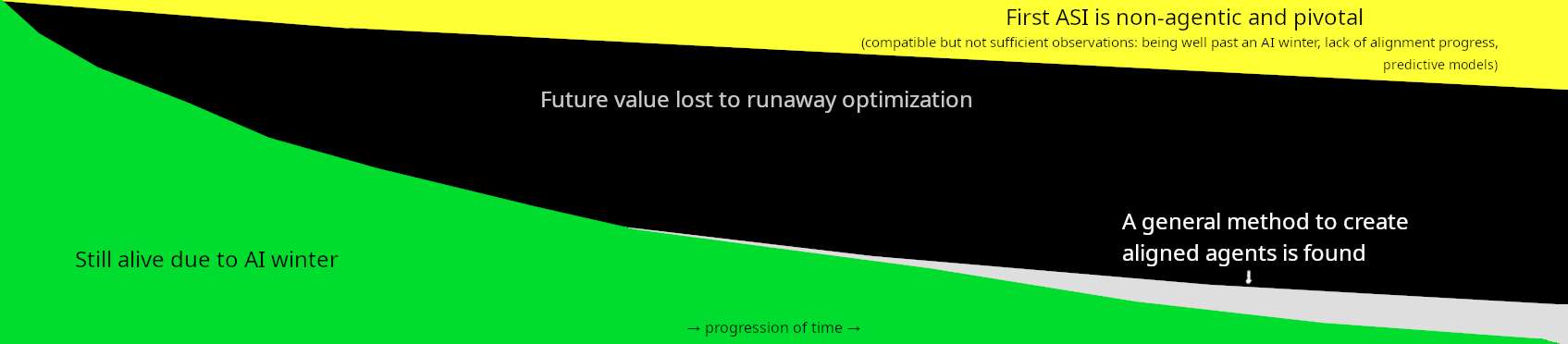
Note that the yellow portion doesn't imply no effort is made to ensure the first ASI's training setup produces a safe system, i.e. that we 'get lucky' by being on an alignment-by-default path.
I'd expect it to instead be the case that the 'luck'/causal determinant came earlier, i.e. initial capabilities breakthroughs being of a type which first produced non-agentic general intelligences instead of seed agents and inspired us to try to make sure the first superintelligence is non-agentic, too.
(This same argument can also be applied to other possible agendas that may not have been pursued if not for updates caused by early AGIs)
- ^
Disclaimer: This is presented as probabilistic evidence rather than as a 'sure conclusion I believe'
Editing in a further disclaimer: This argument was a passing intuition I had. I don't know if it's correct. I'm not confident about anthropics. It is not one of the reasons which motivated me to investigate this class of solution.
Editing in a further disclaimer: I am absolutely not saying we should assume alignment is easy because we'll die if it's not. Given a commenter had this interpretation, it seems this was another case of my writing difficulty causing failed communication.
- ^
Rather than expecting to 'get lucky many times in a row', e.g via capabilities researchers continually overlooking a human-findable method for superintelligence
- ^
(The proportions over time here aren't precise, nor are the categories included comprehensive, I put more effort into making this image easy to read/making it help convey the idea.)