This is a special post for quick takes by Trinley Goldenberg. Only they can create top-level comments. Comments here also appear on the Quick Takes page and All Posts page.
Comment Permalink
Surprising thing I've found as I begin to study and integrate skillful coercive motivation is the centrality of belief in providence and faith of this way of motivating yourself. Here are some central examples: the first from War of Art, the second from The Tools, the third from David Goggins. these aren't cherry picked (this is a whole section of War of Art and a whole chapter of The Tools).
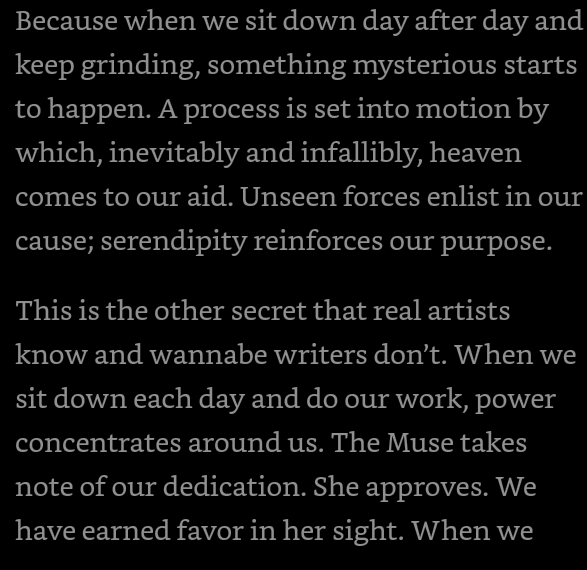

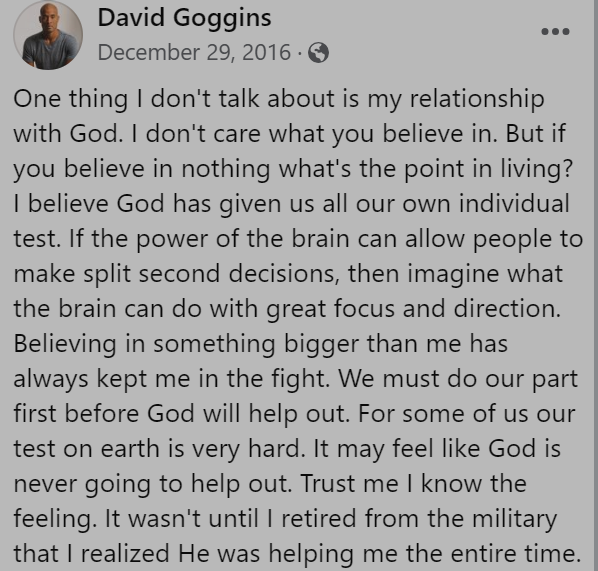
This has interesting implications given that as a society (at least in america) we've historically been motivated by this type of masculine, apollonian motivation - but have increasingly let go of faith in higher powers as a tenet of our central religion, secular humanism.This means the core motivation that drives us to build, create, transcend our nature... is running on fumes. We are motivated by gratitude, w/o sense of to what or whom we should be grateful, told to follow our calling w/o a since of who is calling.
We've tried to hide this contradiction. our seminaries separate our twin Religion (Secular Humanism and Scientific Materialism) into stem and humanities tracks to hide that what motivates The Humanities to create is invalidated by the philosophy that allows STEM o discover. But this is crumbling, the cold philosophy of scientific materialism is eroding the shaky foundations that allow secular humanists to connect to these higher forces - this is one of the drivers of the meaning the crisis.
I don't really see any way we can make it through the challenges we're facing with these powerful new technologies w/o a new religion that connects us to the mystical truly wise core that allows us to be motivated towards what's good and true. This is exactly what Marc Gafni is trying to do with Cosmo-Erotic Humanism, and what Monastic Academy is trying to do with a new, mystical form of dataism - but both these projects are moonshots to massively change the direction of culture.
Where I write up some small ideas that I've been happening that may eventually become their own top level posts. I'll start populating with a few ideas I've posted up as twitter/Facebook thoughts.