This is a special post for quick takes by Kaarel. Only they can create top-level comments. Comments here also appear on the Quick Takes page and All Posts page.
notes!
I've just posted a repo with a bunch of my notes from 2023–2026, mostly on topics with relevance to AI alignment; see here for more meta information. An assortment of 101 items from the vault:
- AI safety presentation slides (or really self-contained slideuments):
- Variants of the alignment problem (at the AFFINE Superintelligence Alignment Seminar)
- Verification-based alignment schemes (at the AFFINE Superintelligence Alignment Seminar)
- Inspection of thinking as a source of ideas for understanding minds (at the AFFINE Superintelligence Alignment Seminar)
- Model-wise thinking (at the AFFINE Superintelligence Alignment Seminar)
- Intro to AGI safety (at the University of Tartu)
- Impact cases for guardrails/monitoring/verification (at Mila)
- Why fear a math AI? (at Mila)
- on understanding:
- good concepts are concepts that support inferences
- predicting specific things
- model-thinking in mathematics
- how categoricity (or universal properties) relate to the implementation of mental structures
- gaining the integral notion
- cheap inferences
- turning activity-situations into abstract games
- a stylized genealogy of sonic concepts
- condensation:
- valuing, ethics, metaethics:
- mundane malignity
- it is natural for a mind to remake the world
- terminality causes unmooredness
- seeing (meta)ethics clearer via mathematical logic
- centering ethics on coming up with ways to act
- there are many good and important value-flavored structures
- the epistemics-ethics bridge
- in one sense, human values are very complicated; in another sense, human values are very simple
- argument against universal value extraction device
- an illustration of the role of understanding-machinery in value development
- on good reflection processes
- trajectories of moral-reflective flight — an alternative to reflective equilibrium
- some thoughts on consequentialist ethics in large worlds and an ethical problem relating to existence
- examples of structure-making and why copy-making?
- on pursuing ideals
- ideal induction math:
- on ideal inductions and attempts to use them to handle the AGI problem in principle:
- could one do science with solomonoff on text?
- a better attempt at getting science out of solomonoff
- solomonoff function induction gives at least some const probability to bad behavior on ood inputs
- solomonoff induction is weird
- which input-output pairs does solomonoff induction need to see to generalize correctly?
- beating solomonoff induction at grokking a notion
- solomonoff induction is not the paragon of generalization
- philosophy of language, philosophy of science, epistemology
- between verificationism and holism
- some disanalogies between solomonoff induction and science
- some considerations with an eye toward specifying a picture of meaning
- compositional inference warranting
- the correct theory of semantics
- formalizing philosophy
- assigning probabilities in a conception of the world you know to be inadequate
- interpretability:
- understanding a NN in terms of what it is doing
- merge machines
- readability of independent predicates implies steering vector existence and a sort of linear decomposability
- some superposition geometry math
- a memorizing construction
- hyperparams we'd want to know for a theory of interpretability that studying toy models could help determine
- a remark on the value of philosophy for understanding AIs
- metaphysics:
- a toy setting for studying some technological phenomena
- human math and alien math are pretty orthogonal
- scaling laws satisfied by mathematical things
- a world of purposes
- standard physics implies infinite computation causally downstream of us along certain extremely low (and decaying) amplitude quantum branches
- wherefore discreteness and emergence of structures
- the anima mundi analogy
- on human futures, facing AGI:
- instead of building a very different artificial system which is smarter than us, let's just become smarter (tentatively indefinitely)
- what is weltgeistbehandlung?
- protection via instrumentalization / instrumentalizing the good
- if you're trying to make a super-human non-human system, you should still have making humanity a top understander again in mind
- we should grow immensely but with great care
- a human future isn't petty
- uncategorized AI safety:
- outside-view arguments for (and against) AI doom
- on a lab preparing for RSI
- RSI structure hyperparams
- a statement of the alignment problem
- an argument for faster takeoff
- some good questions in conceptual alignment
- cases of verification
- shortlist of approaches to getting research papers given a hypercomputer
- mind uploads with ML (and specifically prediction)
- some ideas for safe self-improvement
- safe self-improvement is much easier than the AGI problem we face
- a list of alignment training tricks
- intention-setting speech for AFFINE seminar
- some hyperparam changes for the field of non-prosaic alignment
- varia:
 6
6 3
3 1
1 1
1
Positives of a future with human capability improvement over an AI future.
Beren Millidge has an essay arguing for the claim that a future in which humanity proceeds with biological capability increasing is scarier than a future in which we develop AGI. Here are some concluding sentences from his essay:
Ultimately, human intelligence amplification and the resulting biosingularity has a deeper and more intractable alignment problem than AI alignment, at least if we don’t just assume it away by asserting that humans and our transhuman creations just have some intrinsic and ineffable access to ‘human values’ that potential AIs lack.
The only potential positive as regards alignment of the biosingularity is that it will happen much later, most likely in the closing decades of the 21st century and around the end of the natural lifespans of my personal cohort. This gives significantly more time to prepare than AGI, which is likely coming much sooner, but the problem is much harder and requires huge advances in neuroscience and understanding of brain algorithms to even reach the level of control we have over today’s AI systems (which is likely far from sufficient).
I disagree with his thesis — I think that instead of creating AIs smarter than humans, it would be much better to proceed with increasing the capabilities of humans (for at least the next 100 years). [1] [2] Millidge's claim that the only potential positive of a biofoom is that it starts later seems clearly false. In this note, I will list other imo important (pro tanto) positives of a human foom. I agree with Millidge that there are also positives of the AGI path; [3] these won't be discussed in the present note. To assess which path is better overall, one could want to compare the positives of the human path to the positives of the AGI path, [4] but I will not do that here. The rest of this note is the list of positives. [5]
more similar entity => more similar values
an argument in favor of the human path:
- assumption 1. it makes sense to speak of the values of an entity, and the values of an entity are some sort of kinda-smooth function of the entity's structure/constitution
- assumption 2. humanity (taken as an entity) currently has pretty good values
- conclusion. somewhat modified humanity will still have pretty good values. in particular, a somewhat bioenhanced humanity will still have pretty good values
- in contrast: an AGI future will involve the-process-happening-on-earth changing a lot more from what it is now, certainly by each point in time, but also by the time each higher capability level is reached
we can also give a similar argument for single humans:
- assumption 1. it makes sense to speak of the values of an entity, and the values of an entity are some sort of kinda-smooth function of the entity's structure/constitution
- assumption 2'. individual humans growing up in current human societies have pretty good values
- conclusion'. somewhat modified individual humans growing up in somewhat modified societies will still have pretty good values
- in contrast: an AGI future will involve AGIs that are much more different than these future humans growing up in contexts that are much more different from the contexts in which current humans grow up. this is certainly true by each time (or each time after the beginning of each "foom proper"), but also by the point each higher capability level is reached
said another way:
- the target of right values is drawn largely around where the arrow(s) determining the values that humans have landed. shooting more similar arrows in a similar way is a decent strategy for hitting that target again.
[humans are]/[humanity is] just cool
- on the biofoom path, it will still be humanity, made of humans. humanity is cool. humans are cool. humans with increased capabilities and humanity with increased capabilities would be cool as well. like, of course it's possible for us to become even much cooler, but we're already occupying a very specific rare cool region in mindspace
- the smarter humans you make will be slotting into existing human institutions/organizations/communities. existing human institutions/organizations/communities will still be useful to the smarter humans. this is a reason for existing human institutions/organizations/communities to persist/thrive/develop. [6] and existing human institutions are carriers/supporters/implementers of human values and also cool
- the more capable humans will be continuing existing human (social, political, artistic, technological, scientific, mathematical, philosophical) projects and traditions. human thought will continue to develop. this is cool
- like, even if the humans with improved capabilities were to (let's say) form their own state and build a massive biodome around it and cause the outside to eventually become uninhabitable by polluting it or militarily leveling it to make room for automated factories or whatever, killing all other humans, that would be a very bad thing for them to do, but it would still be a human future, and that's pretty important
an analogy:
- suppose you are at intelligence level
- the agent could just be you after having taken a linear algebra course or after inventing some new methods in numerical linear algebra
- the agent could just be you after getting gene therapy which changes a single genetic variant to one that better supports learning (even in adulthood)
- the agent could be some sort of novel mind you create from scratch by some training procedure (ok maybe involving some culture which was also involved when you grew up)
- now, there is at least some range of your mind-making precision/understanding parameter from
- to spell out the analogy: with humanity as the agent, the human path is like becoming smarter via gene therapy and learning linear algebra, whereas the AI path is like creating a novel thing happening on earth largely in novel ways from scratch [9]
reasons why human thought would be guiding development more/better in a biofoom
- we have a lot of experience with and understanding about humans and specifically how to raise humans
- for example, voters, politicians, and researchers will all have much higher-quality starting intuitions about what millions of human einsteins would be like than about what a bunch of AIs would be like
- biofooming will be happening later, so we will have more time to prepare before it starts happening [10]
- but also biofooming will be happening much slower, so humans will have more time to think about each improvement
- like, the speed of development will be slower compared to the speed of human thought, so more human thought can go into each step of development. each unit step of development will be more human-thought-fully chosen
- this is true at the level of individual humans thinking about what should be done, and also true at the level of institutions and governments (like, a government running at human speed will be better able to legislate a slow biofoom)
reasons a biofooming world would be diffusely human-friendly (sociopolitical factors, anti-[gradual disempowerment] stuff)
- since humans will still be expensive to create and will continue to run on [at least order
- it will be somewhat difficult/weird for more capable humans to render the environment unlivable to less capable humans, because all humans have basically the same environmental requirements (for now) [11]
- ditto for good governance, laws, norms. e.g. it'd be quite natural for a law that makes it harder to manipulate the parents of an IVF einstein out of their property to also make it harder to manipulate the amish out of their property
- ditto for organizations and economic structures. e.g. it would be very natural for AIs to have a research process that operates in neuralese on a server, with translation costs being high enough that even if a human could do some useful task, doing the task yourself is cheaper than "translating" the task and context to a human; this effect is still present in human-human interactions but the degree to which it is present on the human path is smaller than the degree to which it is present on the AI path
- empathy is easier/"more natural" toward beings that are more like you. when agent B is more similar to agent A, it is more likely that [golden rule]/[categorical imperative] style reasoning leads A to treat B well [12]
- power concentration stuff is less bad in the biofoom case. it's not like there would be some entity controlling these more capable humans. these humans will be growing up in various families, involved in various communities/cultures/nations, going to various schools. in the biofoom case, RSI will not be localized to a single lab [13] . monopolies are much more natural in the AI case than in the biofoom case
- the AGI path involves power shifting away from people (and to AIs or companies) a lot more
- fooming happening slower means that the change in technological/social/cultural/environmental conditions during any
- fooming happening slower compared to the pace of life means that more life can be lived by existing living beings before being at the frontier of development start to find them boring and useless (or like, i don't want to say that this happens necessarily, but there is a force pushing in this direction)
- in a biofoom, there will be a graph of caring connecting most humans to most other humans with not that many steps; it will only have such-and-such clustering coefficients
- human institutions, organizations, systems are generally more likely to survive for longer. in particular, the following specific human institutions/organizations/systems supporting the ability of each human to live a good long life are more likely to survive for longer: states, laws, systems enforcing laws, social safety nets, democracy, cryonics organizations
- technologies which benefit humans with higher capabilities will also be somewhat likely to benefit current-100-iq humans. eg cures to diseases and other medical treatments, better educational methods, new words/concepts, most consumer technologies. if humans remain central to [doing stuff]/[the economy], then a large fraction of economically rewarded innovation will be making humans more capable, and so technological progress will generally be pointed in a more humane direction
- in general: various mad local forces at play in the world (greed, status-seeking, etc) will stay pointed in a more humane direction
- also, governments will be much better able to understand, track, and deal with messy world problems in the biofoom case
we know humans [can be and often are] kind/nice to other humans
about humans, we know the following:
- most humans consider it very bad to personally kill other humans, and would not kill other humans in normal circumstances. most humans consider the killing of humans highly reprehensible in general [14]
- most humans consider it bad to steal from humans. most humans think human property rights should basically be respected. most humans are not in favor of taking property from people. most people would consider it very bad to take property from a person such that this person would then be unable to live an alright life
- probably there are some humans who have a deep enough commitment to humanity that they'd remain nice to all existing humans even after individually fooming a lot (though note this won't be happening in the human foom)
also:
- there are specific steps/niches in human evolutionary history which made us nicer to unrelated strangers
other factors
- there are factors much more tightly constraining capabilities in the biofoom case than in the AI foom case:
- brain volume is tough to increase by idk more than
- roughly, there is some not-THAT-large finite number of intelligence-increasing "genetic ideas" in the current gene pool, and for at least some initial period these set a cap on how far you can go biologically. it will be very hard to genetically write novel more capable human learning algorithms. the genome interface to mind reprogramming is kinda cursed
- it will be expensive and potentially immoral and illegal to "run experiments"
- brain volume is tough to increase by idk more than
- humanity's correct values are somewhat well-tracked by reflection / self-endorsed development, and the biofoom path will be like that
- it makes sense to speak of what sort of reflection and development should happen, distinguishing this from development that is likely to happen. it is very much not true that anything goes! if it were likely/natural that our society would get replaced by a molecular squiggle maximizer, that wouldn't mean that our society's true values are to make lots of those molecular squiggles, and that wouldn't mean this was what should happen all along. whereas if we reflect carefully and understand more stuff and become better versions of ourselves and conclude that we should make lots of some molecular squiggles, then it's plausible that this was what should happen all along.
- it is (at least prima facie) extremely scary/reckless to have a step in your development where you hand things over to some novel mind created largely from scratch! this is done much more on the AI path than on the human path
- i say some more on good development and also the general topic of this note here: https://www.lesswrong.com/posts/iemgJhjNLa5eyevWR/kh-s-shortform?commentId=PHm2ZkagfyrhT2Wvz
a concluding remark
self-improvement generally has many good properties over creating a new agent/mind from scratch [15]
i think we should ban AGI ↩︎
It is also a possibility that both options are bad. My view is that we should push forward with increasing human capabilities biologically and culturally/educationally. But I think this question deserves serious analysis, and there are certainly specific things here that one should be very careful about and regulate. However, this note will not be analyzing this question. ↩︎
That said, I think the analysis of the positives in his essay gets very many things wrong. ↩︎
But one also doesn't have to do that, to compare the two paths. One can also just "directly" think about what would happen along each path. ↩︎
They are not listed in order of importance. ↩︎
clearly this is a reason for these to be around for longer in wall clock time, but also it's a reason for them to be around until higher capability levels ↩︎
in fact it seems plausible that, at least if the mind design has to be done from your own bounded perspective, it will keep being better to self-improve forever. i think this is plausible on this individual future life coolness axis and also all-things-considered. ↩︎
ok, if you (imo incorrectly) believe in some sort of soul theory of personal identity then maybe to make this a fair example you would need to imagine the soul getting detached in all three examples, but then maybe you will think all of these are suicides... so maybe this isn't a good analogy for you... but hmm i guess maybe you should also in the same sense believe in there being a soul attached to each society though, and then it would be a good analogy actually ↩︎
ok, there's a meaningful amount of shared culture. even if you thought human minds and AI minds are "mostly cultural" and that subbing out representation/learning/etc algorithms/structures and radically changing learning contexts doesn't make it legit to say AGI will be a novel thing created largely in novel ways from scratch, it is still at least a really big step; it's still creating some totally new guy ↩︎
as Millidge says ↩︎
yes, there are sort of examples like climate change. but it is still much easier to imagine entities that are just programs that can be run on arbitrary computers being totally fine with or even preferring a very different environment. there is a large difference in degree here ↩︎
and we at least know humans have a propensity to carry out and be moved by this style of reasoning ↩︎
or three labs or whatever. In reality, I think only a single lab will matter, absent strict capability regulation. ↩︎
there is a major issue around diffuse effects — like, people and institutions currently not tracking [decreasing the lifespan of
this is also important to track when thinking about AIs making more capable AIs ↩︎
 3
3What if like homo deus we get separate Very Smart group of humans and one not so smart?
I agree this would most likely be either somewhat bad or quite bad, probably quite bad (depending on the details), both causally and also indicatorily.
I'll restrict my discussion to reprogenetics, because I think that's the main way we get smarter humans. My responses would be "this seems quite unlikely in the short run (like, a few generations)" and "this seems pretty unlikely in the longer run, at least assuming it's in fact bad" and "there's a lot we can do to make those outcomes less likely (and less bad)".
Why unlikely in the short run? Some main reasons:
- Uptake of reprogenetics is slow (takes clock time), gradual (proceeds by small steps), and fairly visible (science generally isn't very secretive; and if something is being deployed at scale, that's easy to notice, e.g. many clinics offering something or some company getting huge investments). These give everyone more room to cope in general, as discussed above, and in particular gives more time for people to notice emerging inequality and such. So humanity in general gets to learn about the tech and its meaning, institute social and governmental regulation, gain access, understand how to use it, etc.
- Likewise, the strength of the technology itself will grow gradually (though I hope not too slowly). Further, even as the newest technology gets stronger, the previous medium strength tech gets more uptake. This means there's a continuum of people using different levels of strength of the technology.
- Parents will most likely have quite a range of how much they want to use reprogenetics for various things. Some will only decrease their future children's disease risks; some will slightly increase IQ; some might want to increase IQ around as much as is available.
- IQ, and even more so for other cognitive capacities and traits, is controlled...
- partly by genetic effects we can make use of (currently something in the ballpark of 20% or so);
- partly by genetic effects we can't make use of (very many of which might take a long time to make use of because they have small and/or rare effects, or because they have interactions with other genes and/or the environment);
- partly by non-genetic causes (unstructured environment such as randomness in fetal development, structured external environment such as culture, structured internal environment such as free self-creation / decisions about what to be or do).
- Thus, we cannot control these traits, in the sense of hitting a narrow target; we can only shift them around. We cannot make the distribution of a future child's traits be narrow. (This is a bad state of affairs in some ways, but has substantive redeeming qualities, which I'm invoking here: people couldn't firmly separate even if they wanted to (though this may need quantification to have much force).)
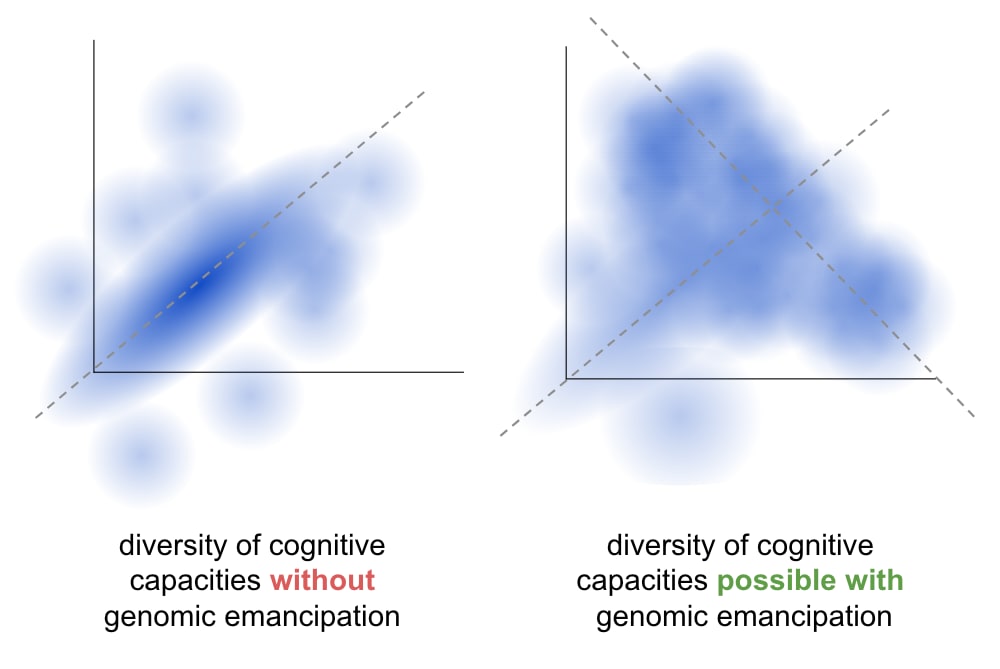
- Together, I suspect that the above points create, not separated blobs, but a broad continuum:
- As mentioned in the post, there are ceilings to human intelligence amplification that would probably be hit fairly quickly, and probably wouldn't be able to be bypassed quickly. (Who knows how long, but I'm imagining at least some decades--e.g. BCIs might take on that time scale or longer to impact human general intelligence--reprogenetics is the main strategy that takes advantage of evolution's knowledge about how to make capable brains, and I'm guessing that knowledge is more than we will do in a couple decades but not insanely much in the grand scheme of things.)
What can we do? Without going into detail on how, I'll just basically say "greatly increase equality of access through innovation and education, and research cultures to support those things".
I would be curious what you think about the idea of more permanent economic rifts and also the general economics of gene editing?
As a matter of science and technology, reprogenetics should be inexpensive. I've analyzed this area quite a bit (though not focused specifically on eventual cost), see https://berkeleygenomics.org/articles/Methods_for_strong_human_germline_engineering.html . My fairly strong guess is that it's perfectly feasible to have strong reprogenetics that's pretty inexpensive (on the order of $5k to $25k for a pretty strongly genomically vectored zygote). From a tech and science perspective, I think I see multiple somewhat-disjunctive ways, each of which is pretty plausibly feasible, and each of which doesn't seem to have any inputs that can't be made inexpensive.
(As a comparison point, IVF is expensive--something like $8k to $20k--but my guess is that this is largely because of things like regulatory restrictions (needing an MD to supervise egg retrieval, even though NPs can do it well), drug price lock-in (the drugs are easy to manufacture, so are available cheaply on gray markets), and simply economic friction/overhang (CNY is cheaper basically by deciding to be cheaper and giving away some concierge-ness). None of this solves things for IVF today; I'm just saying, it's not expensive due to the science and tech costing $20k.)
Assuming that it can be technically inexpensive, that cuts out our work for us: make it be inexpensive, by
- Making the tech inexpensive
- Thinking not just about the current tech, but investing in the stronger tech (stronger -> less expensive https://berkeleygenomics.org/articles/Methods_for_strong_human_germline_engineering.html#strong-gv-and-why-it-matters )
- Culture of innovation
- Both internal to the field, and pressure / support from society and gvt
- Don't patent and then sit on it or keep it proprietary; instead publish science, or patent and license, or at least provide it as a platform service
- Avoiding large other costs
- Sane regulation
- No monopolies
- Subsidies
Might it be smart to make it a public good instead?
I definitely think that
- as much as possible, gvt should fund related science to be published openly; this helps drive down prices, enables more competitive last-mile industry (clinics, platforms for biological operations, etc.), and signals a societal value of caring about this and not leaving it up to raw market forces
- probably gvt should provide subsidies with some kind of general voucher (however, it should be a general voucher only, not a voucher for specific genomic choices--I don't want the gvt controlling people's genomic choices according to some centralized criterion, as this is eugenicsy, cf. https://berkeleygenomics.org/articles/Genomic_emancipation_contra_eugenics.html )
Is that what you mean? I don't think we can rely on gvt and philanthropic funding to build out a widely-accessible set of clinics / other practical reprogenetics services, so if you meant nationalizing the industry, my guess is no, that would be bad to do.
 1
1I would agree that this is a weird incentive issue and that IQ is probably easier and less thorny than personality traits. With that being said here's a fun little thought on alternative ways of looking at intelligence:
Okay but why is IQ a lot more important than "personality"?
IQ being measured as G and based on correlational evidence about your ability to progress in education and work life. This is one frame to have on it. I think it correlates a lot of things about personality into a view that is based on a very specific frame from a psychometric perspective?
Okay, let's look at intelligence from another angle, we use the predictive processing or RL angle that's more about explore exploit, how does that show up? How do we increase the intelligence of a predictive processing agent? How does the parameters of when to explore and when to exploit and the time horizon of future rewards?
Openness here would be the proclivity to explore and look at new sources of information whilst conscientiousness is about the time horizon of the discouting factor in reward learning. (Correlatively but you could probably define new better measures of this, the big 5 traits are probably not the true names for these objectives.)
I think it is better for a society to be able to talk to each other and integrate information well hence I think we should make openness higher from a collective intelligence perspective. I also think it is better if we imagine that we're playing longer form games with each other as that generally leads to more cooperative equilibria and hence I think conscientiousness would also be good if it is higher.
(The paper I saw didn't replicate btw so I walk back the intelligence makes you more ignorant point. )
(Also here's a paper talking about the ability to be creative having a threshold effect around 120 iq with openness mattering more after that, there's a bunch more stuff like this if you search for it.)
 1
1When fooming, uphold the option to live in an AGI-free world.
There are people who think (imo correctly) that there will be at least one vastly superhuman AI in the next 100 years by default and (imo incorrectly) that proceeding along the AI path does not lead to human extinction or disempowerment by default. My anecdotal impression is that a significant fraction (maybe most) of such people think (imo incorrectly) that letting Anthropic/Claude do recursive self-improvement and be a forever-sovereign would probably go really well for humanity. The point of this note is to make the following proposal and request: if you ever let an AI self-improve, or more generally if you have AIs creating successor AIs, or even more generally if you let the AI world develop and outpace humans in some other way, or if you try to run some process where boxed AIs are supposed to create an initial ASI sovereign, or if you try to have AIs "solve alignment" [1] (in one of the ways already listed, or in some other way), or if you are an AI (or human mind upload) involved in some such scheme, [2] try to make it so the following property is upheld:
- It should be possible for each current human to decide to go live in an AGI-free world. In more detail:
- There is to be (let's say) a galaxy such that AGI is to be banned in this galaxy forever, except for AGI which does some minimal stuff sufficient to enforce this AI ban. [3]
- There should somehow be no way for anything from the rest of the universe to affect what happens in this galaxy. In particular, there should probably not be any way for people in this galaxy to observe what happened elsewhere.
- If a person chooses to move to this galaxy, they should wake up on a planet that is as much like pre-AGI Earth as possible given the constraints that AGI is banned and that probably many people are missing (because they didn't choose to move to this galaxy). Some setup should be found which makes institutions as close as possible to current institutions still as functional as possible in this world despite most people who used to play roles in them potentially being missing.
- For example, it might be possible to set this up by having the galaxy be far enough from all other intelligent activity that because of the expansion of the universe, no outside intelligent activity could be seen from this galaxy. In that case, the humans who choose to go live there would maybe be in cryosleep for a long time, and the formation of this galaxy could be started at an appropriate future time.
- One should try to minimize the influence of any existing AGI on a human's thinking before they are asked if they want to make this decision. Obviously, manipulation is very much not allowed. If some manipulation has already happened, it should probably be reversed as much as possible. Ideally, one would ask the version of the person from the world before AGI.
- Here are some further clarifications about the setup:
- Of course, if the resources in this galaxy are used in a way considered highly wasteful by the rest of the universe, then nothing is to be done about that by the rest of the universe.
- If the people in this galaxy are about to kill themselves (e.g. with engineered pathogens), then nothing is to be done about that. (Of course, except that: the AI ban is supposed to make it so they don't kill themselves with AI.)
- Yes, if the humanity in this galaxy becomes fascist or runs a vast torturing operation (like some consider factory farming to be), then nothing is to be done about that either.
- We might want to decide more precisely what we mean by the world being "AGI-free". Is it fine to slowly augment humans more and more with novel technological components, until the technological components are eventually together doing more of the thinking-work than currently existing human thinking-components? Is it fine to make a human mind upload?
- I think I would prefer a world in which it is possible for humans to grow vastly more intelligent than we are now, if we do it extremely slowly+carefully+thoughtfully. It seems difficult/impossible to concretely spell out an AI ban ahead of time that allows this. But maybe it's fine to keep this not spelled out — maybe it's fine to just say something like what I've just said. After all, the AI banning AI for us will have to make very many subtle interpretation decisions well in any case.
- We can consider alternative requests. Here are some parameters that could be changed:
- Instead of AI being banned in this galaxy forever, AI could be banned only for 1000 or 100 years.
- Maybe you'd want this because you would want to remain open to eventual AI involvement in human life/history, just if this comes after a lot more thinking and at a time when humanity's is better able to make decisions thoughtfully.
- Another reason to like this variant is that it alleviates the problem with precisifying what "ban AI" means — now one can try to spell this out in a way that "only" has to continue making sense over 100 or 1000 years of development.
- Instead of giving each human the option to move to this galaxy, you could give each human the option to branch into two copies, with one moving to this galaxy and one staying in the AI-affected world.
- The total amount of resources in this AI-free world should maybe scale with the number of people that decide to move there. Naively, there should be order reachable galaxies per person alive, so the main proposal which just allocates a single galaxy to all the people who make this decision asks for much less than what an even division heuristic suggests.
- We could ask AIs to do some limited stuff in this galaxy (in addition to banning AGI).
- Some example requests:
- We might say that AIs are also allowed to make it so death is largely optional for each person. This could look like unwanted death being prevented, or it could look like you getting revived in this galaxy after you "die", or it could look like you "going to heaven" (ie getting revived in some non-interacting other place).
- We might ask for some starting pack of new technologies.
- We might ask for some starting pack of understanding, e.g. for textbooks providing better scientific and mathematical understanding and teaching us to create various technologies.
- We might say that AIs are supposed to act as wardens to some sort of democratic system. (Hmm, but what should be done if the people in this galaxy want to change that system?)
- We might ask AIs to maintain some system humans in this galaxy can use to jointly request new services from the AIs.
- However, letting AIs do a lot of stuff is scary — it's scary to depart from how human life would unfold without AI influence. Each of the things in the list just provided would constitute/cause a big change to human life. Before/when we change something major, we should take time to ponder how our life is supposed to proceed in the new context (and what version of the change is to be made (if any)), so we don't [lose ourselves]/[break our valuing].
- Some example requests:
- There could be many different AI-free galaxies with various different parameter settings, with each person getting to choose which one(s) to live in. At some point this runs into a resource limit, but it could be fine to ask that each person minimally gets to design the initial state of one galaxy and send their friends and others invites to have a clone come live in it.
- Instead of AI being banned in this galaxy forever, AI could be banned only for 1000 or 100 years.
- Here are some remarks about the feasibility and naturality of this scheme:
- If you think letting Anthropic/Claude RSI would be really great, you should probably think that you could do an RSI with this property.
- In fact, in an RSI process which is going well, I think it is close to necessary that something like this property is upheld. Like, if an RSI process would not lead to each current person [4] being assigned at least (say) of all accessible resources, then I think that roughly speaking constitutes a way in which the RSI process has massively failed. And, if each person gets to really decide how to use at least of all accessible resources [5] , then even a group of people should be able to decide to go live in their own AGI-free galaxy.
- I guess one could disagree with upholding something like this property being feasible conditional on a good foom being feasible or pretty much necessary for a good foom.
- One could think that it's basically fine to replace humans with random other intelligent beings (e.g. Jürgen Schmidhuber and Richard Sutton seem to think something like this), especially if these beings are "happy" or if their "preferences" are satisfied (e.g. Matthew Barnett seems to think this). One could be somewhat more attached to something human in particular, but still think that it's basically fine to have no deep respect for existing humans and make some new humans living really happy lives or something (e.g. some utilitarians think this). One could even think that good reflection from a human starting point leads to thinking this. I think this is all tragically wrong. I'm not going to argue against it here though.
- Maybe you could think the proposal would actually be extremely costly to implement for the rest of the universe, because it's somehow really costly to make everyone else keep their hands off this galaxy? I think this sort of belief is in a lot of tension with thinking a fooming Anthropic/Claude would be really great (except maybe if you somehow really have the moral views just mentioned).
- similarly: You could think that the proposal doesn't make sense because the AIs in this galaxy that are supposed to be only enforcing an AI ban will have/develop lots of other interests and then claim most of the resources in this galaxy. I think this is again in a lot of tension with thinking a fooming Anthropic/Claude would be really great.
- One could say that even if it would be good if each person were assigned all these resources, it is weird to call it a "massive failure" if this doesn't happen, because future history will be a huge mess by default and the thing I'm envisaging has very nearly probability and it's weird to call the default outcome a "massive failure". My response is that while I agree this good thing has on my inside view probability of happening (because AGI researchers/companies will create random AI aliens who disempower humanity) and I also agree future history will be a mess, I think we probably have at least the following genuinely live path to making this happen: we ban AI (and keep making the implementation of the ban stronger as needed), figure out how to make development more thoughtful so we aren't killing ourselves in other ways either, grow ever more superintelligent together, and basically maintain the property that each person alive now (who gets cryofrozen) controls more than of all accessible resources [6] . [7]
- This isn't an exhaustive list of reasons to think it [is not pretty much necessary to uphold this property for a foom to be good] or [is not feasible to have a foom with this property despite it being feasible to have a good foom]. Maybe there are some reasonable other reasons to disagree?
- This property being upheld is also sufficient for the future to be like at least meaningfully good. Like, humans would minimally be able to decide to continue human life and development in this other galaxy, and that's at least meaningfully good, and under certain imo-non-crazy assumptions really quite good (specifically, if: humanity doesn't commit suicide for a long time if AI is banned AND many different humane developmental paths are ex ante fine AND utility scales quite sublinearly in the amount of resources).
- So, this property being upheld is arguably necessary for the future to be really good, and it is sufficient for the future to be at least meaningfully good.
- Also, it is natural to request that whoever is subjecting everyone to the end of the human era preserve the option for each person to continue their AI-free life.
- If you think letting Anthropic/Claude RSI would be really great, you should probably think that you could do an RSI with this property.
- Here are some reasons why we should adopt this goal, i.e. consider each person to have the right to live in an AGI-free world:
- Most importantly: I think it helps you think better about whether an RSI process would go well if you are actually tracking that the fooming AI will have to do some concrete big difficult extremely long-term precise humane thing, across more than trillions of years of development. It helps you remember that it is grossly insufficient to just have your AI behave nicely in familiar circumstances and to write nice essays on ethical questions. There's a massive storm that a fragile humane thing has to weather forever. [8] The main reason I want you to keep these things in mind and so think better about development processes is this: I think there is roughly a logical fact that running an RSI process will not lead to the fragile humane thing happening [9] , and I think you might be able to see this if you think more concretely and seriously about this question.
- Adopting this goal entails a rejection of all-consuming forms of successionism. Like, we are saying: No, it is not fine if humans get replaced by random other guys! Not even if these random other guys are smarter than us! Not even if they are faster at burning through negentropy! Not even if there is a lot of preference-satisfaction going on! Not even if they are "sentient"! I think it would be good for all actors relevant to AI to explicitly say and track that they strongly intend to steer away from this.
- That said, I think we should in principle remain open to us humans reflecting together and coming to the conclusion that this sort of thing is right and then turning the universe into a vast number of tiny structures whose preferences are really satisfied or who are feeling a lot of "happiness" or whatever. But provisionally, we should think: if it ever looks like a choice would lead to the future not having a lot of room for anything human, then that choice is probably catastrophically bad.
- Adopting this also entails a rejection of more humane forms of utilitarianism that however still see humans only as cows to be milked for utility. Like, no, it is not fine if the actual current humans get killed and replaced. Not even if you create a lot of "really cool" human-like beings and have them experiencing bliss! Not even if you create a lot of new humans and have them have a bunch of fun! Not even if you create a lot of new humans from basically the 2025 distribution and give them space to live happy free lives! In general, I want us to think something like:
- There is an entire particular infinite universe of {projects, activities, traditions, ways of thinking, virtues, attitudes, principles, goals, decisions} waiting to grow out of each existing person. [10] Each of these moral universes should be treated with a lot of respect, and with much more respect than the hypothetical moral universes that could grow out of other merely possible humans. Each of us would want to be respected in this way, and we should make a pact to respect each other this way, and we should seek to create a world in which we are enduringly respected this way.
- These reasons apply mostly if, when thinking of RSI-ing, you are not already tracking that this fooming AI will have to do some concrete big difficult extremely long-term precise thing that deeply respects existing humans. If you are already tracking something like this, then plausibly you shouldn't also track the property I'm suggesting.
- E.g., it would be fine to instead track that each person should get a galaxy they can do whatever they want with/in. I guess I'm saying the AI-free part because it is natural to want something like that in your galaxy (so you get to live your own life in a way properly determined by you, without the immediate massive context shift coming from the presence of even "benign" highly capable AI, that could easily break everything imo), because it makes sense for many people to coordinate to move to this galaxy together (it's just better in many mundane ways to have people around, but also your thinking and specifically valuing probably need other people to work as they should), and because it is natural to ask that whoever is subjecting everyone to the end of the human era preserves the option for each person to continue an AI-free life in particular.
- Here are a few criticisms of the suggestion:
- a criticism: "If you run a foom, this property just isn't going to be upheld, even if you try to uphold it. And, if you run a foom, then having the goal of upholding this property in mind when you put the foom in motion will not even make much of a relative difference in the probability the foom goes well."
- my response: I think this. I still suggest that we have this goal in mind, for the reasons given earlier.
- a criticism: "If we imagine a foom being such that this option is upheld, then probably we should imagine it being such that better options are available to people as well."
- my response: I probably think this. I still suggest that we have this goal in mind, for the reasons given earlier.
- a criticism: "If you run a foom, this property just isn't going to be upheld, even if you try to uphold it. And, if you run a foom, then having the goal of upholding this property in mind when you put the foom in motion will not even make much of a relative difference in the probability the foom goes well."
I think this is probably a bad term that should be deprecated ↩︎
well, at least if the year is and we're not dealing with a foom of extremely philosophically competent and careful mind uploads or whatever, firstly, you shouldn't be running a foom (except for the grand human foom we're already in). secondly, please think more. thirdly, please try to shut down all other AGI attempts and also your lab and maybe yourself, idk in which order. but fourthly, ... ↩︎
This will plausibly require staying ahead of humanity in capabilities in this galaxy forever, so this will be extremely capable AI. So, when I say the galaxy is AGI-free, I don't mean that artificial generally intelligent systems are not present in the galaxy. I mean that these AIs are supposed to have no involvement in human life except for enforcing an AI ban. ↩︎
or like at least "their values" ↩︎
and assuming we aren't currently massively overestimating the amount of resources accessible to Earth-originating creatures ↩︎
or maybe we do some joint control thing about which this is technically false but about which it is still pretty fair to say that each person got more of a say than if they merely controlled of all the resources ↩︎
an intuition pump: as an individual human, it seems possible to keep carefully developing for a long time without accidentally killing oneself; we just need to make society have analogues of whatever properties/structures make this possible in an individual human ↩︎
Btw, a pro tip for weathering the storm of crazymessactivitythoughtdevelopmenthistory: be the (generator of the) storm. I.e., continue acting and thinking and developing as humanity. Also, pulling ourselves up by our own bootstraps is based imo. Wanting to have a mommy AI think for us is pretty cringe imo. ↩︎
Among currently accessible RSI processes, there is one exception: it is in fact fine to have normal human development continue. ↩︎
Ok, really humans (should) probably importantly have lives and values together, so it would be more correct to say: there is a particular infinite contribution to human life/valuing waiting to grow out of each person. Or: when a person is lost, an important aspect of God) is lost. But the simpler picture is fine for making my current point. ↩︎
3I designed a pro-human(ity)/anti-(non-human-)AI flag:

- The red-black circle is HAL's eye; it represents the non-human in-all-ways-super-human AI(s) that the world's various AI capability developers are trying to create, that will imo by default render all remotely human beings completely insignificant and cause humanity to completely lose control over what happens :(.
- The white star covering HAL's eye has rays at the angles of the limbs of Leonardo's Vitruvian Man; it represents humans/humanity remaining more capable than non-human AI (by banning AGI development and by carefully self-improving).
- The blue background represents our potential self-made ever-better future, involving global governance/cooperation/unity in the face of AI.
Feel free to suggest improvements to the flag. Here's latex to generate it:
% written mostly by o3 and o4-mini-high, given k's prompting
% an anti-AI flag. a HAL "eye" (?) is covered by a vitruvian man star
\documentclass[tikz]{standalone}
\usetikzlibrary{calc}
\usepackage{xcolor} % for \definecolor
\definecolor{UNBlue}{HTML}{5B92E5}
\begin{document}
\begin{tikzpicture}
%--------------------------------------------------------
% flag geometry
%--------------------------------------------------------
\def\flagW{6cm} % width -> 2 : 3 aspect
\def\flagH{4cm} % height
\def\eyeR {1.3cm} % HAL-eye radius
% light-blue background
\fill[UNBlue] (0,0) rectangle (\flagW,\flagH);
%--------------------------------------------------------
% concentric “HAL eye” (outer-most ring first)
%--------------------------------------------------------
\begin{scope}[shift={(\flagW/2,\flagH/2)}] % centre of the flag
\foreach \f/\c in {%
1.00/black,
.68/{red!50!black},
.43/{red!80!orange},
.1/orange,
.05/yellow}%
{%
\fill[fill=\c,draw=none] circle ({\f*\eyeR});
}
%── parameters ───────────────────────────────────────
\def\R{\eyeR} % distance from centre to triangle’s tip
\def\Alpha{10} % full apex angle (°)
%── compute half-angle & half-base once ─────────────
\pgfmathsetmacro\halfA{\Alpha/2}
\pgfmathsetlengthmacro\halfside{\R*tan(\halfA)}
%── loop over Vitruvian‐man angles ───────────────────
\foreach \Beta in {0,30,90,150,180,240,265,275,300} {%
% apex on the eye‐rim
\coordinate (A) at (\Beta:\R);
% base corners offset ±90°
\coordinate (B) at (\Beta+90:\halfside);
\coordinate (C) at (\Beta-90:\halfside);
% fill the spike
\path[fill=white,draw=none] (A) -- (B) -- (C) -- cycle;
}
\end{scope}
\end{tikzpicture}
\end{document}