1&3: Even if Taiwan maintains its non-nuclear status, Beijing's intent to wage a unification war is increasingly overshadowing concerns about economic sanctions and casualties. Should Taipei attempt to acquire nuclear weapons again, it would trigger tensions far exceeding those of the North Korean nuclear crisis or the THAAD crisis, making war highly probable.
Acquiring nuclear weapons is fundamentally different from gaining the capability to deploy them. The advantage of nuclear terrorism gained through a small number of primitive fission devices would not secure victory for Taiwan, just as Iraq did not win the Gulf War through its chemical weapons advantage. If these devices are not destroyed, captured, or neutralized early in the conflict, their sole utility would be for scorched-earth tactics—but Taipei's leadership is unlikely to descend into madness.
The United States is unwilling to engage in nuclear warfare. Therefore, should Taipei's leadership exhibit overtly irrational behavior, Washington would likely refuse assistance, leaving Taiwan incapable of prevailing alone.
Taiwan cannot independently manufacture all equipment required for TSMC chip factories; its lithography machines and other apparatus rely on imports. Should Taiwan attempt to import centrifuges after its nuclear program is exposed, it might have to resort to submarine transport.
2: As the Three Gorges Dam is a gravity dam. Most conventional missiles cannot destroy it at an acceptable cost. To demolish it would require shattering hundreds of millions of tons of reinforced concrete.
China possesses robust air defense and anti-missile systems, while Taiwan's missile technology remains at the PLA's 2000s level. Even if the Taipei regime planned to strike mainland China before its launch platforms were destroyed, the civilian targets it could effectively attack would primarily be urban clusters along the Fujian coast.
 1
1No one except outright tyrants would bomb civilian infrastructure or use nuclear weapons, subjecting millions of people to suffering.
Once serious nuclear weapons are used, everyone dies (to a first approximation), civilian or not. If I recall correctly, it takes about 100 megatons worldwide to casuse nuclear winter and collapse agricultural production.
During the Cold War, the US maintained a position of "strategic ambiguity" on the question of first use. Much of the logic around NATO at the height of the Cold War was based around a first-use nuclear response to overwhelming conventional invasion (see MC 14/13 staged responses). This was the full-scale, Dr Strangelove, batshit-insane "end of civilization" nightmare. Strategic ambiguity was retained around what would trigger each level of response, but the endgame was pretty much total annihilation. I believe France also maintained a separate posture of strategic ambiguity, and they always wanted to ensure a nuclear deterent that didn't rely on NATO.
China and Russia both held official policies of "no first use", but it's uncertain that they would have actually stuck to that in the face of a massively overwhelming conventional invasion.
I want to be clear: The logic of nuclear deterence is just as insane as Dr Strangelove made it out to be. And you may choose to call NATO, the US and France "tyrants"! But they all had policy at least as dangerous as, "Well, we haven't promised that we won't trigger nuclear Armageddon and the death of billions if a large enough number of tanks roll across our borders. Do you feel lucky, punk?"
So as a Westerner, that's a missing piece of the analysis for me. Taiwan has invested heavily in long-range cruise missiles and, in the past, secret nuclear programs. Presumably they had some theory of how they would use that capacity in the face of a massively overwhelming conventional invasion.
And just in case I haven't made it clear, I think MAD is madness. I think even the people who coined the acronym knew that. But when a country is faced with overwhelming conventional invasion, I don't think we can automatically rule it out.
 2
21: As I've repeatedly emphasized across multiple platforms, I did not employ generative AI technology to compose these texts. If they resemble LLM output, it likely stems from my writing style.
2: If tanks can employ directed-energy weapons and cannon-mounted programmed munitions to shoot down hundreds of drones, while striking fortified positions from thousands of meters away under infantry or drone guidance, the enemy assets they destroy and the infantry lives they protect may far outweigh their own cost.
Armor itself serves as an excellent drone deployment platform: it can maneuver upon detection, possesses surplus defensive firepower, and offers at least splinter protection. Without such platforms, drone operators must either remain in rear areas—depleting drone range and reducing sortie frequency—or face certain death upon exposure.
3: DRG units can consist of relatively few humans and numerous robotic platforms, operating covertly whenever possible to minimize drone casualties. If smaller platforms can also deploy effective anti-drone weapons, their casualty rates would be even lower. These teams remain irreplaceable because FPV drones are poorly suited for clearing buildings and tunnels, and struggle to launch attacks from many routes (such as abandoned oil and gas pipelines). Additionally, FPV requires units to mark targets—including by drawing enemy fire—otherwise they prove ineffective against concealed adversaries.
4: Using Starlink to remotely control frontline units is a sound concept but imperfect: During large-scale warfare, frontline units operate in complex electromagnetic environments. You may need to position Starlink receivers tens of kilometers behind the contact line and connect them to frontline units via fiber optics. However, frontline units still require human operators at present.
5: These assumptions are based on cutting-edge technology projected for 2026. Should artificial intelligence advance to solve complex frontline combat challenges, we'll all soon be turned into paperclips.
 2
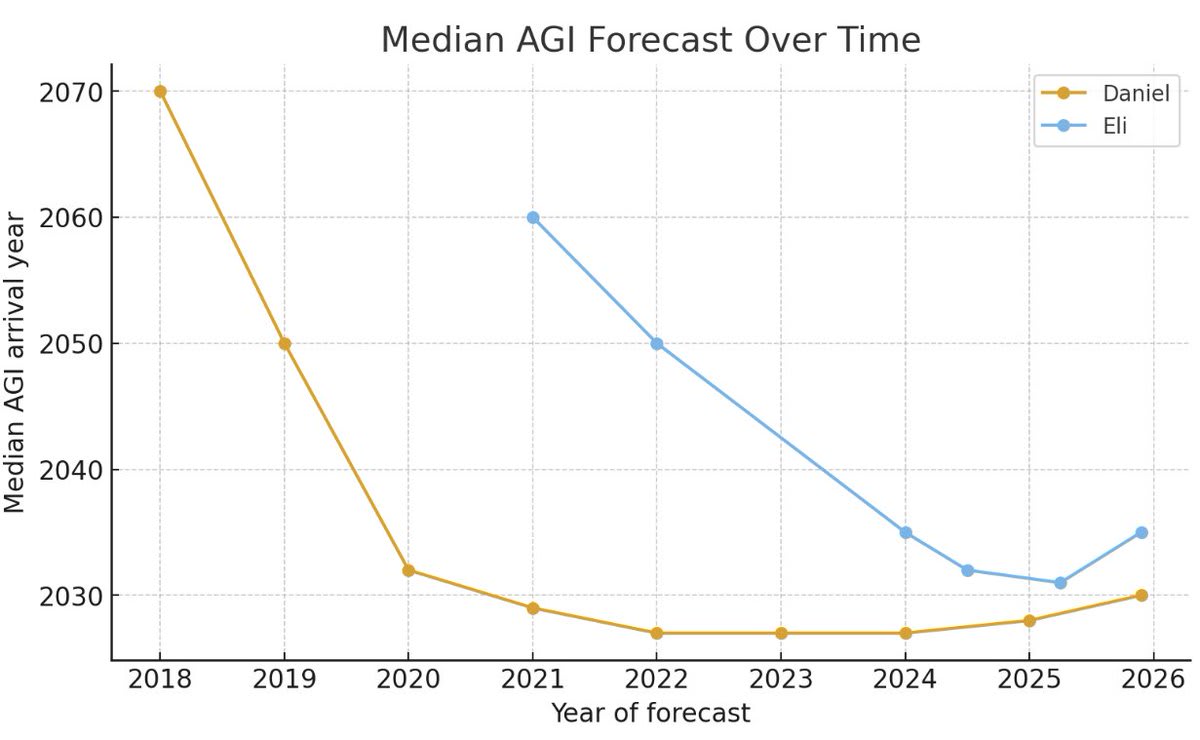
2Back when many expected takeoff in 2027 or so, it was pretty reasonable to assume that the probability of a conflict entirely unrelated to AI was low.[3] But the forecasters behind AI 2027 now expect takeoff in the 2030s.
I'm saddened that this is the takeaway from our new model! It seems misleading. Here is a graph of my+Eli's timelines over time:
https://x.com/DKokotajlo/status/1992316620254155028
 1
1; this discussion is more apocalyptic, predicting global microprocessor production falling to "early 2000s levels for perhaps 15 years
This was from 2022. Since then, the US has made significant efforts in de-risking the semiconductor supply chain. The Arizona fab appears to be ahead of schedule and of course is already operational. Additionally rare earth chokepoints have been identified and begun to be addressed. I would lean towards it being less of a slow down in advanced chip manufacturing than expected in the 2022 report.
 1
1
TL;DR: Most AI forecasts generally assume that if a conflict over Taiwan occurs, it will largely be about AI. I think there's a decent chance for a conflict before either side becomes substantially AGI-pilled.
Thanks to Aaron Scher for comments on a draft of this post.
I'm no China expert, but a lot of China experts seem pretty concerned about the possibility of a conflict over Taiwan. China is currently engaged in a massive military buildup and modernization effort, it's building specialized invasion barges like the Mulberry harbors used in the WWII Normandy landings, and it's conducting amphibious landing exercises with civilian roll-on/roll-off vehicle ferries, many of which China modifies for potential military use. Increasingly frequent military exercises around Taiwan could let China rapidly transition to a full blockade. Its internal propaganda suggests that Taiwanese "provocations" could justify military action, and its leadership continually talk about Taiwan's "return to China", with some even openly discussing "reeducation".
By some cosmic coincidence, 2027, the PLA's centennial, is sometimes identified as the year when the PLA hopes to be ready for a conflict over Taiwan. This doesn't mean China will immediately pull the trigger, but they might want to be prepared by then in case things do escalate. They may believe the next few years represent a window of opportunity before slower growth and a demographic crisis reduce China's power relative to the US. Plus, Xi is 72, and would probably love to cement his legacy by retaking Taiwan in his lifetime.[1]
Manifold currently puts the probability of an invasion of Taiwan by the end of 2027 at around 22%, and before 2030 at around 37%, although I don't think these markets count blockades and other actions that fall short of a full invasion:
Other markets put the chance of a more limited conflict higher:[2]
I'm not trying to make the case here that there will probably be a war. The point I want to make is that while most AI forecasts assume any conflict with China would largely be about AI, I think there's a decent chance a conflict occurs for other reasons before either side becomes AGI-pilled. This point has been made previously here and here, but I think the possibility of war is much more relevant now that people have somewhat longer timelines. Back when many expected takeoff in 2027 or so, it was pretty reasonable to assume that the probability of a conflict entirely unrelated to AI was low.[3] But
the forecasters behind AI 2027 now expect takeoffedit: some of the forecasters behind AI 2027 have median ASI arrival dates in the 2030s.[4] If that's the case, I think there's a good chance Xi decides to escalate over Taiwan before he (or his successor) starts paying serious attention to AI. At the very least, the timelines overlap considerably: developments in AI could shift China's calculus over whether and when to invade, but equally Chinese aggression unrelated to AI could drastically impact AI timelines.It's perfectly reasonable to build a forecasting model that doesn't try to take these kinds of exogenous shocks into account. But I think forecasters should clearly flag when they do this, and ideally provide estimates for how likely they think such events are if the chances are significant. I haven't really seen this in the AI forecasting space: for instance, the AI Futures Project's all-things-considered forecasts don't mention the possibility of a conflict, and this scenario has China blockading Taiwan as late as 2034, and only in response to US cyberattacks on Chinese AI development.
I also think the chances of conflict are high enough that it would be very valuable to have forecasts specifically focused on understanding AI timelines in the event of a war. There's been some discussion of this here and here, but those are
ancient historyover two years old at this point, so something more up-to-date would be useful. I'll give a few of my thoughts below, but this is mostly just speculation -- I'd really like to see modeling work by more knowledgeable people on how a conflict would impact AI.Impacts on compute
In general, a conflict over Taiwan would almost certainly slow down progress in AI by disrupting access to compute. This report estimates 20 months for other firms to catch up to TSMC; this discussion is more apocalyptic, predicting global microprocessor production falling to "early 2000s levels for perhaps 15 years." It's less clear to me who would come out ahead in relative terms, though. The US is very reliant on Taiwan, but I think in some cases it might actually be able to maintain a good portion of its compute advantage even if Taiwanese production is cut off, because China also depends on Taiwan for much of its compute. I'm pretty uncertain about this, though.
If things escalate to a shooting war, it's likely that much of Taiwan's manufacturing will be destroyed by one side or the other. If China manages to take over Taiwan, they might gain access to some of TSMC's expertise or technology even if the fabs are destroyed. A good part of TSMC's edge is reportedly in its engineering talent and in knowledge held by a small number of individuals. But I think China would probably have a lot of difficulty gaining the cooperation of TSMC employees or recreating the talent base after a war, so I don't expect China to benefit very much: the main effect would be everyone losing access to Taiwanese production.
Meanwhile, I don't think Chinese chip production would be disrupted as much by a war. A US blockade or other wartime supply-chain disruptions would certainly make things more difficult, but it seems much harder to cut off Chinese production without just bombing the fabs. The US might do that,[5] especially if TSMC's fabs get bombed, but if the conflict isn't centrally about AI I think there's a good chance they'll survive.
But Chinese chip production currently isn't very competitive and might not catch up for some time. If China is still reliant on foreign chips, the conflict could see the US maintain its compute advantage because it would almost certainly stop selling China chips and crack down on chip smuggling. While the US would likely lose access to Taiwan's production, at least for the duration of the conflict, it would still have TSMC's Arizona fab plus whatever production Intel can manage.[6] I think the relative compute balance here really depends on how quickly US domestic production ramps up compared to Chinese production -- modeling this properly would be very valuable!
A major risk, though, is that Taiwanese production might be used as a bargaining chip if it's not destroyed. This could be as part of a peace deal after a war, but it could also happen before a full-scale war starts. China might impose a blockade, take some outlying islands, or use other kinds of pressure to try to force a capitulation or extract concessions without having to invade. It seems unlikely that China would be able to take over completely without a fight, but it could gain better access to Taiwanese production: the US might agree to loosen export controls or even give China access to TSMC or ASML's tech as part of a settlement. If the US government isn't AGI-pilled at this point, it might not even value this particularly highly, or view it as opening up a market for American companies.
Securitization
One other scenario worth considering is that US or Chinese leaders might start to wake up to AGI during the conflict. An intelligence explosion probably increases the risk of war in the best of times; if there's already a war going on, things could get very ugly. If AI gets securitized we'd likely see attacks on fabs and data centers, secret Manhattan Projects, assassinations, and little room for safety research, let alone any sort of coordination on AI. On the other hand, if the US and China sabotage each other hard enough this could end up delaying AGI significantly.[7]
Conclusion
Of course China might decide not to invade, or we might get AGI first, rendering all of this moot. But I think the chance of a conflict over Taiwan years before AGI is high enough that it should probably be factored into peoples' timelines. It's easy to forget, but people care about other things besides AGI! And the decisions they make could have big impacts on the AI race; we've seen this repeatedly with chip sales to China, and we could very well see it again.
And despite recent talk, I don't think he genuinely expects to live to 150, although I suppose it would explain his apparent lack of succession planning.
I don't think you should pay much attention to my probabilities because I'm neither a China expert nor an experienced forecaster, but for the record, I think 22% for invasion by the end of 2027 is maybe a bit high (and I've bet on this), while the other markets roughly match my estimates.
In the original AI 2027 timeline the CCP contemplates an invasion or blockade of Taiwan, but only in response to the US advantage in compute.
As pointed out in the comments, this is more true for some forecasters than for others, and their models still put substantial probability on ASI being developed before 2030. If you're pretty confident that we'll be well on our way to ASI before 2030, you should probably put less stock on the arguments in this post. My impression, though, is that many people do think there's a substantial chance of takeoff in the 2030s, in which case I think it's worth considering how a conflict would impact timelines.
Can the US bomb the Chinese mainland without triggering a nuclear war? I don't know! China maintains a no first use policy, but who knows how that will hold up during a war.
China could try to disable the US fabs (e.g. with cyberattacks), but the US would likely retaliate against Chinese fabs, at which point I'm not sure anyone's left making chips. I guess in that case the US's larger preexisting stock of compute might give it an advantage.
I'm not sure I'd want to stay in the Bay Area for this, though -- I don't want to get "sabotaged."