This is a linkpost for https://www.ai-2040.com/
Comment Permalink
83
This looks very interesting, thanks for writing!
One minor note for clarity: I initially interpreted the term "employment rate" to be the complement of the unemployment rate and was confused why it was so high (and I didn't realize it was clickable). For example in 2027, its at 62% with only a 1.2x AI R&D speedup. (In this picture, I selected 2027 and hovered over employment to get the tooltip)
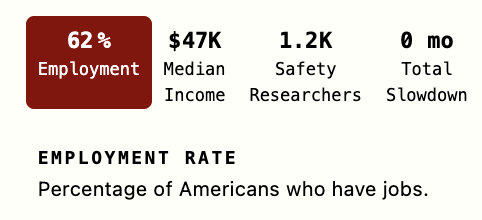
I didn't realize that there was an official meaning of the term (which you had meant) like OECD's official definition.
But I think many readers are likely to misinterpret this. (I I would suggest renaming the tooltip text and possibly also the box.
For a fix, I'd guess that you can come up with something better than me but I'll tentatively suggest 1) Change the tooltip header to Employment to Population Ratio instead of Employment Rate[1], 2) Perhaps change the body of the tooltip to explicitly say this is different from the complement of the unemployment rate and note the age group, and 3) Most tentatively, perhaps change "Employment" on the main image to "Adults with Jobs".
- ^
It sounds less confusing and is pretty commonly used. For example, I'd learned of this metric as employment to population ratio (not employment rate) back in Econ class.
For the past year, we at the AI Futures Project have been sinking most of our time into our next big scenario. Now it’s done!
It’s called AI 2040: Plan A.
It’s called Plan A because it’s a recommendation, not a prediction. It’s what we think should happen, not what will happen, though we think it’s plausible enough to aim for.
It’s called AI 2040 because in it, they delay the creation of superintelligence to 2040. It would have happened much sooner (in 2030, to be precise) if not for decisive action on the part of the US and Chinese governments.
As with AI 2027, summaries don’t really do it justice, since the whole point was to be detailed and comprehensive and work things out step by step rather than rely on high-level abstractions like doom or utopia.
Read the scenario at ai-2040.com. You can listen to it on audio, or view it on mobile, but the experience is significantly better on a normal computer.
What’s next for us?
Well, first we are going to respond to comments and otherwise engage with whatever conversation, responses, critiques, etc. that AI 2040: Plan A sparks. Beyond that, we aren’t sure yet. In general our mission is to help make AGI go well, and now we’ve tried out both forecasting and planning. Maybe we’ll get started on another big scenario. On the other hand, these megaprojects take so much time…