This is a linkpost for https://www.ai-2040.com/
New Comment
Mr Kokotajlo, one of the authors of this AI 2040 scenario, describes it as follows:
If you read the scenario, you'll see that the regulations are mostly about what people can do with giant compute clusters, and not about the ideas themselves. The ideas themselves are required to be totally transparent to the public.
Although regulations on giant compute clusters would give humanity more time, they might not avert extinction by themselves. If AI researchers continue to be able to communicate without restriction, the research community might discover (and I'm tempted to say, "will probably discover") and publish a machine-learning algorithm efficient enough to make an AI superhumanly capable, even when running on modest hardware. I'm not the only one who thinks that. Here is Steve Byrnes writing 12 months ago:
...I’m not sure that actual existing efforts towards delaying AGI are helping. I think the path from here to AGI is bottlenecked by researchers playing with toy models, and publishing stuff on arXiv and GitHub. … Once the new paradigm is known and developed, the actors able to train ASI from scratch will probably number in the tens of thousands, spread all around the world. We’
 2
2 1
1 1
1Many would reply that these restrictions on dissemination of knowledge will drastically slow down AI research. Yes: the drastic slowing constitutes most of the benefit of imposing the restrictions.
Plan A largely doesn't agree with this. Since they expect the slowdown treaty to eventually fall apart--at which point we revert to the status quo arms race, which we all agree is bad--they argue for slowing only insofar as it allows alignment research to outpace general AI research.
Scott Alexander had a nice little graphic on this point in his ACX post on Plan A:
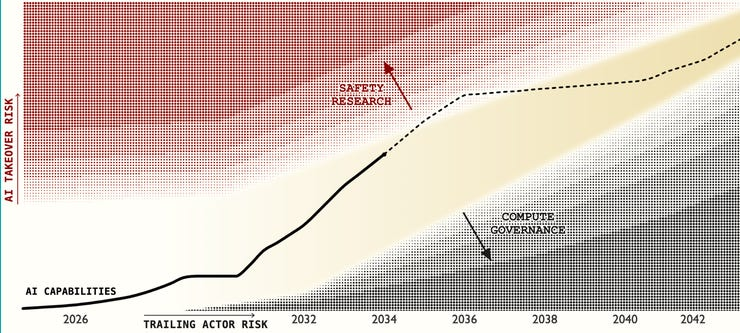
Plan A also seems to largely discount the possibility of smaller research labs discovering some new paradigm that is capable of becoming an ASI without massive amounts of compute. I largely agree with this view, since ~90% of algorithmic progress is scale/compute-dependent, but either way this seems like an important crux.
 11
11Plan A involves significant attempts to slow down algorithmic progress
Plan A does not advocate for what I consider the most potent brake on that "progress", namely restrictions enforced with penalties on dissemination of new knowledge from one researcher to another (and related measures like bans on founding a new AI lab or seeking additional investment for an existing lab).
there’s no longer as much incentive to race to discover new AI paradigms and more powerful algorithms, because companies wouldn’t be able to hoard such discoveries and profit greatly from them.
Most of the advances in AI so far have not been the result of any hoarding, but rather of researchers and labs freely giving away knowledge. The most salient example is Google Deep Mind's freely giving away the knowledge described in the "Attention is all you need" paper that started the transformer revolution on which the success of OpenAI and Anthropic depended, and I got the impression from my brief study of the history of the field that every breakthrough in machine learning on which the transformer breakthrough depended was also freely given away shortly after its discovery. Although I know little about the h...
19
It sounds like you are proposing a more hardcore version of Plan A or Plan S, where individual researchers are prohibited from talking to each other about certain kinds of ideas?
I think that would have some benefits, but also some costs. For example, restrictions on speech of the sort you want are going to hurt public epistemics probably, when it comes to assessing AI risks and safety cases. Also, it's generally bad to restrict speech for the usual reasons. Lukas Finnveden's comments elsethread are good. I'm open to doing the more hardcore thing if the political will for it manifests and we can work out a way to mitigate the downsides.
7
The Chinese and US government will probably be able to build covert projects with more compute and knowledge than outsiders. It seems like you're proposing a regime where, once extremely efficient ASI algorithms are discovered, both the US government and the Chinese government would know about it. ("Chinese officials and AI researchers would be a constant presence in US AI labs, and vice versa".) So then they would both be able to secretly defect on the deal and run many ASIs, unknown to the other party, if they so pleased. How are you hoping that the deal will remain stable beyond this point?
(USG + China being sufficiently convinced about misalignment risk that they each unilaterally refuse to run their ASIs, even knowing that the other party could do it without their knowledge? Not impossible, but a significantly higher bar than how bought into the risk you need to be to have the bilateral deal work up until that point.)
(Or maybe you just accept that many ASIs will be launched at that point, and the main goal of the anti-proliferation stuff was just to buy more time for earlier alignment research and/or to prevent lone wolf misuse once ASI is developed?)
4
~~I think this is unlikely given AI scaling laws. Algorithmic improvements could drastically decrease the amount of training required but capabilities could still be limited at a given model size and compute requirement. In other words you could have AI with a human brain's plasticity and it wouldn't matter if it doesn't also have sufficient size.~~
Edit: Never mind, I just noticed that in the AI 2040 scenario, AI progress is supposed to mostly come from compute improvements, with algorithmic improvements deliberately suppressed. So the impact of a low hanging fruit algorithmic breakthrough is much higher than a counterfactual scenario where algorithmic improvements are allowed to continue and global compute rollout is slowed instead.


I worked on this for many months, and other Lightcone staff (most notably Ray, and next Joanna) worked on this for even more months. Unsurprisingly, I think it is a truly tremendous contribution to the state of AI policy and strategy.
We really gotta figure out how, as humanity, we can realistically navigate the development of ASI. This isn't the best plan I've seen for that, but it is the best plan that I've seen that has been written up in as detailed of a fashion. And most importantly, in the process of gaming out that plan, illuminates a huge number of crucial considerations that relate to AI governance and policy.
 3
3Either that, or what I've been calling "Plan A*" which is where you do a lot of the things you do in Plan A, but the central lever you pull is compute governance, not trying to stop algorithmic progress. I.e. instead of building tons of datacenters, you instead aim for a policy regime where you expect algorithmic progress to continue, but to be substantially slowed down by heavy restrictions on compute supply. I think in many world this buys you 15-30 years on its own.
 1
1Given the level of political will and international coordination in the story, why can't they just dismantle the compute supply chain?
If I understand correctly, the main argument agains Plan S is that at some point the global pause agreement will break down, and then we will be back where we are right now, and the race restarts again at a break-neck speed.
But what if part of the pause deal is that, both in China and in US allies, we destroy a large chunk of the existing GPUs, destroy the fabs, destroy the cutting-edge EUV machines, destroy the equipment necessary to build the EUV machines and disperse the teams working at all these companies so institutional knowledge is lost?
Once the compute supply chain is dismantled, governments can pay attention that no new cutting-edge chip fabs or necessary equipments are made - something that seems much easier to enforce than the restrictions on dangerous algorithmic progress in Plan A.
My understanding is that this wouldn't have huge effects outside the AI industry. While there would be a huge stock market crash and it would be expensive to compensate the the affected companies, I'm not sure the financial loss would be more than 2x bigger ...
2My other objection is that I feel a lot of despair when thinking in near-mode about the Plan A proposal of slowing down algorithmic progress.
----
India's leading company publishes a paper about a training dataset they used to make the user-experience for their AI smoother. The Indian regulator apparently green-lighted it, but they are known for their lenient approach. Some academics notice that the Indian model is now not just smoother to use, but it subtly feels like it's smarter than other models, even though it doesn't directly show on the standard benchmarks. The American AISI starts getting emails from academics, explaining that they feel like the Indian model got smarter, and that they think the paper the Indians published was too high-level to fully reconstruct what they did.
Meanwhile the American AISI is also getting emails from academics complaining about how the European AI is too biased against minorities, and how the Brazilian AI has too high persuasive capabilities, and how the compute cluster in the ocean is harming the fish. They are also tasked with defending the US companies from the totally unfair complaints coming from China and India that they are not transpare...
 2
29
I think I'm just not as afraid of covert projects. In the world that has enough political will for Plan A or compute supply dismantling, I think it's likely that neither the US nor China even wants to attempt a covert project, because they are both genuinely afraid of AI. And I don't see who else could attempt a covert project with 100k hidden GPUs.
And once the compute chain dismantling happens, it becomes very obvious that the leading powers are extremely serious about not wanting AI. I think it's over 70% likely that espionage will uncover the existence of a covert project, and then they will very likely get bombed in the world where everyone was so serious that they already blew up their own EUV machines. I expect that the US and China will be aware of this and not attempt a covert project.
(It's also my understanding that GPUs probably mostly break after about 5 years of use. That will really hurt the covert project if they can't source new GPUs, no? I don't remember this being addressed in the supplement, but maybe I missed something.)
Also, even if a covert project manages to build something smarter than anyone else has, that's not necessarily catastrophic. If they manage to build such a strong superintelligence that it can build invincible nanobot-armies in a basement without any previous industrial build-out, that's bad. But if they would just want to do the usual strategy of building robots to build better robots to build more compute and drone armies, that will very likely be visible an be noticed, in a world that otherwise doesn't have advanced compute an robotics, and will lead to bombing.
My understanding is that in this way, Plan A is more vulnerable to covert projects than the compute dismantling plan: in Plan A, if someone secretly builds a smarter AI than anyone else has, they can use it to devise a plan to bring a few percent of the huge compute clusters outside the easily bombable places, and then hook up the secretly built smart AI to the co
7
I think it should be if people were well-calibrated? (Which is more likely in worlds where people are taking things seriously enough for these proposals.)
Delaying ~infinity growth by 100 years seems more than twice as bad as delaying ~infinity growth for 10 years. With exponential discounting, the only way I can currently see for this to be false (though there's probably other ways) is if you think that most of the value of "~infinity growth now" would already have been lost by moving to "~infinity growth in 10 years". But that doesn't seem consistent with how low real interest rates are. (They tend to value stuff in 10 years at more than half as much as stuff now.)
And plan A looks better than "singularity in 10 years" by any very time-sensitive financial measure, since you get lots of growth in the intermediate 10 years too.
6
Your proposal would be net positive but the question is whether it’s better than Plan A. Even if takeoff is very slow post-deal if you didn’t advance ai capabilities much during the deal or use them heavily to do useful work then you get much less benefit from the deal than in Plan A.
I know you and the AI futures team have likely queued up an update on AI timelines that will come out pretty soon, so I don't want to disrupt that project, but after the AI timelines update comes up, I'd like you to start modelling data trends of AIs (as well as how AIs could maybe need less data than currently) as well as how you modeled compute trends, because I find it reasonably plausible by 2028-2030, the bottleneck to further AI progress will start becoming data, rather than compute.
In particular, I expect high-quality data to become both much more valuable and much more of a bottleneck than today, based on how companies like Mercor are skyrocketing in revenue.
Probably the best case for this is Will Depue's substack post on A Stargate for Data.
Especially in worlds where we don't get a software intelligence explosion by 2030, modeling data trends becomes way, way more important than now.
1Overall really glad this was made! Wanted to flag that there appears to be a UI bug on the side menu of the supplemental pages where the menu overlaps the text.
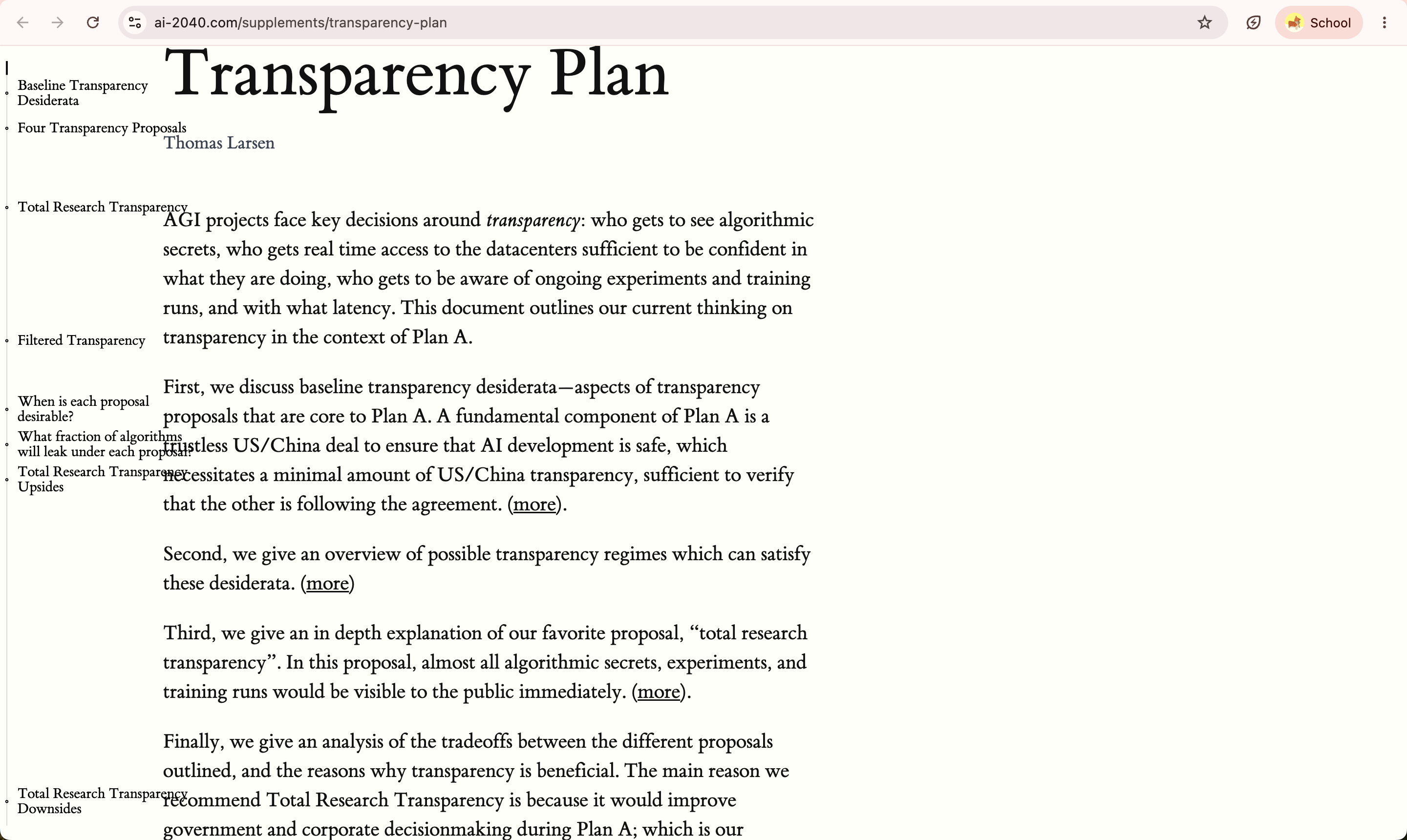
I have broad agreement with this overall document, with some relatively minor/subjective disagreements on what would be the optimal point to pause further capabilities work [1] , but unless A) I have missed the section where you address this directly, or B) you have deliberately omitted this for strategic reasons, there does seem to be a serious oversight in the current plan that could render it unviable unless a solution to it is found:
You correctly point out that it is in the interests of China to agree to this treaty, but have not explained wh...
1This looks very interesting, thanks for writing!
One minor note for clarity: I initially interpreted the term "employment rate" to be the complement of the unemployment rate and was confused why it was so high (and I didn't realize it was clickable). For example in 2027, its at 62% with only a 1.2x AI R&D speedup. (In this picture, I selected 2027 and hovered over employment to get the tooltip)
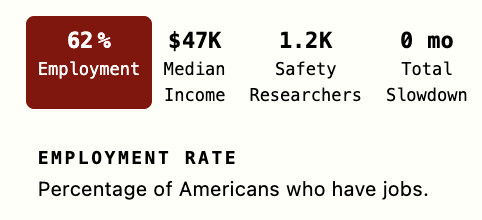
I didn't realize that there was an official meaning of the term (which you had meant) like OECD's official definition.
But I think many readers are likely to misi...
We have a get involved page for verification in particular. It tracks the current state of play wrt verification and what still needs to be done: https://ai-2040.com/supplements/verification-plan/get-involved
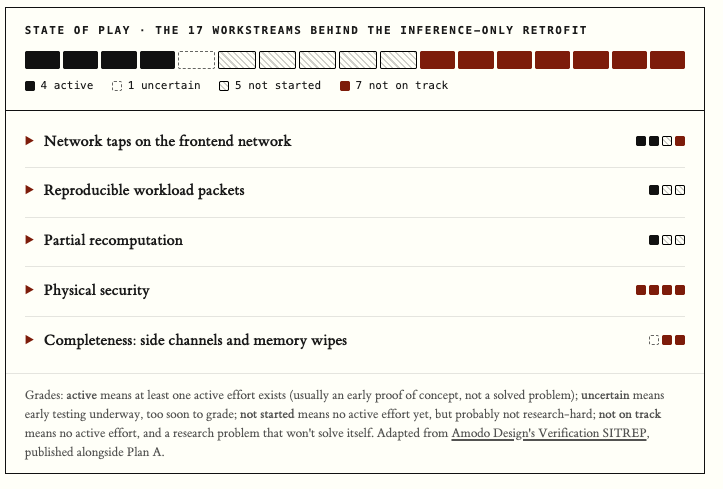
We might do a blog post on other actions as well.
I'm at 2029 or 2028 median now, not sure. We'll try to do a reassessment of timelines soon and get out an update.
71Okay, I'm baffled by the Plan A: Chinese Covert Project sub-branch.
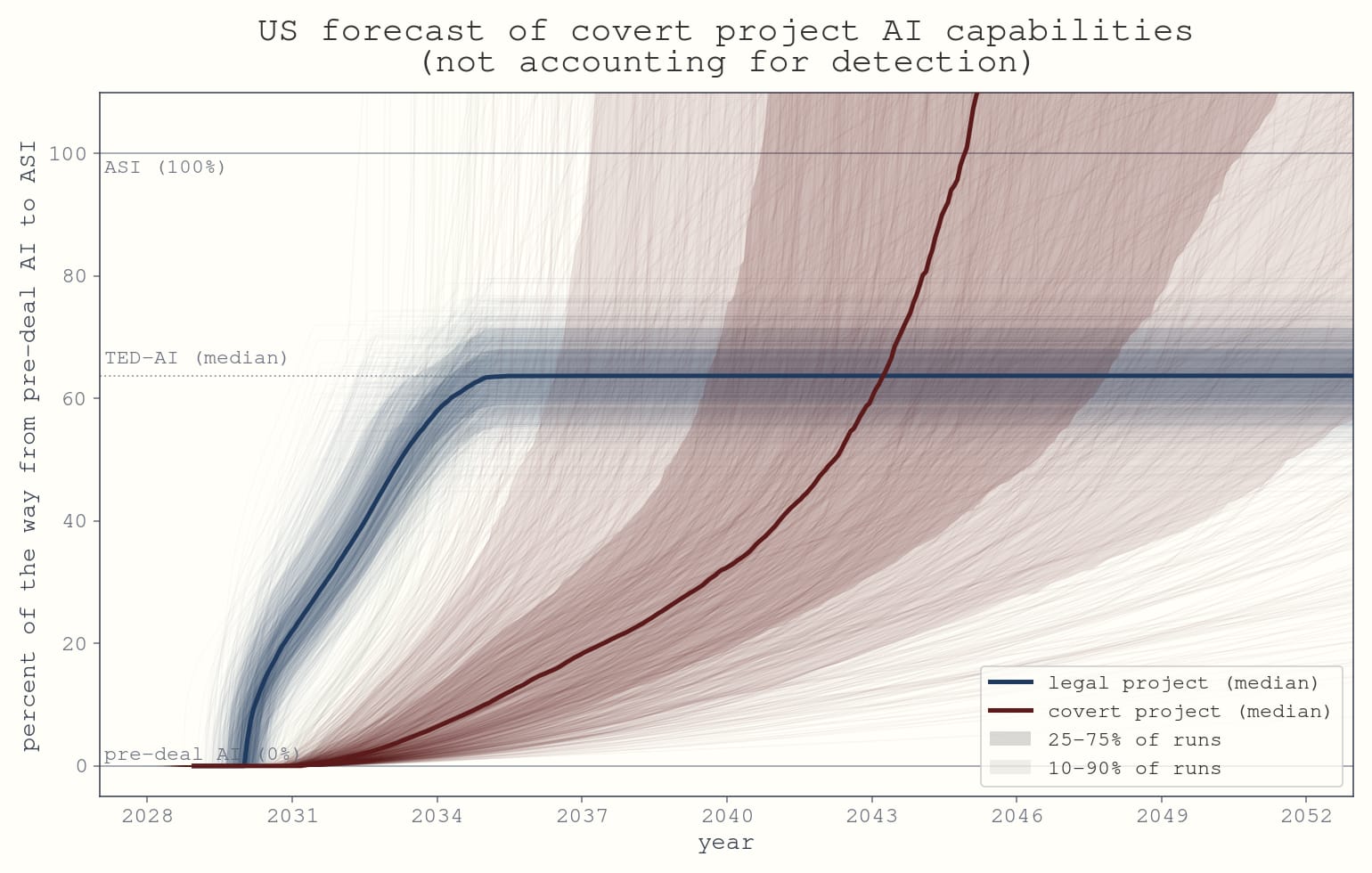
This seems to imply an expected 2044 or so for a covert project to succeed at ASI, and 2043 just to reach TED-AI?
The pause goes fully in to place early 2030: "In 2030, they’ll have the infrastructure in place to proceed with Plan A."
"Plan D", racing for ASI, places the ASI threshold at 2031. That means we're pausing a year out from ASI:
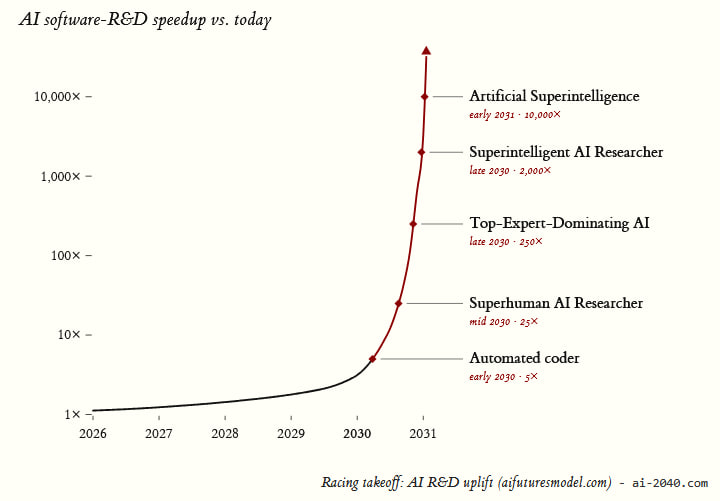
Why does it take the covert project 10+ years to do 1 year of work? Especially given "Under Total Research Transparency, virtually all of the algorithmic in...
I have read the entire post and sub-scenarios and know I am not able to gauge the reality and speed of what is said to lie before us. Nonetheless, I am in shock.
Another Tolkien quote ""It does not do to leave a live dragon out of your calculations, if you live near him."
And so we do.
Questions/thoughts:
- What will be the cost of a bag of potato chips if everyone is making $10MM?
- What the heck is all the work being done?
- What is the cost to the environment with such large GDP increases?
- Will anyone have children?
- What happens to all the parchment books squirrele
 1
1
For the past year, we at the AI Futures Project have been sinking most of our time into our next big scenario. Now it’s done!
It’s called AI 2040: Plan A.
It’s called Plan A because it’s a recommendation, not a prediction. It’s what we think should happen, not what will happen, though we think it’s plausible enough to aim for.
It’s called AI 2040 because in it, they delay the creation of superintelligence to 2040. It would have happened much sooner (in 2030, to be precise) if not for decisive action on the part of the US and Chinese governments.
As with AI 2027, summaries don’t really do it justice, since the whole point was to be detailed and comprehensive and work things out step by step rather than rely on high-level abstractions like doom or utopia.
Read the scenario at ai-2040.com. You can listen to it on audio, or view it on mobile, but the experience is significantly better on a normal computer.
What’s next for us?
Well, first we are going to respond to comments and otherwise engage with whatever conversation, responses, critiques, etc. that AI 2040: Plan A sparks. Beyond that, we aren’t sure yet. In general our mission is to help make AGI go well, and now we’ve tried out both forecasting and planning. Maybe we’ll get started on another big scenario. On the other hand, these megaprojects take so much time…