Thanks for continually writing about these kinds of political opportunities, in public!
Some people & places you may want to reach out to to float this article (and your volunteer signup form), chosen for having some context on NYC specifically:
- Zvi Mowshowitz
- Jessie of collider.nyc
- @Screwtape / Skyler who organizes the east coast megameetup
- EA NYC
- Overcoming Bias/ACX/Rationality NYC (maybe, @Robi Rahman?)
(happy to intro, and apologies if these are obvious!)
 1
1Reading these posts caused me to go canvassing for Bores with my partner (who lives in his district):
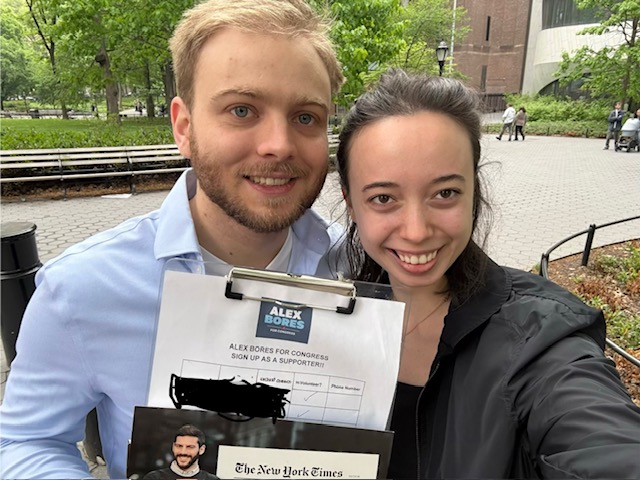
I have never done this before and felt a bit unprepared, which is unusual for me! I spent some time researching his platform and particularly the RAISE Act, but expected to have some holes in my knowledge in other areas. But a congressional race is even more complicated on the ground than I expected! Most straightforwardly, it would have been useful to be more knowledgeable about the other candidates. There are also some less-obvious-in-hindsight difficulties to this sort of conversation; for example most of the people who actually stopped to talk to me for an extended period had some very specific axe to grind on some issue less closely connected to Bores' platform, but perhaps connected to (New York) politics at large, e.g. opposition to buffer zones (this was maybe my first conversation). Handling this sort of thing gracefully probably would have required following local news consistently for at least several months prior (and I only live in New York around 20% of the time). This is probably a natural challenge of jumping abruptly into local political activism for EA reasons! On the plus side, I learned a lot very quickly, most conversations were brief and easy to handle competently, and my job was mostly to provide people with other sources of information (leaflets, his website, campaign staff). Also, my partner was actually good at it. So, I am pretty confident it was a net positive and would do it again.
 3
3 2
2The campaign volunteer opportunities include phone banking and door knocking as well as training on an app (Raise) that supports relational organizing. Basically it cross references your phone’s contacts with the campaign’s list of registered voters and shows you who you know in the district to potentially reach out to. This dovetails with your recommendation above to reach out to people you know in the district. If you‘re not in touch with the campaign about that, you might want to touch base and include it as part of your how to do this well advice!
1This seems to be an unusual opportunity where Coefficient Giving[1] can donate and not incur any reputational costs[2]. because of LTF / OpenAI / Palantir's unpopularity.
For example if CG's c4 arm donated $1M to Bores, then I would expect good first-order effects for reasons in the above posts but also positive second-order reputational impacts:
- AI populists often attack AI Safety / CG on the grounds that they're just increasing the AI hype and are secretly AI industry shills. It would be very easy to that point and say that the biggest funder donated significant money to the anti-LTF candidate in a way it almost never does.
- Concrete example: according to this politico article about these very tensions, More Perfect Union's Faiz Shakir was very (unfairly) critical of AI safety[3] but he said he liked Bores in the same article.
- AI may later trigger huge backlash if the unemployment rate spikes. In that case, it is particularly valuable for the AI Safety movement to credibly signal not being AI shills so the work of Redwood/Apollo/METR ends up important.
- Also, truth isn't on LTF's side since their anti-Bores ads are very disingenous [4](moreso than even other political attack ads). Having truth on your side generally has good second-order effects.
I'm not familiar with the actual views of prominent CG-people beyond public statements so I'm unsure if a CG donation is possible. If it is possible, though, it seems very valuable.
EDIT: After thinking it over, I feel more unsure about the second-order impacts of this now, mostly because CG's involvement may cause AI populists to sour on Bores (though the direct impacts seem good). I still think having a clear thing to point to populists that AI Safety (especially CG) is very anti AI-accelerationism is good on the long run. But I'm unsure about how to accomplish it.
- ^
Same logic applies to other prominent and wealthy people in AIS but note that according to Claude, other AIS funders like SFF and Manifund don't have a c4 vehicle and cannot donate from the fund itself -- and that more recent reporting indicates Anthropic hasn't actually donated to Bores.
- ^
My (possibly mistaken) understanding is that CG typically doesn't donate from its c4's to political candidates largely because reputational costs may harm EA cause areas
- ^
To quote: " 'The [institutional AI Safety coalition] is comfortable with the politics around this centrism, of coziness around AI development,' said Faiz Shakir, the executive director of the progressive nonprofit media organization More Perfect Union and a senior adviser to Sanders. 'They’re deeply concerned, I think, about those of us who have far more committed views around pausing their AI development, and they’re spending a lot of dollars to go after us.' "
- ^
See the first 2 minutes of this
 1
1- I appreciate the practice of transparently updating previous recommendations with new information!
- On the object level, without having though deeply about it, I like your reasoning. The points about LTF's theory of change and how this affects the value of donations is both non-obvious in prospect and easy to follow in retrospect.
1
In October, I wrote a post arguing that donating to Alex Bores's campaign for Congress was among the most cost-effective opportunities that I'd ever encountered.
(A bit of context: Bores is a state legislator in New York who championed the RAISE Act, which was signed into law last December.[1] He's now running for Congress in New York's 12th Congressional district, which runs from about 17th Street to 100th Street in Manhattan. If elected to Congress, I think he'd be a strong champion for AI safety legislation, with a focus on catastrophic and existential risk.)
It's been six months since then, and the election is just two months away (June 23rd), so I thought I'd revisit that post and give an update on my view of how things are going.
How is Alex Bores doing?
When I wrote my post, I expected Bores to talk little about AI during the campaign, just because it wasn't a high-salience issue to voters. But that changed in November, when Leading the Future (the AI accelerationist super PAC) declared Bores their #1 target. Since then, they've spend about $2.5 million on attack ads against him.
LTF's theory of change isn't actually to decrease Bores's chances of winning; rather, it's to make an example out of him. Bores is an underdog, and if he loses, LTF will be able to take credit for his loss in the public eye (even if they aren't counterfactual). The goal is to scare other elected officials into avoiding pro-AI safety policy stances, for fear of also being attacked by LTF.[2] My AI policy friends in D.C. say that the strategy is working.
Ever since LTF starting attacking Bores, he has been talking about AI a lot, and has arguably made it his #1 issue. This has resulted in a substantial amount of positive national news coverage for Bores.
The most common type of coverage is "Here's why AI billionaires are spending millions to stop Alex Bores" (see e.g. New York Times, Wired). But there's also object-level coverage of his AI policies, including this Axios piece and this recent Ezra Klein podcast. This kind of coverage is really unusual for someone who's just running for Congress!
In October, I gave Bores a 20% chance of winning his race. My estimate is now up to 30% (and prediction markets agree).[3] It's mostly been various small updates rather than one large one, but I do think that Leading the Future's attacks on Bores have raised, not lowered, his chances of winning, by giving him favorable press coverage.[4] However, Bores remains an underdog: the Democratic establishment (including outgoing congressman Jerry Nadler) is mostly behind Micah Lasher, and Michael Bloomberg said that he'll spend $5 million in support of Lasher.
I have also come to think that the benefits of Bores winning his race are even greater than I suggested in my initial post. This is for three main reasons:
How to help
Donations continue to be very helpful. You can donate $3,500[6] at this link (but please be mindful of the potential career capital costs of donating). A $3,500 would allow the Bores campaign to run TV ads and do other kinds of voter outreach; my guess is that the overall expected effect of such outreach would be about five votes[7] for Bores. That doesn't sound like a lot, but the election is looking quite close, and it wouldn't be that surprising if the election is decided by fewer than a thousand votes. Overall, I estimate that a marginal $3,500 donation increases Bores's chances of winning by a little over 0.01%.[8] In my view, donations to Bores's campaign are substantially more cost-effective than any other currently-available donation opportunity to make AI go well.
Alternatively, you can volunteer in a couple different ways.
The Bores campaign has a "get involved" form; I think the campaign is likely to direct you to activities such as phone banking (calling voters who live in the district) or, if you live in New York, canvassing (either door knocking or talking to voters on street corners). My (pretty uninformed) guess is that these kinds of activities will would yield a net vote to Bores per 5-10 hours spent. (And so if you're choosing between donating and this kind of volunteering, I recommend volunteering if you value your time at less than $100/hour.)
The other way to volunteer your time is to talk to voters in the district who you already know, or to encourage your friends to do this. It's much easier to persuade someone who you already know than to persuade a stranger, so this will generally be a more effective way to spend your time (it might yield one vote per hour or so). If you're interested in learning how to do this well, fill out this form, and I (or someone else) will probably reach out to you around soon with instructions/suggestions.
If you're interested in organizing people to do this kind of outreach, you can fill out this form and I (or someone else) might reach out to you soon!
A quick note about other opportunities
I've spent the last few months assessing the cost-effectiveness of a variety of donation opportunities, particularly political ones. I think the next-best currently-existing donation opportunity continues to be the Scott Wiener campaign.[9] If you're interested in more detailed political donation recommendations, you can fill out this form. I might get back to you, but no promises!
The final version of the RAISE Act is different than the version that Zvi covered in his post; see here for the final version.
This strategy is modeled after the pro-cryptocurrency super PAC Fairshake, which successfully made an example out of Katie Porter in her Senate run in 2024, scaring Congress into opposing crypto regulation.
Although my probabilities are more like Lasher 55%, Bores 30%, Schlossberg 15% (whereas the markets say Lasher 45%, Bores 30%, Schlossberg 25%).
Does this mean that LTF has made a strategic error? Not necessarily; I'm agnostic on this. LTF's strategy is to take credit for Bores's probably loss in order to cow other legislators, not to decrease his chances of winning.
I don't think that they would be correct to update on LTF's strength based on the outcome of this race. But in practice, I think they will take away a very different lesson if he wins by 1% than if he loses by 1%.
You can donate up to $7,000. However, the second half of that cannot be used by Bores until the general election (which won't be competitive). Before March 31st, the second $3,500 was valuable for signaling campaign strength (it's easier for campaigns to get endorsements if they demonstrate that they can fundraise well). But now that the quarterly reporting deadline has passed, there will be no more fundraising reports before the primary election, so the second $3,500 doesn't carry much signaling value.
This is lower than my original estimate in this post, where I suggested that a marginal $3,500 would net about 12 extra votes for Bores (before taking into account the effects from signaling campaign strength). That's primarily because Bores has raised somewhat more than I expected, and because the amount of money being spent on this race by outside groups is substantially higher than I expected (so we're further into diminishing returns territory).
How does this compare to the numbers in my original post? There are three main changes:
Because of California's top-two primary system, I recommend a $7,000 donation to Wiener, rather than just $3,500.